BLOG
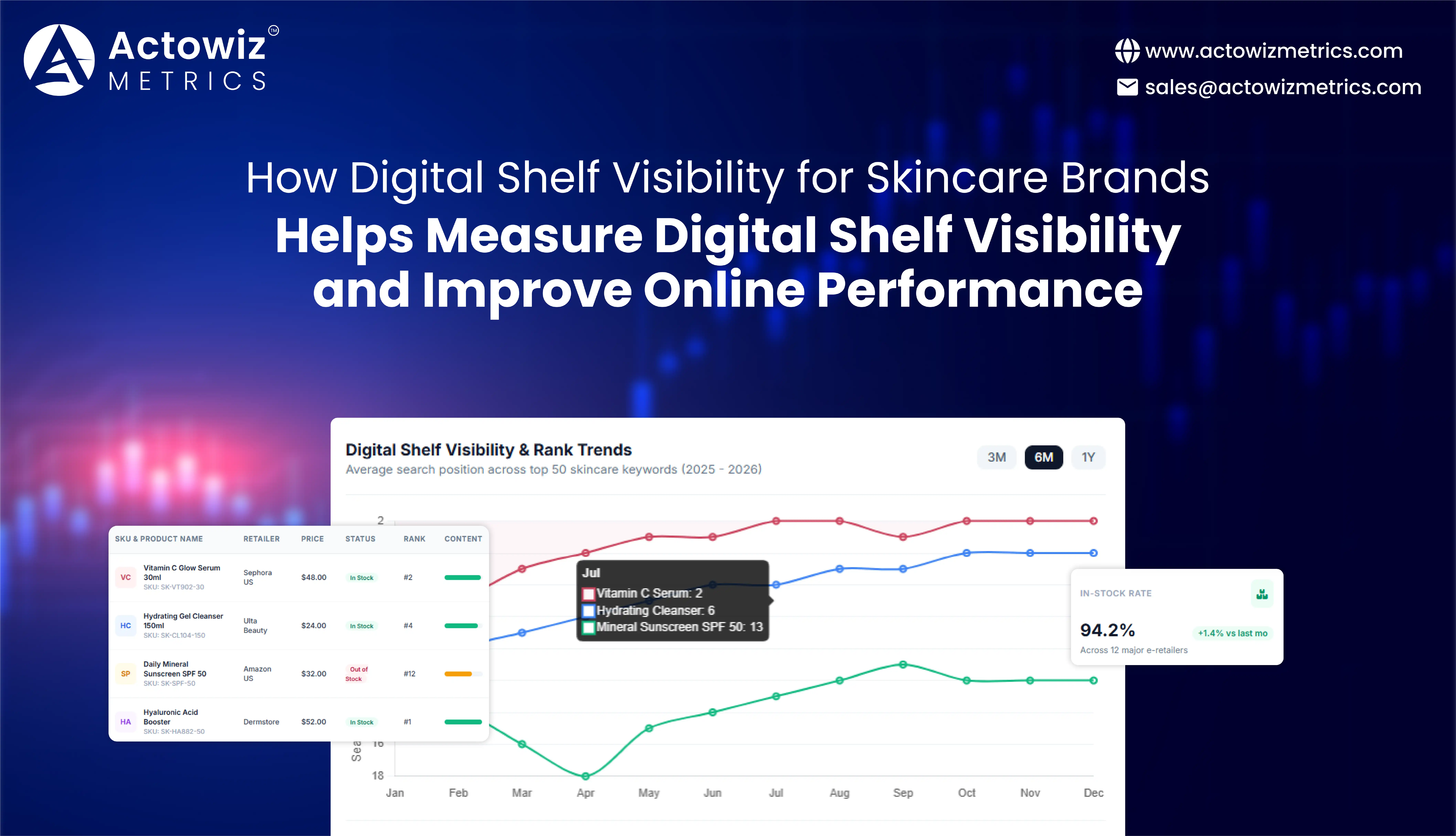
















Digital Shelf Visibility for Skincare Brands matters because consumers increasingly discover, compare, and purchase beauty products through online retailers and marketplaces. A skincare product can have strong demand and still underperform if it is difficult to find, ranked below competing products, out of stock, poorly represented, or surrounded by stronger competitor content.
For brand managers, the challenge is no longer simply getting products listed online. They need to understand how products actually appear to shoppers across retailers, marketplaces, search results, and category pages. This includes monitoring price, availability, ratings, reviews, product titles, descriptions, images, rankings, promotions, and competitor activity.
The broader digital commerce environment makes this increasingly important. U.S. retail e-commerce sales reached an estimated $1.2337 trillion in 2025, according to the U.S. Census Bureau. In Q2 2026, e-commerce represented 17.1% of total U.S. retail sales. (Census.gov)
Brands evaluating the Best Digital-Shelf Analytics Tools 2026 should therefore look beyond basic price tracking. Effective platforms should connect product-level visibility with availability, content, search positioning, competitive assortment, and historical performance.
Skincare Digital Shelf Data Scraping helps brands collect structured information from online retailers and marketplaces to understand how their products appear to shoppers. Digital Shelf Visibility for Skincare Brands becomes measurable when individual observations are organized into consistent product, retailer, and time-based datasets.
A useful dataset can include product names, SKUs, brand names, category placement, product URLs, prices, discounts, availability, ratings, review counts, search rankings, images, descriptions, ingredients, pack sizes, and other accessible attributes.
For example, a skincare brand selling a vitamin C serum across five retailers could monitor whether the same SKU is consistently available, correctly categorized, competitively priced, and supported by complete product content. If one retailer shows the product as unavailable while others show active inventory, the brand can investigate the channel rather than assuming overall demand has declined.
| Digital Shelf Element | What It Helps Measure |
|---|---|
| Product availability | Whether shoppers can purchase |
| Price | Competitive positioning |
| Discount | Promotional activity |
| Search ranking | Product discoverability |
| Ratings | Customer perception |
| Review count | Social proof |
| Images | Content completeness |
| Product description | Information quality |
| Category placement | Assortment visibility |
| Product URL | Listing verification |
From 2020 through 2026, the digital shelf became increasingly important as online retail expanded. U.S. e-commerce sales were estimated at $1.1926 trillion in 2024, representing 16.1% of total retail sales. (Census Bureau) By 2025, annual e-commerce sales increased further to approximately $1.2337 trillion. (Census Data) For skincare brands, this expansion creates more digital touchpoints where products can be discovered and compared. The challenge is that visibility can vary significantly between retailers. A product may rank well on one website but appear much lower on another. It may have complete imagery on one channel but missing attributes on another. Similarly, inventory can differ by retailer and location. Between 2020 and 2026, brands therefore moved toward more structured digital shelf monitoring to understand these differences. A recurring dataset can preserve observations over time and allow teams to identify persistent problems instead of reacting to isolated incidents. By 2026, a scalable monitoring approach can combine product discovery, content validation, availability tracking, price monitoring, ranking analysis, and competitor comparison. This gives e-commerce managers a single analytical framework for understanding how products are represented and how effectively they compete online.
Skincare Product Visibility Across Online Retailers depends partly on whether consumers can actually find and purchase the product. A product may rank well and receive strong reviews, but an out-of-stock listing can interrupt the shopper journey and potentially redirect demand toward competing products.
Availability monitoring should therefore be treated as more than an inventory report. Brands can compare availability by SKU, retailer, region, product variant, and time period. This helps identify recurring stock gaps and distinguish isolated inventory events from broader distribution problems.
For example, if a moisturizer is consistently available on a brand's DTC website but unavailable on two major retailers, the brand can investigate retailer replenishment or distribution issues. If multiple competitors remain available while the brand's SKU is unavailable, the potential commercial impact becomes more significant.
| Metric | Business Value |
|---|---|
| In-stock rate | Measures purchase availability |
| Out-of-stock frequency | Identifies recurring gaps |
| Availability by retailer | Compares channel performance |
| Availability by SKU | Finds product-specific issues |
| Variant availability | Tracks size or shade gaps |
| Historical availability | Identifies persistent problems |
The 2020–2026 period demonstrated that online shoppers increasingly expect products to be immediately discoverable and purchasable. The U.S. Census Bureau reported that e-commerce accounted for 16.1% of total U.S. retail sales in 2024, compared with 15.3% in 2023. (Census Bureau) In 2026, the share remained significant, reaching 17.1% of total retail sales in the second quarter. (Census.gov) This creates an important operational consideration for skincare brands: digital visibility does not end with appearing in search results. A product needs to remain commercially available when shoppers reach the listing. Availability can also affect retailer search positioning and the likelihood that consumers encounter alternative products. Over time, brands can use historical availability data to identify recurring stock issues, retailer-specific gaps, and high-demand products that require closer replenishment attention. Monitoring can also be segmented by product type. Serums, cleansers, moisturizers, sunscreens, and treatments may have different demand patterns and availability profiles. By 2026, combining availability information with search rank, pricing, and competitor data gives brands a more complete picture of digital shelf performance. The practical objective is simple: identify where shoppers encounter friction and determine whether the problem originates from inventory, content, distribution, or competitive positioning.
Skincare Share of Search Across Online Retailers provides insight into how prominently a brand's products appear compared with competing products for relevant search terms.
Search visibility is particularly important in skincare because consumers frequently research concerns and ingredients before choosing a product. Searches can involve product types such as cleanser or moisturizer, ingredients such as niacinamide or retinol, or needs such as acne care, hydration, or sun protection.
Brands can monitor search results for selected keywords and record product position, competing products, sponsored placements where visible, ratings, prices, and availability. This creates a searchable historical dataset.
| Metric | Interpretation |
|---|---|
| Search position | Product discoverability |
| Brand appearances | Brand visibility |
| Competitor appearances | Competitive presence |
| First-page presence | High-value discovery |
| Rank movement | Visibility trend |
| Keyword coverage | Search-market breadth |
A useful approach is to distinguish branded searches from generic category searches. Ranking highly for a brand name demonstrates brand visibility, while ranking for generic skincare terms can indicate broader category discoverability.
Consumer behavior across digital commerce became increasingly search-led between 2020 and 2026. As online retail expanded, product discovery increasingly involved search, category pages, recommendations, reviews, and comparison experiences. U.S. e-commerce sales reached $1.1926 trillion in 2024 and grew 8.1% from 2023. (Census Bureau) The continued growth of online shopping creates more opportunities for brands to compete for digital attention. For skincare companies, search visibility can be particularly complex because consumers may search by brand, product type, ingredient, skin concern, or desired benefit. A product that ranks well for its brand name may have limited visibility for generic terms. Conversely, a competitor can gain visibility through strong content, reviews, assortment, or retailer optimization. Between 2020 and 2026, brands increasingly needed to measure search presence as a recurring performance indicator rather than relying on occasional manual searches. Historical search observations can reveal whether products are gaining or losing visibility, which competitors repeatedly appear in top positions, and which search themes offer opportunities for optimization. By combining share-of-search information with availability, pricing, ratings, and content completeness, e-commerce teams can better understand why a product is visible—or why it is being displaced by competing listings.
Skincare Product Data Extraction allows brands to examine whether online product listings contain the information shoppers need to make purchase decisions. Digital Shelf Visibility for Skincare Brands is stronger when products are not only discoverable but also presented consistently and accurately.
Skincare products require detailed information because shoppers often evaluate ingredients, skin concerns, product benefits, size, usage instructions, claims, ratings, and reviews before purchasing. Missing or inconsistent content can make a product harder to understand and compare.
Brands can establish content standards for titles, descriptions, images, attributes, ingredients, claims, product variants, and other relevant fields. Automated monitoring can then identify listings that do not meet those standards.
| Content Attribute | Monitoring Purpose |
|---|---|
| Product title | Search relevance |
| Product description | Product understanding |
| Ingredients | Transparency |
| Product benefits | Shopper education |
| Images | Visual presentation |
| Size/quantity | Comparison accuracy |
| Usage information | Purchase confidence |
| Product attributes | Filtering and discovery |
| Reviews | Social proof |
Between 2020 and 2026, online product pages evolved from basic catalog listings into detailed digital shopping experiences. E-commerce growth increased the importance of product content because shoppers could not physically examine products before purchase. This is particularly relevant to skincare, where ingredients, product claims, usage instructions, skin type, and product benefits can influence purchase decisions. In 2024, U.S. e-commerce sales represented 16.1% of total retail sales, while annual e-commerce sales reached approximately $1.1926 trillion. (Census Bureau) At this scale, inconsistent content across retailers can create significant operational challenges for brands managing large product catalogs. A product may have high-quality content on its own website while retailer listings contain incomplete descriptions or missing attributes. Between 2020 and 2026, automated product data extraction enabled brands to compare these listings systematically. By 2026, content monitoring can be connected with ranking, availability, reviews, and pricing data to understand whether content gaps coincide with weaker visibility. For example, if a product consistently ranks below competing listings and also lacks key attributes, the brand has a specific optimization opportunity to investigate. This makes content monitoring actionable rather than simply a compliance exercise. Brands can prioritize high-value SKUs and retailers where improved content could have the greatest potential impact.
Skincare Product Ranking & Visibility Analytics helps brands understand where products appear within retailer search results, category pages, recommendations, and other digital discovery environments.
Ranking should be monitored alongside other variables because position alone does not explain performance. A product may rank highly but be unavailable, overpriced, poorly reviewed, or supported by incomplete content. Conversely, a lower-ranked product may have strong ratings and competitive pricing but require better search optimization.
Brands can therefore create a composite monitoring framework covering ranking, availability, price, ratings, reviews, promotions, and content.
| Ranking Metric | What It Reveals |
|---|---|
| Average position | Overall discoverability |
| First-page rate | High-visibility frequency |
| Rank change | Performance movement |
| Competitor position | Relative visibility |
| Keyword coverage | Search breadth |
| Category position | Shelf placement |
The importance of ranking increased alongside the expansion of digital shopping. In the U.S., e-commerce represented 17.1% of total retail sales in Q2 2026, according to the Census Bureau. (Census.gov) This means a meaningful share of shopping activity occurs in environments where product discovery is influenced by digital search, category placement, recommendations, and merchandising. For skincare brands, ranking can change frequently as retailers adjust algorithms, competitors introduce products, inventory changes, reviews accumulate, or promotional activity increases. A ranking observation taken once provides limited insight. Repeated observations reveal movement. From 2020 through 2026, brands increasingly benefited from combining ranking data with product and competitor information. Historical ranking records can identify products that consistently lose visibility, products that improve after content updates, and competitors that repeatedly occupy prominent positions. By 2026, ranking analytics can also be segmented by search term, retailer, product category, geography, and product type. This makes it possible to distinguish a broad visibility problem from a retailer-specific or keyword-specific issue. For e-commerce managers, this creates a practical prioritization system. Instead of attempting to optimize every product simultaneously, teams can identify SKUs with significant visibility gaps, strong availability, competitive pricing, and sufficient demand signals, then investigate the factors contributing to their ranking performance.
Digital Shelf Analytics brings together the individual signals required to understand online product performance. Digital Shelf Visibility for Skincare Brands can be measured more effectively when ranking, availability, pricing, content, reviews, promotions, and competitor presence are analyzed together.
A complete framework should begin with a standardized product catalog. Each SKU should have a consistent identifier that allows the brand to match its products across retailers and marketplaces.
The next layer is recurring observation. Data can be collected at scheduled intervals, normalized, validated, and stored historically. Dashboards can then show current performance alongside previous observations.
| Measurement Area | Key Questions |
|---|---|
| Availability | Is the product in stock? |
| Pricing | Is the price competitive? |
| Search | Can shoppers find the product? |
| Ranking | Where does it appear? |
| Content | Is the listing complete? |
| Reviews | What are shoppers saying? |
| Promotions | Is the product actively promoted? |
| Competition | Which brands are gaining visibility? |
| Assortment | Which products are present? |
From 2020 to 2026, digital shelf measurement evolved from individual metrics toward integrated commerce intelligence. The growth of online retail created more product pages, marketplaces, search environments, and retailer-specific experiences for brands to monitor. U.S. Census Bureau data shows that e-commerce sales reached $1.2337 trillion in 2025 and represented 16.4% of total sales in Q4 2025 on an adjusted basis. (Census Data) In Q2 2026, e-commerce reached 17.1% of total retail sales. (Census.gov) For skincare brands, these developments reinforce the need to connect multiple performance signals. A ranking decline may be related to availability, a content gap, stronger competitors, or changes in retailer merchandising. A price increase may affect competitiveness, while a rise in reviews may improve consumer trust. Monitoring these signals separately can create fragmented insights. Connecting them creates a more useful explanation of digital shelf performance. By 2026, brands can build centralized dashboards showing SKU-level performance across retailers and time periods. This allows teams to prioritize issues, compare retailers, identify competitive threats, and evaluate changes after optimization. The strongest framework is therefore not simply a reporting system. It is a continuous feedback loop that converts digital shelf observations into actions for e-commerce, marketing, sales, merchandising, and brand teams.
Actowiz Metrics can help skincare brands transform fragmented retailer and marketplace information into structured datasets for digital commerce analysis. The approach can support recurring collection of product, price, availability, ranking, review, content, category, and competitor information from relevant online channels, subject to applicable access conditions and platform policies.
For teams evaluating Beauty & Personal Care E-commerce Analytics, the key challenge is often not a lack of data but the lack of a consistent structure for turning different retailer observations into comparable metrics.
Actowiz Metrics can organize product records around SKU, retailer, category, brand, product variant, and timestamp. This makes it easier to compare the same skincare product across multiple online channels.
For example, a skincare brand can monitor a moisturizer across several retailers and identify whether the product is consistently available, correctly categorized, competitively priced, supported by complete content, and visible for relevant search terms.
The same data can support competitor monitoring. Brands can compare competing products based on price, ratings, reviews, search position, availability, promotions, and assortment.
Historical data adds another layer of value. Instead of viewing today's ranking or price as an isolated number, teams can compare current performance against previous observations and determine whether visibility is improving, declining, or remaining stable.
Actowiz Metrics can also support dashboards and recurring reporting workflows so e-commerce and brand teams can focus on interpreting the data rather than manually collecting it.
For skincare companies with large product catalogs, this approach can help prioritize high-impact issues. A product with strong reviews but poor search visibility may require a different response from a product that has strong visibility but repeated stockouts. Separating these scenarios helps teams move from generic monitoring to targeted digital shelf optimization.
Digital Shelf Visibility for Skincare Brands is ultimately about understanding how effectively products can be discovered, evaluated, and purchased across online retail channels. The most useful measurement framework connects availability, pricing, search visibility, rankings, reviews, content quality, promotions, and competitor activity.
The need for this visibility has increased alongside e-commerce growth. U.S. e-commerce sales reached approximately $1.2337 trillion in 2025, while e-commerce accounted for 17.1% of total retail sales in Q2 2026. (Census Data) Beauty brands therefore operate in an environment where digital shelf performance can directly influence how consumers encounter products.
For skincare companies, measuring visibility should not be limited to checking whether a product is listed. Teams need to understand whether it is available, searchable, correctly represented, competitively positioned, well-reviewed, and visible against competing products.
A structured monitoring program provides the historical context and cross-retailer visibility needed to identify these issues. It can help brands prioritize high-value products, identify retailer-specific gaps, monitor competitive movement, and create actionable workflows for e-commerce teams.
Want to improve your skincare brand's online performance? Connect with Actowiz Metrics to build scalable digital shelf datasets and measure product visibility, pricing, rankings, availability, and competitor performance across online retailers!
Expert blogs, research reports and infographics — practical, data-driven reading across e-commerce and quick-commerce.
Most fields are optional — the more you share, the better your sample.
.webp "infographics")
.webp "infographics")