BLOG




















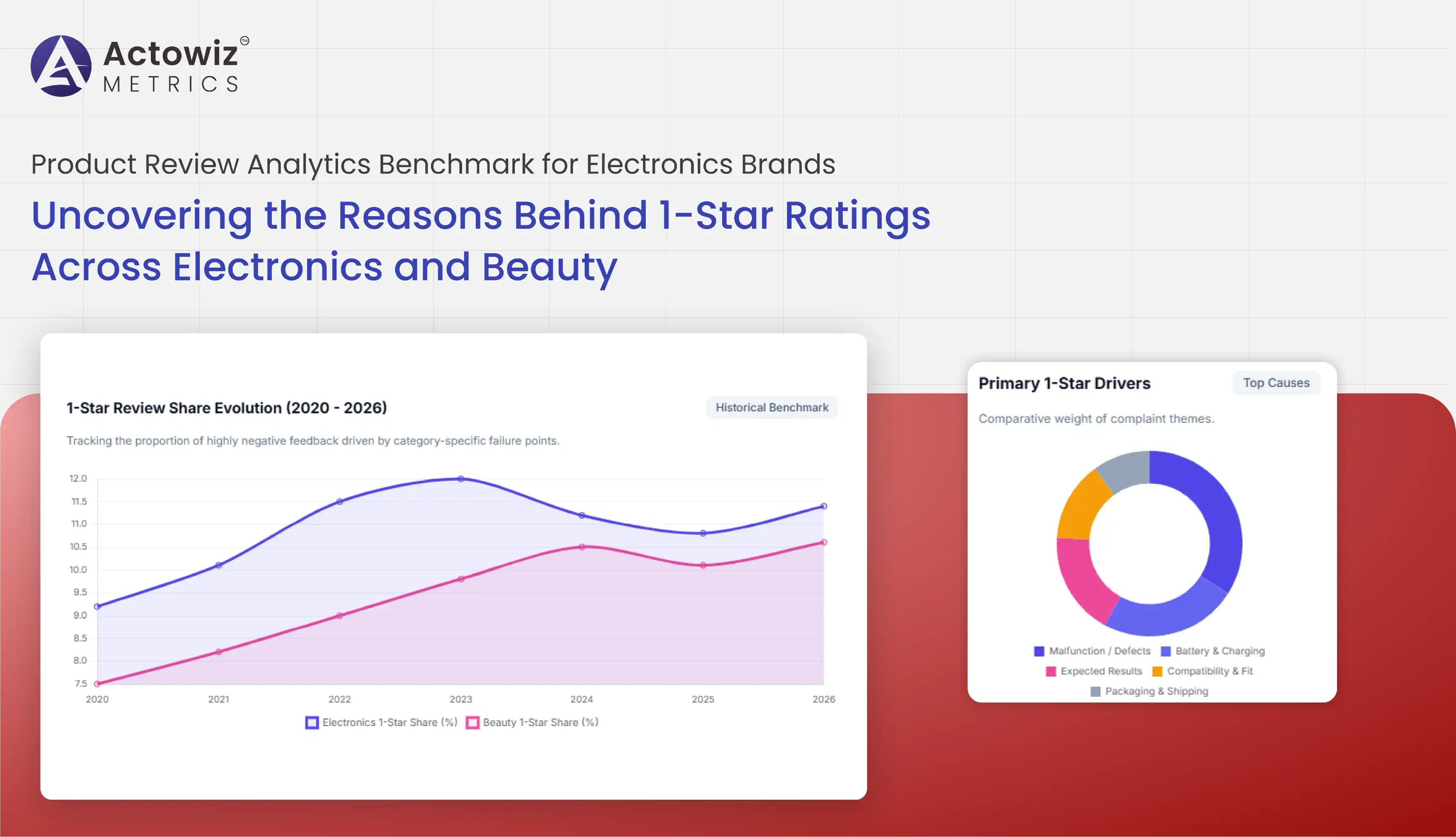
Customer reviews have become an important source of market intelligence for electronics and beauty brands. Beyond star ratings, reviews contain detailed information about product quality, usability, performance, packaging, delivery expectations, durability, compatibility, and customer satisfaction. For brands managing large product portfolios, analyzing this information at scale can reveal why customers leave positive or negative feedback and where product improvements may be required.
The Product Review Analytics Benchmark for Electronics Brands provides a structured approach to understanding rating patterns, review sentiment, recurring complaints, and category-level differences. Instead of focusing only on average ratings, brands can examine the underlying reasons behind 1-star reviews and identify which product attributes generate the most dissatisfaction.
The analysis becomes even more valuable when electronics are compared with beauty products. Consumer electronics analytics can help brands understand how electronics customers focus heavily on functionality, durability, compatibility, battery performance, or ease of use, while beauty shoppers may pay greater attention to product effectiveness, texture, fragrance, skin compatibility, packaging, and perceived results.
This report examines review patterns between 2020 and 2026, with particular attention to 1-star ratings, review aspects, product-level issues, and category differences. Using structured review data and recurring analysis, brands can transform customer feedback into actionable product, quality, marketing, and customer-experience insights.
Customer feedback provides brands with information that traditional sales data cannot always explain. A decline in product ratings may indicate dissatisfaction with quality, usability, performance, packaging, or expectations. However, the underlying cause is often buried within thousands of individual review comments.
Electronics and Beauty Customer Feedback Analytics enables brands to categorize customer comments according to specific themes and product attributes. When combined with Product Review Analytics Benchmark for Electronics Brands, organizations can compare review performance across products, subcategories, competitors, and rating levels.
| Metric | What It Measures |
|---|---|
| Average rating | Overall customer perception |
| 1-star review share | Proportion of highly negative reviews |
| Review volume | Level of customer feedback |
| Aspect mentions | Frequency of specific product issues |
| Negative sentiment | Intensity of dissatisfaction |
| Complaint frequency | Recurring customer problems |
| Rating trend | Changes in perception over time |
From 2020 to 2026, online reviews have evolved from simple post-purchase feedback into a valuable source of structured consumer intelligence. In 2020, brands increasingly relied on reviews to understand changing customer expectations as online shopping became more important. During 2021 and 2022, growing e-commerce adoption generated larger volumes of customer reviews across electronics, personal care, and other categories. By 2023, businesses increasingly began separating overall sentiment from specific review aspects, allowing them to determine whether customers were dissatisfied with performance, packaging, usability, or other characteristics. In 2024, the growth of AI-supported text classification made it easier to process large review volumes and identify recurring themes. During 2025 and 2026, review analysis has become increasingly useful for benchmarking individual products against competitors and category averages. Historical review data can also show whether a complaint is temporary or persistent. For electronics brands, recurring complaints about battery life, connectivity, setup, or durability may indicate product-level concerns. In beauty, repeated complaints about texture, fragrance, irritation, or effectiveness can provide different signals. Comparing these patterns gives brands a more detailed understanding of what drives customer satisfaction and dissatisfaction.
Electronics products can generate large volumes of reviews because customers often evaluate multiple aspects of their experience. A single review may mention product functionality, build quality, setup, compatibility, battery life, accessories, and customer service.
Electronics Review Data Scraping for Rating Analysis allows brands to collect review information from relevant online retail sources and organize it into a consistent dataset. Depending on the available source data, fields can include product name, SKU, rating, review title, review text, reviewer information where publicly available, review date, verified-purchase indicator, helpfulness metrics, and product attributes.
| Data Field | Analytical Use |
|---|---|
| Product name | Product identification |
| SKU/product ID | Product-level matching |
| Star rating | Rating distribution |
| Review title | Quick issue classification |
| Review text | Aspect and sentiment analysis |
| Review date | Trend analysis |
| Verified status | Review segmentation |
| Helpful votes | Identifying influential feedback |
| Product category | Category benchmarking |
Between 2020 and 2026, the scale and importance of online review datasets increased significantly. In 2020, many brands still depended on manual sampling of reviews to understand customer concerns. As online electronics sales expanded during 2021 and 2022, review volumes increased, making manual analysis increasingly difficult for larger catalogs. By 2023, structured review collection enabled brands to analyze thousands or millions of customer comments using consistent fields. In 2024, aspect-based analysis became more important because brands wanted to understand not only whether a review was negative but also what caused the negative experience. During 2025 and 2026, review datasets can be connected with product catalogs, pricing information, seller data, and competitive intelligence to provide a broader market view. Historical review collection is particularly valuable because product improvements can be evaluated against changes in customer sentiment. For example, if a product update addresses battery performance, brands can monitor subsequent reviews to determine whether battery-related complaints decline. Similarly, sudden increases in complaints may help identify potential quality or manufacturing issues. A structured dataset therefore creates a foundation for continuous customer-feedback monitoring.
Star ratings provide a quick indication of customer satisfaction, but they do not explain why customers feel positively or negatively about a product. Aspect-level analysis addresses this limitation by separating reviews into specific themes.
Beauty Product Rating Analysis by Review Aspect can examine attributes such as effectiveness, texture, fragrance, packaging, application, skin compatibility, and value. Meanwhile, electronics reviews may be analyzed around functionality, durability, setup, battery, connectivity, design, and performance.
| Review Aspect | Electronics Example | Beauty Example |
|---|---|---|
| Performance | Device functionality | Product effectiveness |
| Usability | Setup and controls | Application experience |
| Quality | Build and durability | Formula and packaging |
| Compatibility | Devices/software | Skin or hair compatibility |
| Sensory experience | Noise/display feel | Texture/fragrance |
| Value | Price versus functionality | Price versus results |
From 2020 to 2026, aspect-based review analysis has become increasingly important for understanding category-specific customer expectations. In 2020 and 2021, brands commonly looked at aggregate ratings and broad positive or negative sentiment. As review volumes expanded in 2022, it became increasingly difficult to identify the specific issues responsible for poor ratings through manual reading alone. In 2023, aspect-based classification enabled businesses to organize reviews around product attributes and compare complaint frequencies. By 2024, brands could increasingly identify relationships between individual aspects and overall ratings. For electronics, a product might have strong ratings for design but recurring complaints about battery life. A beauty product might receive positive feedback for packaging while generating negative comments about effectiveness. During 2025 and 2026, these insights can support more granular benchmarking across products and categories. Aspect-level analysis also helps brands avoid treating every 1-star review as evidence of the same problem. Instead, businesses can determine which product characteristics are repeatedly associated with dissatisfaction. This makes review analysis more actionable for product teams, quality managers, marketers, and customer-experience teams.
One-star reviews deserve particular attention because they often contain detailed descriptions of significant customer dissatisfaction. However, the reasons behind these ratings can vary substantially by category.
Brands can benchmark 1-star reviews across electronics and beauty products to identify recurring complaint themes and understand how dissatisfaction differs between categories.
| Category | Common Analytical Theme |
|---|---|
| Electronics | Product malfunction |
| Electronics | Battery or charging problems |
| Electronics | Connectivity issues |
| Electronics | Difficult setup |
| Electronics | Durability concerns |
| Beauty | Lack of expected results |
| Beauty | Texture or application problems |
| Beauty | Fragrance concerns |
| Beauty | Compatibility concerns |
| Beauty | Packaging issues |
Between 2020 and 2026, 1-star review analysis has become more relevant as consumers increasingly use online reviews to assess products before purchasing. In 2020, a limited review sample could often be assessed manually, but growing e-commerce volumes quickly made this approach less scalable. During 2021 and 2022, increased online purchasing generated more detailed customer feedback across both electronics and beauty categories. By 2023, brands could use structured text analysis to identify repeated reasons for 1-star ratings. In 2024, businesses increasingly examined whether negative reviews were concentrated around specific SKUs, product versions, sellers, or time periods. During 2025 and 2026, historical benchmarking can provide additional context by showing whether a complaint is persistent or emerging. Electronics dissatisfaction may frequently center on functionality and reliability, whereas beauty dissatisfaction can be more closely connected with product results, sensory characteristics, or individual expectations. These are analytical patterns rather than universal rules, and individual products can differ substantially. A useful benchmark therefore measures actual review content instead of assuming that every category follows the same complaint structure. Tracking the frequency and intensity of 1-star themes can help brands identify areas for investigation and prioritize product-level improvements.
Comparing categories can reveal how customer expectations influence review behavior. A customer purchasing an electronic device may evaluate whether it works as described, while a beauty shopper may judge whether the product produces an expected personal-care result.
An electronics vs beauty customer review analytics benchmark can therefore provide a structured framework for comparing rating distributions, complaint themes, review sentiment, and aspect-level dissatisfaction.
| Benchmark Area | Electronics | Beauty |
|---|---|---|
| Functional expectations | High | Moderate |
| Performance evaluation | Core review theme | Often tied to effectiveness |
| Sensory factors | Product-dependent | Frequently relevant |
| Compatibility | Device/software | Skin/hair/user-specific |
| Durability | Often important | Packaging/product stability |
| Customer expectations | Feature-led | Result and experience-led |
From 2020 to 2026, cross-category review benchmarking has become more valuable as brands expand into multiple consumer segments. In 2020 and 2021, many organizations primarily evaluated reviews within individual product categories. As digital commerce expanded, businesses gained access to larger datasets that made cross-category comparisons possible. During 2022 and 2023, structured sentiment and aspect classification allowed brands to compare the types of complaints that appeared in different industries. By 2024, review benchmarking could incorporate rating distribution, review volume, aspect frequency, and sentiment intensity. During 2025 and 2026, businesses can use these comparisons to understand whether a particular issue is category-specific or reflects a broader customer-experience challenge. It is important, however, to compare equivalent metrics because review behavior can vary by product type, price point, customer expectations, and purchase occasion. A 1-star rating for an inexpensive accessory may reflect different expectations from a 1-star rating for a premium electronic device. Likewise, beauty reviews can be influenced by personal preferences and individual experiences. A well-designed benchmark therefore provides context alongside numerical comparisons, allowing brands to interpret customer feedback without reducing complex consumer experiences to a single score.
Review data becomes more valuable when brands can connect customer feedback with products, categories, competitors, and commercial outcomes. Instead of treating reviews as isolated comments, organizations can use them as a continuous feedback mechanism.
Beauty analytics can help brands examine product ratings, customer sentiment, review aspects, and recurring concerns across beauty categories. Similar analytical principles can also be applied to electronics and other consumer product segments.
| Insight | Potential Business Application |
|---|---|
| Rising 1-star share | Investigate product or quality issues |
| Repeated complaint | Prioritize product improvement |
| Negative aspect trend | Review specific product attribute |
| Competitor strength | Identify market opportunity |
| Rating improvement | Measure impact of changes |
| Emerging complaint | Investigate early warning signals |
From 2020 to 2026, review analytics has progressed from retrospective customer-feedback reporting toward continuous market intelligence. In 2020, brands frequently used reviews to understand broad customer satisfaction. During 2021 and 2022, increasing review volumes created a stronger need for automated classification and structured analysis. By 2023, businesses could segment reviews by rating, product, aspect, and sentiment. In 2024, historical review databases became more valuable for measuring changes following product launches, packaging updates, formula changes, or software improvements. During 2025 and 2026, review intelligence can be integrated with broader product and competitive datasets to support more comprehensive decision-making. For example, a sudden increase in 1-star reviews combined with a recurring complaint may warrant investigation by product or quality teams. A competitor consistently receiving better feedback on a specific aspect may indicate an opportunity for product differentiation. Similarly, improving sentiment following a product update can provide evidence that customer concerns are declining. The goal is not simply to collect more reviews but to convert unstructured customer language into structured signals that teams can monitor over time. This approach can support product development, quality control, marketing strategy, customer experience, and competitive analysis.
Actowiz Metrics helps brands transform large volumes of online product and customer data into structured, analysis-ready datasets. For organizations managing extensive electronics and beauty portfolios, automated review collection and analytics can reduce manual research while improving historical visibility.
Large product catalogs can generate substantial volumes of customer feedback. Actowiz Metrics can support recurring collection frameworks designed to organize review information at product and SKU levels.
Ratings And Reviews Analysis enables businesses to move beyond average ratings by examining rating distributions, review sentiment, recurring complaints, and product-specific themes.
Historical review datasets help brands compare customer feedback across different periods. This can reveal whether negative themes are increasing, declining, or remaining consistent.
Electronics and beauty products can be evaluated using category-specific review attributes while still maintaining standardized analytical structures for cross-category benchmarking.
Review intelligence can help brands identify competitor strengths, recurring market complaints, product gaps, and customer expectations. These insights can complement pricing, product, and digital shelf datasets.
Structured review datasets can be prepared for dashboards, analytical models, internal reporting, product research, and recurring market intelligence workflows.
Online customer reviews provide a detailed record of how consumers experience products after purchase. For electronics brands, analyzing review content can reveal recurring concerns around functionality, durability, compatibility, battery performance, setup, and value. Beauty brands may encounter different themes involving effectiveness, texture, fragrance, packaging, and individual suitability.
The key is to move beyond simple average ratings. A structured review analytics approach can identify the reasons behind 1-star ratings, compare product-level performance, monitor aspect-specific sentiment, and establish benchmarks across categories. Historical analysis from 2020 through 2026 further enables brands to understand how customer perceptions evolve over time.
For businesses seeking to strengthen their customer intelligence capabilities, Product Review Analytics Benchmark for Electronics Brands can provide a framework for transforming unstructured reviews into measurable insights. By combining review collection, aspect classification, sentiment analysis, rating benchmarking, and historical tracking, brands can better understand customer expectations and identify areas that require attention.
Partner with Actowiz Metrics to build scalable review data collection and analytics solutions that uncover customer concerns, benchmark product performance, and turn review intelligence into actionable business insights!
Expert blogs, research reports and infographics — practical, data-driven reading across e-commerce and quick-commerce.
Most fields are optional — the more you share, the better your sample.


.webp "infographics")
.webp "infographics")