BLOG


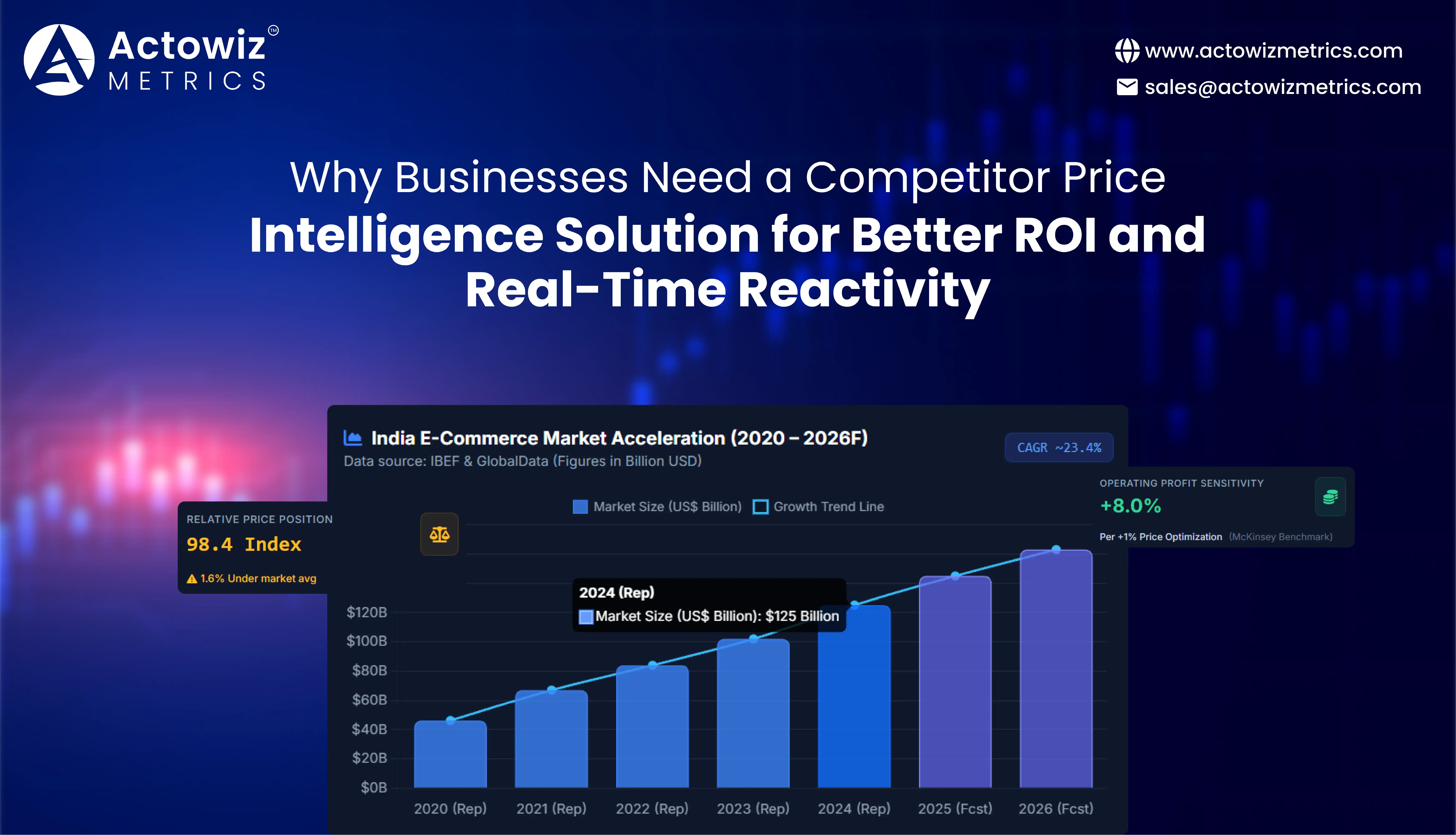
Businesses need faster, evidence-based pricing decisions because online markets can change faster than manual monitoring cycles. A Competitor Price Intelligence Solution gives pricing, category, e-commerce, and revenue teams a structured way to observe competitor prices, promotions, availability, and market movements instead of relying on occasional checks. This matters especially in India, where the e-commerce market has expanded rapidly: IBEF reports that India's e-commerce market was valued at US$125 billion in 2024 and is projected to reach US$345 billion by 2030. India Brand Equity Foundation
The commercial importance of pricing is substantial. McKinsey estimates that, when volume remains stable, a 1% price increase can generate an approximately 8% increase in operating profit for an average S&P 1500 company. McKinsey & Company That does not mean every retailer should raise prices by 1%; rather, it demonstrates why small pricing decisions can have disproportionately large financial consequences.
For brands selling across Amazon, Flipkart, quick-commerce platforms, D2C websites, and other marketplaces, the challenge is no longer simply knowing a competitor's price. Teams need Price & Promotion Intelligence to understand why a price changed, whether a promotion is active, how the change affects relative price position, and whether reacting would improve or damage margin.
| Year | Indian e-commerce market | Status |
|---|---|---|
| 2020 | US$46.2B | Reported |
| 2021 | US$67B | Reported |
| 2022 | US$84B | Reported |
| 2023 | US$102B | Reported |
| 2024 | US$125B | Reported |
| 2025 | US$145B | Forecast |
| 2026 | US$163B | Forecast |
The 2020 figure comes from GlobalData reporting, while the 2021–2026 series is reported by IBEF; 2025 and 2026 are explicitly forecasts in the latter source. India Brand Equity Foundation
Real-Time Competitor Price Monitoring enables pricing teams to move from periodic observation to continuous competitive awareness. Instead of discovering that a rival has undercut a key SKU during a weekly review, teams can identify the movement closer to when it occurs. This is particularly important for marketplaces and quick-commerce environments where assortment, promotions, stock, and prices can vary by platform or location. Actowiz Metrics states that its platform tracks competitor price, promotion, availability, and search-related signals across marketplaces, including hyperlocal pricing for quick-commerce.
The financial argument is equally important. McKinsey's pricing research shows why even apparently small pricing movements deserve attention: a 1% price increase can produce roughly an 8% operating-profit improvement when volume is unchanged. McKinsey & Company Meanwhile, Walmart reported that its FY2025 gross-profit rate increased 40 basis points and attributed part of the improvement to managing prices in line with competitive historical price gaps. Walmart News & Leadership
This is where Margin Intelligence becomes essential. A competitor price should not automatically trigger a matching response. A lower competitor price may be temporary, promotion-led, location-specific, or supported by a different cost structure. A better workflow evaluates the competitor movement alongside your selling price, costs, promotion status, and target margin.
| Pricing signal | Business question |
|---|---|
| Competitor price falls | Do we need to respond? |
| Competitor promotion starts | Is the discount temporary? |
| Competitor goes out of stock | Can we capture demand without cutting price? |
| Your price becomes the highest | Is the premium justified? |
| Market prices rise | Can margin be protected? |
The goal is therefore not simply to become the cheapest seller. It is to understand competitive movement quickly enough to make profitable decisions.
The concept of Competitor Price Intelligence ROI should be measured through business outcomes rather than dashboard activity. A useful evaluation framework connects competitive data with decisions such as avoided unnecessary discounts, recovered margin, faster promotional responses, reduced manual research, and improved price positioning.
A Competitor Price Intelligence Solution can support that framework by bringing competitor observations into a repeatable process. McKinsey's research on pricing and promotions found that companies using more sophisticated approaches to connect pricing, customer price sensitivity, and promotions can improve revenue and profits by three to five percentage points overall. In one international online retailer example discussed by McKinsey, the company expected sales revenue to increase by 3–5% and profits by two to four percentage points over three years following its pricing-and-promotions transformation. McKinsey & Company
These figures are examples from McKinsey's research, not guaranteed outcomes for every retailer.
| ROI lever | What should be measured? |
|---|---|
| Margin protection | Gross margin before and after pricing actions |
| Discount control | Promotional spend and depth |
| Faster response | Time between competitor change and internal action |
| Productivity | Hours spent on manual competitor checks |
| Revenue protection | Sales on strategically monitored SKUs |
| Decision quality | Percentage of price actions supported by competitive data |
For a buyer evaluating technology, the key question should be: Can the system connect competitive observations to financial KPIs? A dashboard showing thousands of competitor prices is useful only when category managers can determine which changes deserve action.
The strongest business case therefore starts with a defined SKU group, baseline margin, existing monitoring effort, and measurable pricing objectives. The technology investment can then be compared with the financial value generated or protected.
Automated Competitor Price Tracking addresses a basic limitation of manual research: humans cannot efficiently check thousands of SKUs across multiple retailers at frequent intervals. Automation can collect, normalize, compare, and organize observations so teams spend more time interpreting changes and less time gathering them.
The scale of India's digital commerce market makes this increasingly relevant. IBEF reports that India had more than 270 million online shoppers in 2024, while its e-retail market was valued at approximately US$60 billion that year in a Bain & Company and Flipkart report. The same report projected Indian e-retail GMV of US$170–190 billion by 2030. India Brand Equity Foundation
The evolution of online grocery also demonstrates why frequency matters. IBEF cites an IIM Ahmedabad study showing that online grocery purchases in India increased 80% in 2020 to approximately 23,951 crore, reflecting the pandemic-era acceleration in online purchasing. India Brand Equity Foundation
| Monitoring approach | Typical limitation |
|---|---|
| Manual spreadsheet checks | Slow to refresh and difficult to scale |
| Periodic screenshots | Weak historical structure |
| Individual marketplace checks | Fragmented competitive view |
| Automated collection | Better suited to high-frequency monitoring |
| Automated comparison | Makes relative price movement easier to identify |
Automation is especially valuable when product matching is complex. The system must distinguish the same SKU from different pack sizes, variants, sellers, bundles, and product configurations. Actowiz Metrics states that its pipelines combine AI and human-in-the-loop verification for product matching and provide dashboards, reports, APIs, and alerts.
The practical objective is simple: create a reliable competitive dataset that pricing teams can query repeatedly instead of rebuilding the same analysis manually.
Competitor Price Change Alerts can turn competitive monitoring into an action-oriented workflow. Instead of requiring managers to repeatedly inspect dashboards, alerts can highlight predefined events such as a competitor price decrease, new promotion, stock change, or movement in competitive position.
A Competitor Price Intelligence Solution is most useful when alerts are configured around material events rather than every minor fluctuation. An alert for every one-rupee movement can create noise; an alert for a significant price gap on a high-revenue SKU can be far more actionable.
This distinction is particularly relevant as pricing becomes more geographically dynamic. Actowiz Metrics reports that its platform can track pricing at pincode and dark-store levels for quick-commerce channels.
Regulation also demonstrates why historical price data matters. Under EU Directive 98/6/EC, when a price reduction is announced, the prior price generally means the lowest price applied during at least the previous 30 days, subject to national rules and exceptions. Eur-Lex
| Alert type | Recommended business response |
|---|---|
| Competitor undercuts key SKU | Review price gap and margin |
| Competitor launches promotion | Check promotion duration and mechanics |
| Competitor stockout | Evaluate availability advantage |
| Multiple competitors raise price | Reassess market price position |
| Competitor enters category | Review assortment and positioning |
The best alert system therefore supports decision prioritization, not automatic repricing. A category manager should be able to see the changed price, previous price, timestamp, competitor, SKU match, promotion context, and current internal margin before deciding what to do.
That creates a crucial distinction between being fast and being impulsive: real-time intelligence should accelerate informed decisions, not replace them.
Competitor Price Monitoring Cost Savings should be evaluated beyond software subscription fees. The largest opportunity can come from reducing repetitive data-gathering work and preventing expensive pricing decisions based on incomplete information.
McKinsey has documented how manual and poorly coordinated pricing and promotional processes can create unnecessary work. In one online-retailer example, pricing required significant manual effort and lacked transparency, while uncoordinated promotions created additional work and contributed to lost revenue and profit opportunities. McKinsey & Company
Cost savings can therefore come from several areas: reducing spreadsheet maintenance, minimizing repeated marketplace searches, standardizing competitor data, shortening reporting cycles, and directing analyst time toward exceptions rather than routine collection.
| Cost area | Efficiency opportunity |
|---|---|
| Manual competitor checks | Automate recurring collection |
| Spreadsheet consolidation | Centralize structured data |
| Repeated reporting | Schedule dashboards/reports |
| Exception identification | Use thresholds and alerts |
| Cross-market comparisons | Standardize SKU and competitor matching |
| Historical analysis | Maintain time-series observations |
There is also a broader economic reason to control pricing waste. McKinsey's research found that a 1% price reduction can have approximately the opposite profit effect of a 1% price increase when other factors remain constant. McKinsey & Company That makes unnecessary discounting a potentially material issue for businesses operating with tight margins.
For an e-commerce team, the right measurement is therefore not simply "how many competitor prices were collected?" Instead, track analyst hours saved, pricing decisions accelerated, discount leakage reduced, and margin preserved.
The business case becomes stronger when competitive monitoring is integrated with existing category-management and pricing workflows rather than treated as a standalone reporting exercise.
Competitor Pricing Intelligence for Profitability means using market prices as one input into a broader commercial decision rather than treating competitor pricing as an instruction to match. Profitability depends on price, volume, cost, promotion, product differentiation, inventory position, and customer response.
McKinsey's research reinforces this approach. Its pricing-and-promotions analysis recommends combining competitor considerations with customer price sensitivity and company economics rather than relying on a single factor. McKinsey & Company Its pricing practice also reports that dynamic-pricing approaches can improve sales growth and margin growth in specific client contexts, although those results should not be interpreted as guaranteed outcomes for every business. McKinsey & Company
A Competitor Price Intelligence Solution can help organize these signals around specific commercial questions.
| Decision | Data required |
|---|---|
| Should we match a competitor? | Competitor price + own margin + price gap |
| Should we promote? | Competitor promotion + historical response + margin |
| Can we increase price? | Market price + differentiation + demand sensitivity |
| Should we defend a SKU? | Revenue importance + competitive intensity |
| Can we hold price during a competitor discount? | Promotion context + product positioning |
| Where should pricing attention go first? | Price gap + sales importance + margin exposure |
The result is a more disciplined pricing hierarchy. High-volume, price-sensitive products may deserve close competitive monitoring, while differentiated products may justify a wider price position. McKinsey specifically describes "key value items" as products where consumers are particularly price sensitive and notes that these can account for 10–20% of a retailer's sales in its research framework. McKinsey & Company
Profitability therefore comes from knowing where to react, where to hold, and where to increase price—not from automatically following every competitor movement.
For brands, retailers, sellers, and agencies, Competitor Analysis for Brands can become more actionable when price data is combined with assortment, availability, search visibility, promotions, and reviews. Actowiz Metrics states that its platform benchmarks competitors across these dimensions and supports monitoring across marketplaces and geographies.
Its published platform information says it tracks price, promotion, availability, search, reviews, and other digital-shelf signals across 1,000+ marketplaces, including Amazon, Flipkart, Blinkit, Zepto, Swiggy Instamart, and Noon. It also describes pincode-level and dark-store-level tracking for quick commerce.
For teams assessing a Competitor Price Intelligence Solution, the practical workflow can include:
Actowiz Metrics also states that its platform provides dashboards, scheduled reports, APIs, and alerts, while its pricing page describes plans that can be scoped around platforms, markets, SKU volume, and refresh frequency.
For agencies, this can also support multi-brand competitive reporting by providing a common data layer across clients and marketplaces. The company's agency solution specifically positions its platform as a way to manage multiple brands from a single source of truth.
The case for competitive pricing intelligence is ultimately about decision speed plus financial discipline. India's e-commerce market has expanded substantially, with IBEF reporting growth from US$46.2 billion in 2020 to US$125 billion in 2024 and forecasting US$163 billion by 2026. India Brand Equity Foundation At the same time, pricing research shows that relatively small price movements can have significant effects on operating profit. McKinsey & Company
For pricing managers, category leaders, e-commerce heads, D2C brands, marketplace sellers, and agencies, the objective should not be to react to every competitor move. It should be to identify the moves that matter, understand their commercial context, and respond with evidence.
That requires reliable data, historical comparisons, automated monitoring, meaningful alerts, and a clear connection between competitive movements and margin decisions.
If your team is still relying on manual competitor checks or fragmented spreadsheets, the next step is to evaluate how a structured intelligence workflow could improve speed, coverage, and pricing discipline.
Explore how Actowiz Metrics can support your E-commerce Intelligence For Agencies workflow and benchmark competitors across marketplaces, prices, promotions, availability, and digital-shelf signals. See the platform and request a tailored sample!
Expert blogs, research reports and infographics — practical, data-driven reading across e-commerce and quick-commerce.
Most fields are optional — the more you share, the better your sample.
.webp "infographics")
.webp "infographics")