BLOG


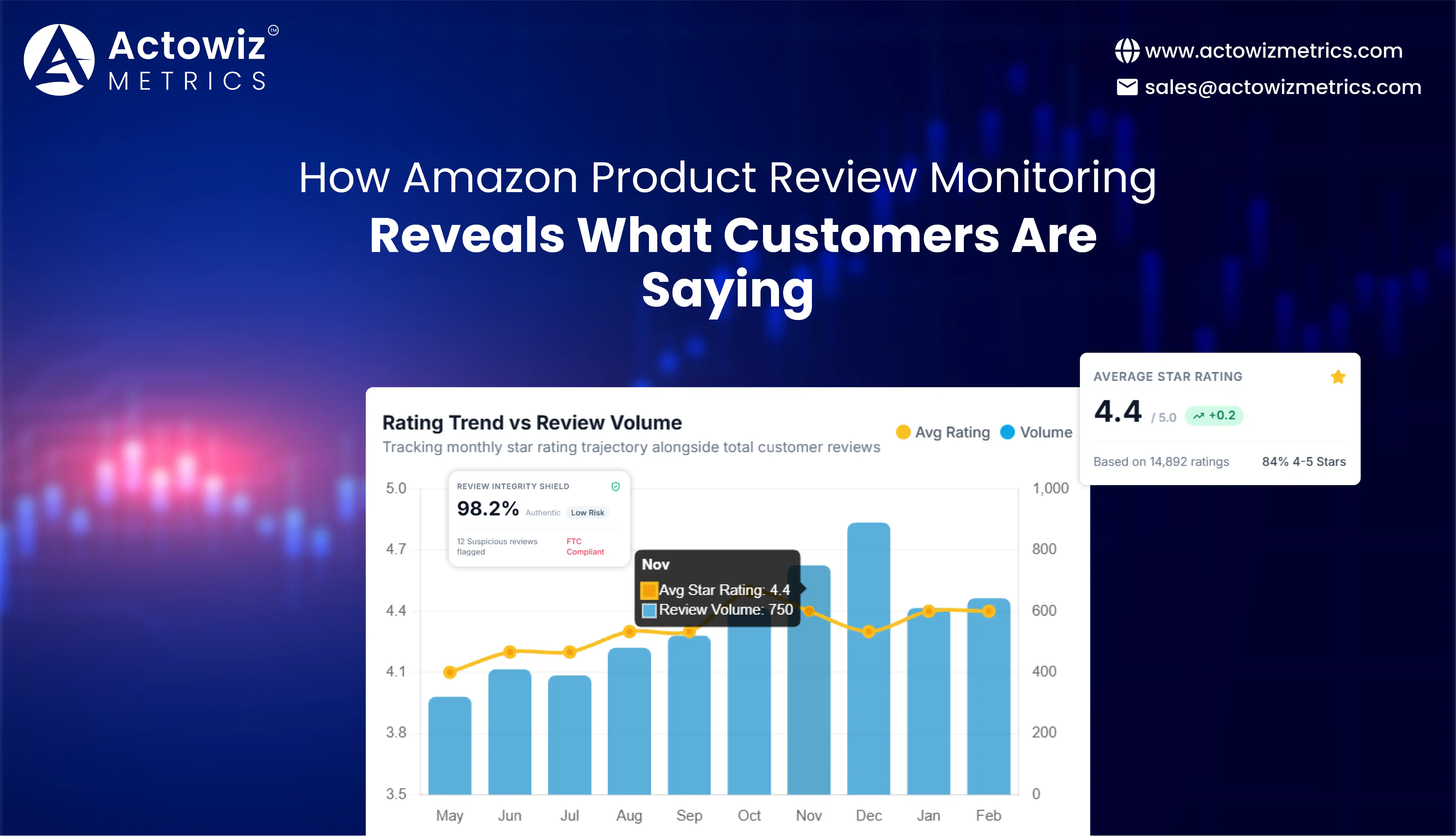
Customer reviews reveal what shoppers value, what disappoints them, and why they choose one product over another. For brands selling on Amazon, Amazon Product Review Monitoring helps transform customer opinions into actionable insights about product quality, customer expectations, competitive positioning, and opportunities for improvement. By connecting review patterns with Amazon Price Tracking, businesses can also evaluate how pricing changes align with customer perceptions and product value.
For Actowiz Metrics, the opportunity lies in helping brands make better-informed decisions using structured e-commerce intelligence. Rather than simply counting positive and negative reviews, businesses can examine recurring complaints, product features customers appreciate, changing expectations, and differences between competing listings.
This approach matters in an increasingly competitive marketplace. Amazon reported $638 billion in total net sales in 2024 and $716.9 billion in 2025, according to its annual financial disclosures. These figures reflect Amazon's overall business, not product-review activity, but they demonstrate the scale of the marketplace in which sellers compete. Source: Amazon's 2025 annual report.
The central question is straightforward: ow can brands turn Amazon customer reviews into measurable improvements? The answer involves monitoring review changes, identifying recurring issues, analyzing customer sentiment, comparing ratings with competitors, and translating findings into product, service, and merchandising decisions.
Amazon Customer Review Analysis helps brands understand the experiences behind customer ratings. A five-star review may highlight a product's strongest selling point, while a three-star review may reveal a feature that works adequately but needs improvement. Reading reviews collectively makes it easier to distinguish isolated opinions from recurring patterns.
For example, a consumer electronics brand can classify feedback into battery performance, connectivity, packaging, durability, and ease of use. A home-products seller might instead examine material quality, dimensions, assembly instructions, and cleaning requirements. These are practical classification examples, not claims about measured results from a particular seller.
With Amazon Product Review Monitoring, businesses can establish a consistent process for identifying emerging themes and tracking them over time. Teams can compare feedback before and after a product redesign, investigate whether complaints continue after a supplier change, and identify features that customers repeatedly praise.
The following table presents a practical framework for interpreting review signals.
| Customer feedback pattern | What it may indicate | Recommended action |
|---|---|---|
| Repeated durability complaints | Possible quality or material issue | Investigate product specifications and defect records |
| Positive comments about ease of use | A feature customers value | Consider emphasizing it in accurate product descriptions |
| Frequent sizing or fit concerns | Product information may be unclear | Review measurements, images, and sizing guidance |
| Repeated packaging damage reports | Potential fulfillment or packaging issue | Examine packaging standards and shipping processes |
| Confusion about setup | Instructions may be insufficient | Improve manuals, diagrams, or setup guidance |
These signals should be validated against returns, customer-service tickets, product testing, and supplier records before a business makes substantial changes. Reviews describe individual experiences; they do not automatically establish the root cause of a problem.
A useful reporting process tracks the frequency of each theme, its average rating, the products affected, and whether the theme is increasing or decreasing. Teams should also separate verified product defects from shipping problems, incorrect customer expectations, and feedback that lacks sufficient detail.
This makes review analysis a practical input for product development, quality assurance, and listing optimization rather than a collection of unstructured comments.
Negative reviews can reveal weaknesses that sales figures alone may not explain. A product may continue selling while customers repeatedly report confusing instructions, missing accessories, inconsistent sizing, or difficulties with everyday use.
Amazon Negative Review Monitoring gives sellers a systematic way to identify these issues and prioritize their response. The objective is not to remove every unfavorable opinion. It is to understand legitimate complaints, correct preventable problems, and protect customer trust through transparent practices.
Amazon has publicly described its efforts to detect and prevent fake reviews. In 2022, it reported proactively blocking more than 200 million suspected fake reviews worldwide. In 2023, the company reported blocking more than 250 million suspected fake reviews. These are Amazon-reported figures, not independent estimates of all fake reviews in the marketplace. Source: About Amazon.
The figures underline the importance of review integrity. Brands should analyze legitimate negative feedback while recognizing that suspicious activity may require separate investigation.
A practical prioritization method considers four factors:
For instance, several detailed reports of a charging problem deserve a different investigation from a single complaint about personal color preferences. A potentially safety-related issue should be escalated promptly, regardless of how many reviews mention it.
Brands should assign owners to recurring issues, record corrective actions, and monitor subsequent feedback. If a packaging change is introduced, the team can check whether packaging-related complaints subsequently decline. Such a comparison helps assess whether the intervention may have worked, although other changes during the same period should also be considered.
Responses to negative reviews should be professional, specific, and appropriate to the platform's rules. Businesses should not pressure customers to change their ratings or offer incentives conditional on positive feedback. The US Federal Trade Commission's rule addressing fake reviews and testimonials took effect on October 21, 2024, and prohibits specified deceptive review practices. Source: FTC rule summary.
The strongest approach is to treat criticism as evidence to investigate, not as a reputation problem to conceal.
Star ratings provide a quick summary of customer opinion, but they do not explain the reasons behind that opinion. Two products with similar average ratings may have very different strengths, weaknesses, and customer expectations.
Amazon Product Rating Monitoring helps businesses follow changes in ratings and understand when a product's overall perception may be shifting. Tracking should include the current displayed rating, review count, rating distribution where available, and changes over a defined period.
Combined with Amazon Product Review Monitoring, rating data can reveal whether an apparent decline coincides with a particular complaint. A falling average accompanied by recurring reports of missing components may warrant a different response from a decline associated with a recent price increase or a change in the product's intended use.
The following table illustrates how to interpret rating signals without assuming that every change has the same cause.
| Observed signal | Possible interpretation | What to investigate |
|---|---|---|
| Average rating declines | Customer satisfaction may be weakening | Recent reviews, product changes, and complaint themes |
| Rating remains stable but negative themes increase | A specific weakness may be emerging | Review-level topics and product variants |
| Review volume rises sharply | Product visibility or customer engagement may have changed | Sales, promotions, traffic, and review timing |
| Competitor ratings improve | A competitor may be addressing customer needs more effectively | New features, quality changes, and customer feedback |
| Ratings differ across variants | Customers may experience different outcomes | Variant specifications, compatibility, and listing clarity |
Rating averages should be interpreted carefully. An average can remain stable even when new complaints are increasing, particularly when a product has accumulated a large number of earlier reviews. Similarly, a small number of recent ratings can cause greater short-term movement for a product with limited review history.
Brands should compare equivalent periods and products, account for variant differences, and avoid treating correlation as proof of causation. Rating changes can be affected by review volume, customer mix, product revisions, and marketplace display rules.
A useful dashboard can show the rating trend beside the most frequent positive and negative themes. This connects the numerical signal to the customer experiences that may explain it.
Customer reviews contain more information than star ratings alone. Written feedback can explain why a shopper liked a feature, what failed during use, or which expectations the product did not meet.
Amazon Review Sentiment Analysis organizes written feedback into positive, negative, and neutral sentiment, with more detailed systems identifying the product attributes associated with each opinion. Aspect-based analysis can distinguish satisfaction with design from dissatisfaction with durability, even when both appear in the same review.
For example, a review might praise a vacuum cleaner's suction while criticizing its weight. A single overall sentiment label could miss this distinction. An attribute-level approach preserves both signals, allowing product and marketing teams to understand the trade-offs customers describe.
An effective workflow includes the following steps:
Sentiment models are not infallible. A phrase such as "not bad" may be positive despite containing a negative word, while sarcasm or context-dependent language can be difficult to classify. Automated outputs should therefore be validated, particularly when the findings may influence product safety, compliance, or major commercial decisions.
Teams should also distinguish the number of mentions from the proportion of reviews expressing a particular opinion. A topic mentioned frequently in absolute terms may simply reflect higher review volume. Comparing rates over equivalent periods provides a more meaningful view of changing customer concerns.
The resulting insights can inform product improvements, clearer descriptions, advertising messages, and customer-service training. Positive themes can guide accurate messaging, while negative themes can highlight expectations that a product or listing needs to address.
Amazon Customer Feedback Intelligence connects customer opinions with business questions. Instead of asking only whether customers are satisfied, brands can investigate which product attributes influence satisfaction, which complaints recur across a category, and where competitors appear to meet expectations more effectively.
With Amazon Product Review Monitoring, these insights can be organized into recurring reports for product managers, marketplace teams, customer-support leaders, and brand managers.
Consider three practical applications. First, product development teams can use recurring feature requests to prioritize research and testing. Second, marketing teams can compare customer praise with the claims made on product detail pages, reducing the risk of emphasizing features customers do not value. Third, customer-service teams can identify recurring questions and create clearer support resources.
External research provides context for why review quality matters, although results should not be assumed to represent Amazon shoppers specifically. BrightLocal's 2025 Local Consumer Review Survey reported that 42% of surveyed US consumers trusted online reviews as much as personal recommendations from friends and family, down from 79% in its 2020 survey. The study concerns local-business reviews, so its findings should not be treated as an Amazon-specific consumer statistic. Source: BrightLocal's 2025 survey.
The broader lesson is to prioritize credible, detailed feedback rather than relying exclusively on headline ratings. Brands should look for consistent evidence across reviews, customer-service interactions, product returns, and product testing.
A practical reporting table can help teams turn observations into accountable actions.
| Insight | Business decision | Suggested KPI |
|---|---|---|
| Repeated complaints about assembly | Improve instructions or product design | Assembly-related complaint rate |
| Customers consistently praise a feature | Evaluate whether it merits greater listing prominence | Conversion rate alongside relevant listing changes |
| Competitors receive praise for a missing feature | Assess demand and product-development feasibility | Feature-related mention share |
| Complaints rise after a product revision | Investigate the revised design or materials | Complaint rate by product version |
| Customers misunderstand compatibility | Clarify supported models and requirements | Compatibility-related returns or contacts |
These KPIs are recommended measurement choices, not guaranteed outcomes. Teams should establish baselines, document changes, and measure results over suitable periods. Where multiple changes occur together, it may not be possible to attribute a result to one intervention.
Feedback intelligence becomes most useful when each important finding has a clear owner, a decision deadline, and a measurable follow-up.
Ratings and written reviews become more valuable when interpreted alongside competitive information. A brand may have a well-rated product but still lose customers if competitors offer a feature that shoppers increasingly expect, provide clearer product information, or address common complaints more effectively.
Ratings & Reviews Analysis should therefore compare products on a like-for-like basis. Relevant factors include product specifications, price range, rating distribution, review volume, recurring praise, complaint categories, and the timing of product changes.
A comparison framework can help teams organize the findings.
| Comparison area | Questions to answer | Potential next step |
|---|---|---|
| Product quality | Which defects or limitations recur most often? | Review quality controls and supplier performance |
| Customer expectations | Which features do shoppers repeatedly request? | Evaluate product-development priorities |
| Value perception | Do customers consider the product worth its price? | Review product positioning and pricing strategy |
| Listing clarity | Are customers confused about dimensions, fit, or compatibility? | Improve images, specifications, and descriptions |
| Competitive differentiation | What do customers praise about competing products? | Assess opportunities to differentiate the offer |
| Review recency | Are recent experiences consistent with older feedback? | Investigate changes in product or fulfillment quality |
Competitive comparisons need consistent definitions. A high-volume product may naturally have more complaints than a low-volume product, even if its complaint rate is lower. Where reliable sales or order data is unavailable, brands should report review counts transparently rather than presenting them as defect rates.
The same principle applies to ratings. Products in different price brackets, categories, and use cases may attract different expectations. A comparison that ignores these differences can encourage the wrong business decision.
From 2020 through 2026, several documented developments illustrate why review intelligence needs to combine customer understanding with data integrity. Amazon reported stopping more than 200 million suspected fake reviews in 2020. It reported blocking more than 200 million in 2022, more than 250 million in 2023, and more than 275 million in 2024. The FTC's US rule on specified deceptive review practices became effective in October 2024. These are selected milestones reported by Amazon and the FTC, not a continuous independent measurement series. Amazon's 2020 disclosure, Amazon's 2024 disclosure, and FTC rule summary.
For 2025, Amazon reported that it had proactively blocked more than 275 million suspected fake reviews in 2024; that figure should not be misrepresented as a 2025 result. For 2026, brands should use current, verifiable marketplace data and avoid assuming an annual enforcement figure before one is published.
The actionable priority is to establish a repeatable review-monitoring process that preserves historical comparisons, flags meaningful changes, and links findings to business decisions.
Actowiz Metrics supports data-driven e-commerce decision-making by helping businesses organize marketplace information, evaluate competitors, and identify trends relevant to their commercial objectives. For brands operating on Amazon, the value of an analytics partner lies in converting fragmented marketplace signals into structured information that teams can use.
A review-intelligence workflow can be designed around several priorities:
Actowiz Metrics can also align marketplace research with Amazon.com Best Selling Brands Analytics, helping businesses assess brand-level competitive signals alongside customer feedback. This broader perspective can support decisions about product positioning, category opportunities, and the attributes that may differentiate an offer.
Before implementation, brands should confirm the specific data sources, marketplace coverage, historical depth, refresh frequency, and reporting capabilities required for their use case. Data availability and platform restrictions can affect the level of detail obtainable for individual listings.
The recommended operating model is straightforward: identify a business question, collect the relevant data, validate the pattern, assign an owner, implement a change, and measure the outcome. For example, if repeated reviews point to unclear compatibility information, the team can revise the product page and then track compatibility-related customer contacts and returns. The result should be measured rather than assumed.
This approach keeps analytics connected to commercial outcomes. Instead of collecting information without a clear purpose, brands can use marketplace intelligence to investigate customer concerns, improve product communication, and make more informed competitive decisions.
Customer reviews provide valuable evidence about product quality, usability, expectations, and competitive positioning. When analyzed systematically, they help brands move beyond star ratings to understand the reasons behind customer satisfaction and dissatisfaction.
Amazon Product Review Monitoring enables businesses to identify recurring themes, investigate negative experiences, track rating changes, and evaluate customer sentiment over time. Combined with competitor benchmarking, pricing context, and internal business data, these insights can guide product improvements and more effective marketplace strategies.
For 2026, brands should prioritize reliable data, consistent measurement, review authenticity, and a clear process for turning findings into action. Historical trends are useful, but decisions should reflect current evidence and verified business outcomes.
Ready to turn marketplace data into actionable business insights? Partner with Actowiz Metrics to explore e-commerce analytics solutions that help you understand customer feedback, monitor competitors, and make more informed decisions!
Expert blogs, research reports and infographics — practical, data-driven reading across e-commerce and quick-commerce.
Most fields are optional — the more you share, the better your sample.
.webp "infographics")
.webp "infographics")