BLOG
HALLOWEEN SPECIAL OFFER
Data Analytics & Intelligence Solutions
Turn Data into Smarter Business Decisions!
Offer Terms & Conditions Apply


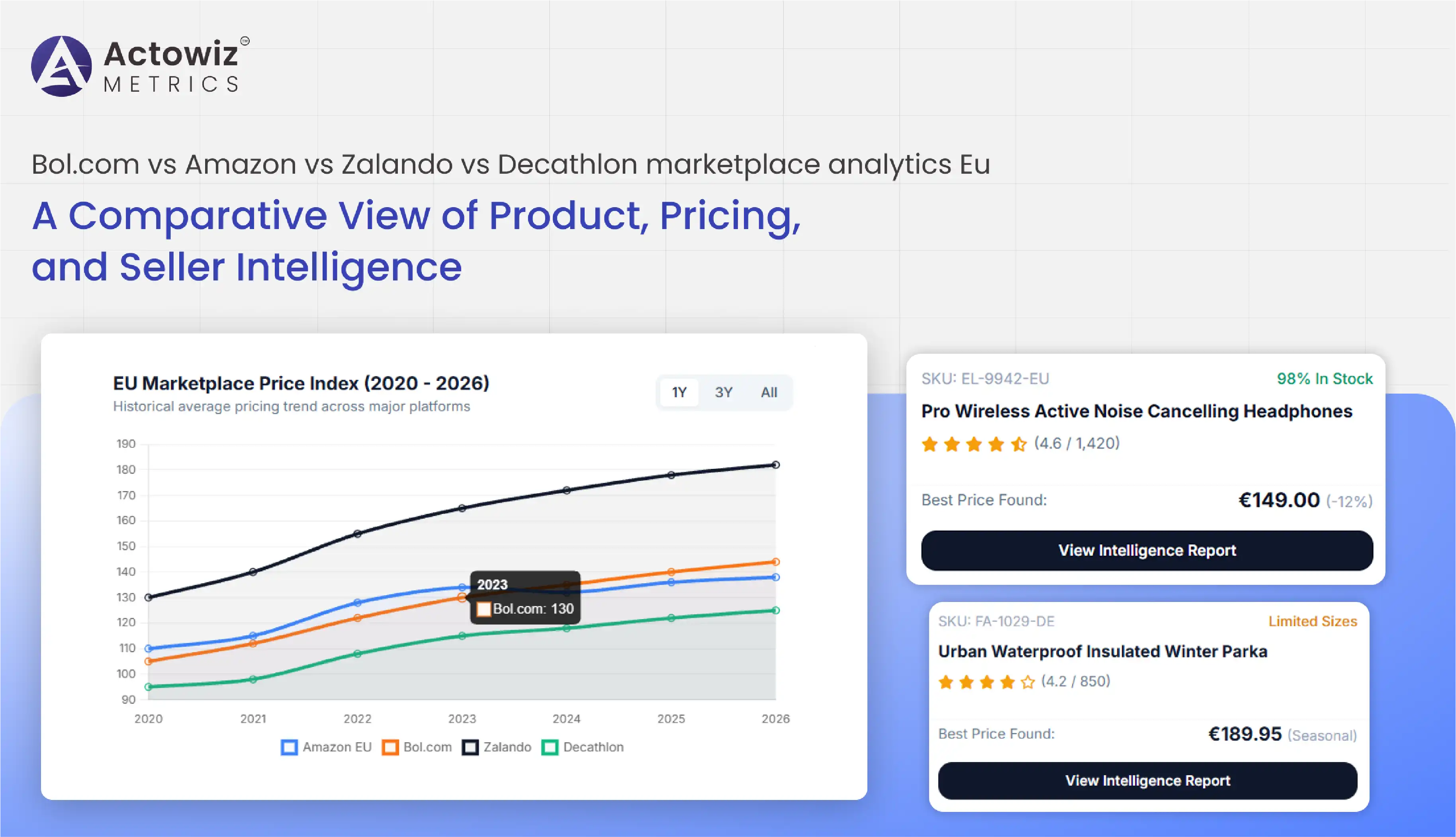
European e-commerce has become increasingly competitive, with marketplaces serving as important channels for product discovery, pricing, customer engagement, and sales growth. For brands operating across multiple countries, understanding marketplace-level differences is essential for identifying pricing gaps, monitoring competitors, and improving digital shelf performance. Bol.com vs Amazon vs Zalando vs Decathlon marketplace analytics Eu provides a comparative framework for evaluating these platforms through product assortment, pricing, seller activity, availability, promotions, and customer-facing signals. At the same time, E-Commerce Data Tracking from Bol.com can help businesses monitor marketplace movements and convert product-level observations into structured intelligence for decision-making.
From 2020 to 2026, European marketplaces have experienced significant changes in consumer expectations, omnichannel retail strategies, seller participation, and competitive pricing. Businesses increasingly need recurring data rather than occasional market snapshots. Structured marketplace intelligence allows retailers, manufacturers, distributors, and D2C brands to compare competing assortments, identify price deviations, monitor product availability, and understand category-level movements.
This report examines six important dimensions of European marketplace intelligence. It explores compliance monitoring, price comparison, Bol.com and e-commerce analytics, Amazon competitor monitoring, Zalando price intelligence, and Decathlon marketplace data collection. The objective is to demonstrate how structured marketplace data can support stronger competitive positioning across Europe.
European marketplace operations involve more than monitoring prices and products. Brands must also consider product information quality, regulatory expectations, seller transparency, promotions, availability, and consistency across countries. EU marketplace compliance monitoring for brands helps businesses identify inconsistencies that may affect product presentation, pricing communication, or marketplace governance.
A structured monitoring framework can capture product titles, descriptions, specifications, prices, seller information, stock status, promotional messages, ratings, and other publicly available attributes. Comparing these elements across marketplaces gives brands a clearer picture of how their products and competitors are represented.
Between 2020 and 2026, European digital commerce increasingly shifted toward data-driven marketplace management. The pandemic accelerated online purchasing, while subsequent years brought greater emphasis on profitability, pricing discipline, and operational efficiency. By 2024-2026, brands were increasingly required to manage multiple marketplaces simultaneously rather than relying on a single online channel.
| Period | Marketplace Intelligence Focus | Business Priority |
|---|---|---|
| 2020 | Rapid digital adoption | Online visibility |
| 2021 | Marketplace expansion | Product availability |
| 2022 | Competitive pricing | Price consistency |
| 2023 | Seller and assortment monitoring | Digital shelf control |
| 2024 | Cross-marketplace analytics | Competitive intelligence |
| 2025 | Automated monitoring | Faster decision-making |
| 2026 | Integrated marketplace intelligence | Scalable EU operations |
The value of compliance-oriented monitoring is that it can move marketplace management from reactive checking to proactive control. Instead of manually reviewing thousands of listings, businesses can establish recurring collection schedules and compare changes over time. This approach can highlight unusual price movements, missing product information, seller changes, or assortment inconsistencies.
For brands selling across several European marketplaces, standardized monitoring also improves internal reporting. Teams can create common data fields for marketplace, product, SKU, seller, price, promotion, availability, and category. This makes comparisons easier and provides a consistent foundation for commercial and operational decisions.
Price remains one of the most visible competitive signals in online retail. Customers can compare similar products across marketplaces within seconds, making price positioning increasingly important. Bol.com Amazon Zalando Decathlon EU marketplace price comparison enables brands to understand how similar products are positioned across different digital retail environments.
A useful comparison dataset can include regular price, discounted price, promotion type, seller, stock availability, product rating, product identifier, and timestamp. Historical data then allows companies to identify whether price differences are temporary or part of a longer-term marketplace strategy.
| Year | Key Market Trend | Analytics Requirement |
|---|---|---|
| 2020 | Increased online shopping | Basic price tracking |
| 2021 | Marketplace competition | Competitor benchmarking |
| 2022 | Inflationary pressure | Price-change monitoring |
| 2023 | Promotional competition | Discount tracking |
| 2024 | Multi-channel selling | Cross-marketplace comparison |
| 2025 | Automated repricing | Near-real-time intelligence |
| 2026 | Advanced marketplace analytics | Historical and predictive analysis |
From 2020 onward, pricing intelligence has increasingly moved from spreadsheet-based analysis toward automated data pipelines. A brand may have thousands of products distributed across multiple categories and marketplaces. Manually checking each product is therefore inefficient and prone to missed changes.
Automated collection can establish a historical record of marketplace prices and make it easier to calculate minimum, maximum, average, and median prices. Businesses can also segment results by category, brand, SKU, seller, country, or marketplace.
The same data can support promotional analysis. For example, a retailer can identify whether competitors are using percentage discounts, fixed-price reductions, bundles, or temporary campaigns. Combining price and availability data provides an even stronger picture because a low price may have limited commercial impact when the competing product is out of stock.
Bol.com is an important digital commerce environment for businesses targeting consumers in the Netherlands and Belgium. Bol.com price tracking Europe can provide brands with recurring visibility into product prices, promotions, availability, sellers, and assortment changes.
Price data becomes considerably more valuable when combined with broader E-commerce & D2C analytics. Instead of examining pricing in isolation, businesses can connect marketplace information with product performance, category trends, competitor behavior, and digital shelf observations.
| Year | Analytics Evolution | Potential Business Use |
|---|---|---|
| 2020 | Basic marketplace tracking | Product visibility |
| 2021 | SKU-level monitoring | Assortment management |
| 2022 | Price history | Competitive benchmarking |
| 2023 | Promotion monitoring | Campaign evaluation |
| 2024 | Seller intelligence | Marketplace strategy |
| 2025 | Automated reporting | Faster decisions |
| 2026 | Integrated analytics | Strategic forecasting |
A structured Bol.com dataset can include product name, SKU, brand, category, price, discount, seller, rating, review count, availability, and product URL. With recurring collection, businesses can build historical records instead of relying on individual observations.
This historical layer is particularly valuable for identifying seasonal pricing patterns. A business could compare product prices before, during, and after major promotional periods to understand competitive behavior. It could also identify products that repeatedly experience aggressive discounting.
For D2C brands, marketplace analytics can complement first-party data. Internal sales data may show how products perform on the brand's own website, while marketplace data can reveal how competitors position similar products. Together, these sources can support decisions related to pricing, assortment, promotions, inventory, and channel strategy.
The broader benefit is improved visibility. Instead of asking what the marketplace looks like today, businesses can examine how product and pricing conditions have changed over weeks, months, and years.
Amazon operates across several European markets, creating a complex competitive environment for brands and retailers. Amazon competitor price monitoring EU helps businesses track changes in competitor pricing, product availability, sellers, discounts, and marketplace positioning.
Competitor monitoring is especially useful for categories where many sellers offer similar products. A price difference of a few percentage points may influence visibility and customer choice, while changes in stock availability can create opportunities for competing products.
| Year | Competitive Challenge | Intelligence Requirement |
|---|---|---|
| 2020 | Rapid e-commerce growth | Competitor discovery |
| 2021 | Seller expansion | Seller monitoring |
| 2022 | Price volatility | Price history |
| 2023 | Promotional intensity | Discount monitoring |
| 2024 | Cross-country competition | EU benchmarking |
| 2025 | Faster marketplace changes | Automated alerts |
| 2026 | Data-driven competition | Continuous intelligence |
Effective monitoring should go beyond recording the lowest price. A complete competitive dataset can connect product identifiers with seller information, stock status, discounts, ratings, review volumes, and product positioning.
Historical monitoring can also reveal competitor strategies. For example, a brand may discover that a competitor consistently reduces prices during specific periods or adjusts pricing when inventory changes. Such patterns can help commercial teams evaluate their own pricing response.
Another important use case is assortment benchmarking. Businesses can compare the number of products competitors offer in a category, identify newly introduced products, and detect discontinued or unavailable listings. This helps category managers understand where competitors are expanding or reducing their presence.
For international brands, country-level comparisons are equally important. The same product may have different prices, promotions, availability, or seller structures in different European markets. A centralized dataset makes these variations easier to identify and analyze.
Fashion and lifestyle marketplaces have unique pricing characteristics because product assortment can change rapidly with seasons, collections, promotions, sizes, colors, and availability. Zalando Price Comparison Europe enables brands to monitor these dynamics and compare product positioning across relevant competitors. The broader Bol.com vs Amazon vs Zalando vs Decathlon marketplace analytics Eu framework also allows businesses to place Zalando insights within a wider European marketplace context.
Zalando-focused analytics can include product name, brand, category, size, color, price, discount, availability, rating, and product URL where publicly accessible. Tracking these attributes repeatedly can provide a historical view of assortment and price movements.
| Year | Marketplace Development | Analytics Opportunity |
|---|---|---|
| 2020 | Digital fashion acceleration | Product monitoring |
| 2021 | Broader online adoption | Assortment analysis |
| 2022 | Promotional competition | Price benchmarking |
| 2023 | Brand marketplace growth | Competitor monitoring |
| 2024 | Advanced digital merchandising | Product intelligence |
| 2025 | Automated marketplace analytics | Trend detection |
| 2026 | Integrated competitive intelligence | Cross-market comparison |
One important consideration is that fashion pricing cannot always be evaluated using price alone. Availability by size or variant can affect the actual competitiveness of a listing. A product appearing at a low headline price may have limited availability in popular sizes, while another product with a higher price may have broader stock coverage.
This is why marketplace analytics should combine pricing, assortment, and availability. Brands can identify products that are repeatedly discounted, categories with high promotional intensity, and competitors that maintain strong availability.
Historical datasets can also support seasonal analysis. By comparing observations across months and years, businesses can examine how prices change during collection launches, seasonal sales, and clearance periods.
Decathlon represents a distinctive marketplace and retail environment because its assortment spans sports equipment, apparel, accessories, and specialized products. Decathlon EU marketplace data scraping can help businesses collect publicly available product and pricing information at scale for competitive and category analysis.
A structured dataset can capture product titles, categories, brands, prices, discounts, product identifiers, availability, ratings, reviews, and other accessible product attributes. Recurring collection allows businesses to compare marketplace conditions over time.
| Year | Data Requirement | Strategic Application |
|---|---|---|
| 2020 | Product visibility | Assortment tracking |
| 2021 | Category monitoring | Market research |
| 2022 | Price changes | Competitive pricing |
| 2023 | Promotion tracking | Campaign analysis |
| 2024 | Product intelligence | Category strategy |
| 2025 | Automated collection | Continuous monitoring |
| 2026 | Cross-marketplace datasets | European benchmarking |
Sports retail is particularly suitable for structured product analytics because product specifications and categories can vary considerably. A monitoring system can normalize attributes across products and make comparisons easier.
For example, businesses can compare prices for similar product categories, identify products with frequent discounts, and monitor availability changes. Historical information can then help identify recurring patterns. The real value comes from integrating Decathlon observations with data from other marketplaces. A business can determine whether a product category is competitively priced across several platforms or whether one marketplace demonstrates significantly different pricing behavior.
A recurring dataset also supports alert-based workflows. Teams can establish thresholds for price changes, availability shifts, or new product appearances. This reduces the need for manual marketplace checks and enables commercial teams to respond more quickly.
Actowiz Metrics helps businesses transform publicly available marketplace information into structured datasets designed for analysis, benchmarking, and decision-making. Amazon analytics can support competitor monitoring, pricing intelligence, assortment analysis, seller research, and historical marketplace comparisons. These capabilities become even more valuable when organizations need a unified view across multiple European marketplaces.
A scalable data collection framework can standardize product identifiers, prices, sellers, categories, availability, ratings, reviews, and promotional information. Recurring data collection allows businesses to create historical datasets rather than relying on one-time snapshots.
The platform can also support customized data requirements. Businesses can define the marketplaces, categories, products, countries, attributes, and monitoring frequency relevant to their objectives. Data can then be cleaned, normalized, validated, and structured for downstream analytics.
For brands managing several marketplace channels, centralized datasets reduce the complexity of comparing information from different sources. Teams can build dashboards, pricing reports, competitor trackers, and category intelligence workflows from consistent data.
Most importantly, Bol.com vs Amazon vs Zalando vs Decathlon marketplace analytics Eu can help organizations move toward a more comprehensive European marketplace intelligence strategy, allowing decision-makers to evaluate product, price, seller, and availability signals together rather than separately.
European marketplace competition is becoming increasingly data-driven. Brands need continuous visibility into product assortment, prices, sellers, promotions, availability, and competitor movements to make informed commercial decisions. Comparing multiple marketplaces creates a stronger foundation for identifying pricing gaps, assortment opportunities, and emerging market trends.
Decathlon 2026 Sales Analytics can contribute to a broader marketplace intelligence framework by helping businesses examine product and sales-related signals in the sports and lifestyle category. When combined with structured monitoring across other major platforms, organizations can develop a more complete view of European digital commerce.
The key advantage of a recurring data strategy is historical visibility. Instead of seeing marketplace conditions as isolated snapshots, businesses can track how prices, products, sellers, promotions, and availability evolve from one period to another. This supports more informed pricing, assortment, competitive, and category decisions.
Explore how Actowiz Metrics can help you build scalable European marketplace intelligence and turn marketplace data into actionable business insights!
Expert blogs, research reports and infographics — practical, data-driven reading across e-commerce and quick-commerce.
Most fields are optional — the more you share, the better your sample.
.webp "infographics")
.webp "infographics")