BLOG
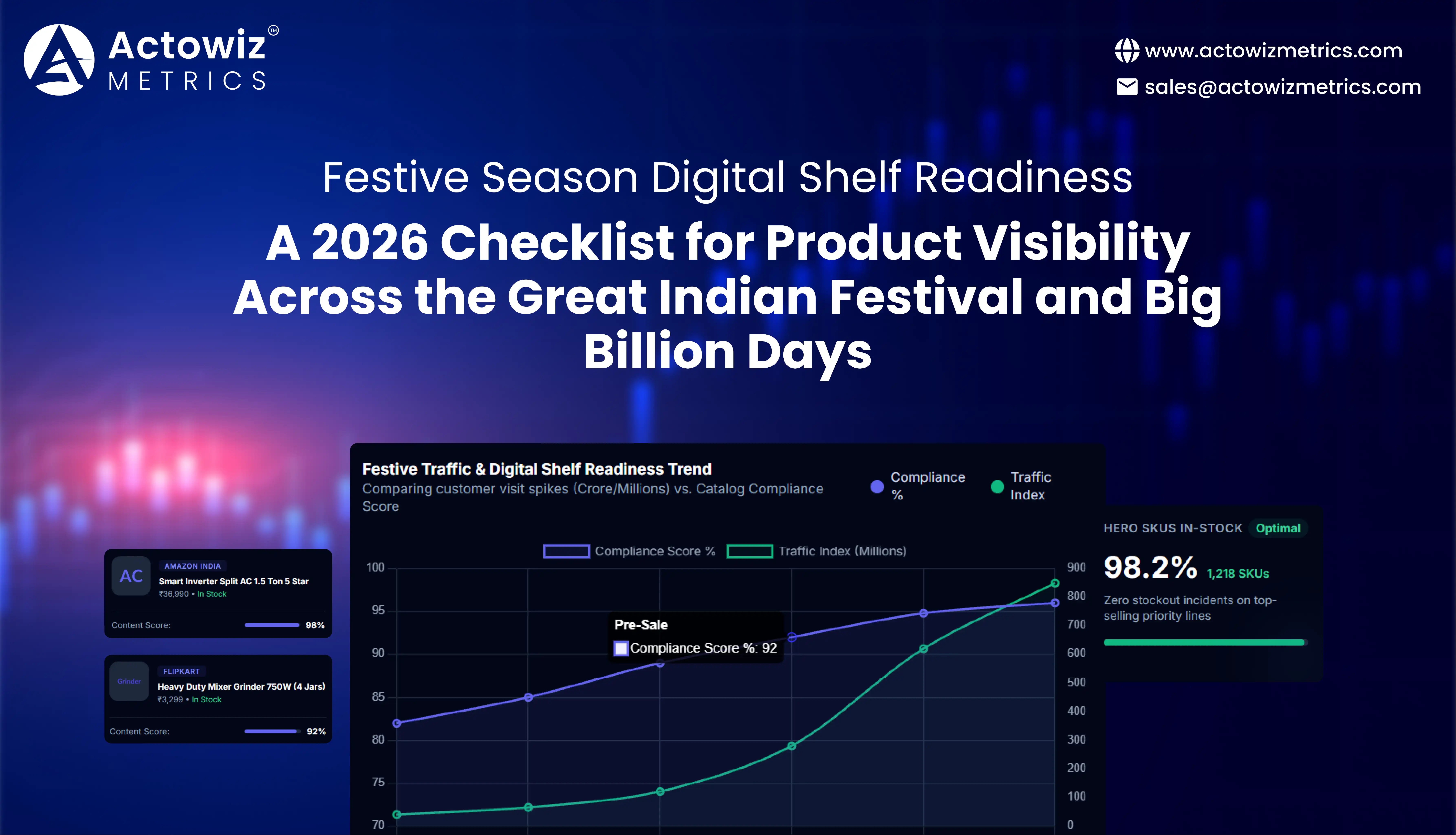


Brands can improve festive-season sales by making every product page accurate, discoverable, competitively priced, and available when shoppers are ready to buy. Festive Season Digital Shelf Readiness is the process of checking these factors across marketplaces before and throughout major events such as Amazon's Great Indian Festival, Flipkart's Big Billion Days, Myntra's Big Fashion Festival, and quick-commerce promotions.
For e-commerce heads, marketplace managers, brand teams, and category leaders, the central challenge is execution at scale. A product may have a strong discount but lose sales because its image is outdated, the size variant is unavailable, the title misses relevant search terms, or a competitor offers a clearer product page. Teams need a repeatable way to find and fix these gaps before traffic peaks.
This is where Assortment and Availability Optimization Strategies become essential. Brands should prioritize high-demand SKUs, verify product content, monitor price and stock conditions, and measure search visibility across each relevant channel. Amazon India and Flipkart often matter for electronics, appliances, home, and general merchandise; Myntra is critical for fashion and beauty; Meesho serves value-focused shoppers; and Blinkit, Zepto, Swiggy Instamart, and Flipkart Minutes can matter for fast-moving essentials and last-minute purchases.
The opportunity is substantial, but so is the operational pressure. In 2024, Amazon reported 140 crore customer visits during its Great Indian Festival, while Myntra recorded 627 million visits during its Big Fashion Festival. These are platform-reported figures from different events, not directly comparable measures. They demonstrate why brands should audit the digital shelf before shoppers arrive—not after visibility or availability problems have already affected performance. (Amazon; Myntra coverage by Business Standard)
Amazon and Flipkart Digital Shelf Optimization should begin with a SKU-level audit of product titles, images, descriptions, specifications, variants, ratings, reviews, availability, and price presentation. The aim is to remove purchase friction and help shoppers understand why a product fits their needs. Festive Season Digital Shelf Readiness also requires brands to verify that the same product is represented consistently across their own catalogue, marketplace listings, and campaign materials.
Start by segmenting the catalogue into hero SKUs, seasonal products, high-margin products, new launches, and long-tail listings. Hero SKUs need the most frequent checks because problems on these products may affect a larger share of campaign performance. For each priority item, assign an owner, define required content fields, and record a baseline snapshot before the sale begins.
Product content should reflect the way customers search. A title for a mixer grinder, for example, should communicate relevant capacity, wattage, and model details; a fashion listing should clearly identify brand, style, colour, fabric, and size options. Do not add unsupported claims or irrelevant keywords to improve discoverability. Accurate attributes help shoppers compare products and reduce confusion.
| Year | Platform or market | Reported real-world figure | Digital shelf implication |
|---|---|---|---|
| 2020 | Amazon India, Great Indian Festival | Amazon reported orders from 99.3% of India's pin codes during the event. | Check serviceability, delivery promises, and listing accuracy across a geographically broad customer base. |
| 2022 | Flipkart, Big Billion Days | Flipkart reported more than one billion customer visits during its eight-day event. | Validate the most commercially important listings before the traffic spike. |
| 2023 | Myntra, Big Fashion Festival | Myntra reported approximately 460 million visits. | Ensure fashion images, size options, colour variants, and product attributes are complete. |
| 2024 | Amazon India, Great Indian Festival | Amazon reported 140 crore customer visits and more than 25,000 new product launches. | New launches need content QA and product-page checks alongside established bestsellers. |
| 2024 | Myntra, Big Fashion Festival | Myntra reported 627 million visits, up from approximately 460 million in 2023. | Fashion brands should check listing completeness and variant availability before the event. |
| 2025 | Amazon India, Great Indian Festival | Amazon reported 276 crore customer visits. | Build a clear audit schedule for high-traffic SKUs and newly launched products. |
| 2026 | Flipkart, Big Billion Days opening | Flipkart reported 6.3 million concurrent users in a minute at the opening of its 2026 festive event. | Use a live issue queue for critical listing, price, and availability problems during peak periods. |
These platform-reported figures use different metrics and periods. They are context for planning, not a standardized measure of product-page performance.
For each SKU, use a readiness scorecard that checks content completeness, image quality, variant accuracy, price validity, stock status, and search discoverability. Resolve errors that can block a purchase first, then prioritize content improvements likely to help shoppers compare products more confidently.
E-commerce Product Listing and Content Audit should test whether a listing is complete, accurate, easy to understand, and consistent with the brand's product information. An audit should cover the title, bullet points, description, images, videos where supported, technical attributes, product identifiers, variant relationships, and visible customer feedback. It should also identify missing fields and differences between the brand's approved product data and the live marketplace page.
The process is especially important for new launches and products sold in multiple configurations. A listing can look complete while still showing the wrong colour, capacity, pack size, or compatibility information. These errors can distort comparisons, increase customer uncertainty, and complicate returns. A good audit therefore checks both the quality of the content and whether it belongs to the correct SKU.
Use a practical pre-sale checklist:
Amazon's 2024 Great Indian Festival featured more than 25,000 new product launches, according to the company. That number makes launch readiness a real operational concern: brands need a process that can audit new listings as well as maintain mature catalogue pages. Amazon's 2024 event report
Content auditing should not be a one-time pre-sale task. Marketplace pages can change as sellers update offers, variants, and descriptions. Schedule checks before the event, after major catalogue updates, and during the sale for priority products. Track issue type, severity, assigned owner, correction status, and the time taken to resolve each issue. This makes readiness measurable and helps teams identify recurring catalogue problems rather than repeatedly fixing the same errors.
Festive Sale Product Availability Monitoring helps teams identify when a product or specific variant is unavailable, has changed seller, or shows a different delivery promise. Stock problems can undermine even well-optimized pages: a customer may find the product through search but be unable to purchase the required size, colour, pack, or configuration. Festive Season Digital Shelf Readiness should therefore connect listing checks with inventory and fulfilment monitoring.
Start by identifying the products most exposed to festive demand. Use prior sales, campaign plans, current inventory, replenishment lead times, and category seasonality to rank SKUs. A popular gift item may need more frequent stock checks than a low-demand accessory. For fashion, track sizes separately; for electronics, track model and colour variants; for grocery, track pack size and fulfilment availability.
| Year | Platform | Reported figure | Operational takeaway |
|---|---|---|---|
| 2020 | Amazon India | Orders came from 99.3% of India's pin codes during the Great Indian Festival. | Check regional serviceability and avoid assuming that national stock means local availability. |
| 2022 | Flipkart | The company said it was delivering to every serviceable pin code in India and reported more than one billion visits during Big Billion Days. | Review stock and fulfilment coverage for priority regions. |
| 2024 | Amazon India | More than 3 crore products were delivered the same day or next day to Prime members during the Great Indian Festival. | Delivery speed is part of the visible offer; monitor delivery promises where available. |
| 2025 | Quick commerce in India | Datum Intelligence estimated that quick commerce represented 12% of festive online sales, up from 8% in 2024. | Extend availability checks beyond traditional marketplaces for relevant fast-moving products. |
| 2026 | Flipkart Minutes | Flipkart announced that Minutes would offer more than 77,000 products across 1,400-plus categories in 150-plus cities during the 2026 festive period. | For eligible categories, monitor assortment and local stock signals as well as national listings. |
These figures do not report stockout rates; they illustrate why availability and fulfilment deserve dedicated checks. A monitoring system should distinguish an unavailable product from a temporarily unobservable listing, a variant-level stockout, or a delivery limitation. Treat these as different issues because each requires a different response.
Teams should also agree on escalation rules. A stock issue on a hero SKU may require a replenishment review or a shift in campaign promotion to an available substitute. If a product is unavailable on one platform but in stock elsewhere, marketplace-specific merchandising may help capture demand without misleading shoppers. Never advertise an item as available unless the current evidence supports that claim.
E-commerce Competitor Price and Promotion Tracking helps brands understand whether their offers are competitive on the products shoppers actually compare. Monitoring should record the displayed price, discount, coupon conditions, payment-linked offers, seller identity, and availability. A competitor's headline discount may not equal the price available to every shopper, so comparisons should separate unconditional markdowns from offers that require a specific card, exchange, membership, or minimum basket value.
For Amazon India and Flipkart, prioritize matched products and exact model numbers in electronics, appliances, and home categories. For Myntra and AJIO, compare relevant brands, styles, and variants. For Meesho, focus on comparable value-oriented products and pack sizes. For Blinkit, Zepto, Swiggy Instamart, and other quick-commerce platforms, compare items that are actually listed and available in the relevant service area.
| Year | Platform or market | Reported figure | What brands should examine |
|---|---|---|---|
| 2020 | Amazon India | Amazon reported orders from 99.3% of India's pin codes during the Great Indian Festival. | Regional price and delivery differences where visible. |
| 2021 | Amazon India | Amazon said the Great Indian Festival involved more than 75,000 local shops from 450 cities. | Compare relevant local and national sellers rather than assuming every competitor is a large brand. |
| 2022 | Flipkart | Flipkart reported more than one billion customer visits during Big Billion Days. | Establish a price baseline before the sale and monitor key products throughout it. |
| 2023 | Amazon India | Amazon reported that customers saved more than ₹600 crore through bank discounts and rewards during its Great Indian Festival. | Separate platform discounts, bank offers, and seller-funded promotions in comparisons. |
| 2024 | Amazon India | Shoppers saved ₹240 crore through SBI card offers in the first 48 hours of the Great Indian Festival, according to Amazon. | Record offer eligibility before deciding whether a competitor's effective price is lower. |
| 2025 | Indian festive e-commerce | Datum Intelligence estimated quick commerce's share of festive online sales at 12%, up from 8% in 2024. | Include quick commerce in the comparison set for relevant grocery, beauty, gifting, and household products. |
| 2026 | Indian festive e-commerce | Industry projections reported by Financial Express put festive online sales at ₹1.5–1.55 lakh crore, with expected growth of 25–29%. | Plan for changing price pressure, but do not treat a market forecast as an observed price or sales result. |
A reliable comparison framework should calculate the price gap against the brand's chosen benchmark and label the offer type. Use those results alongside minimum margin, stock cover, and campaign objectives. If a competitor is cheaper only because of a restricted payment offer, the brand might respond with a targeted bank promotion rather than a broad price cut. If competitors are not offering a meaningful advantage, maintaining price and improving content or availability may be the better decision.
The key is to avoid reactive discounting. A price alert should trigger an assessment, not an automatic markdown. This protects contribution margin and helps the team understand which promotional tactics are worth repeating.
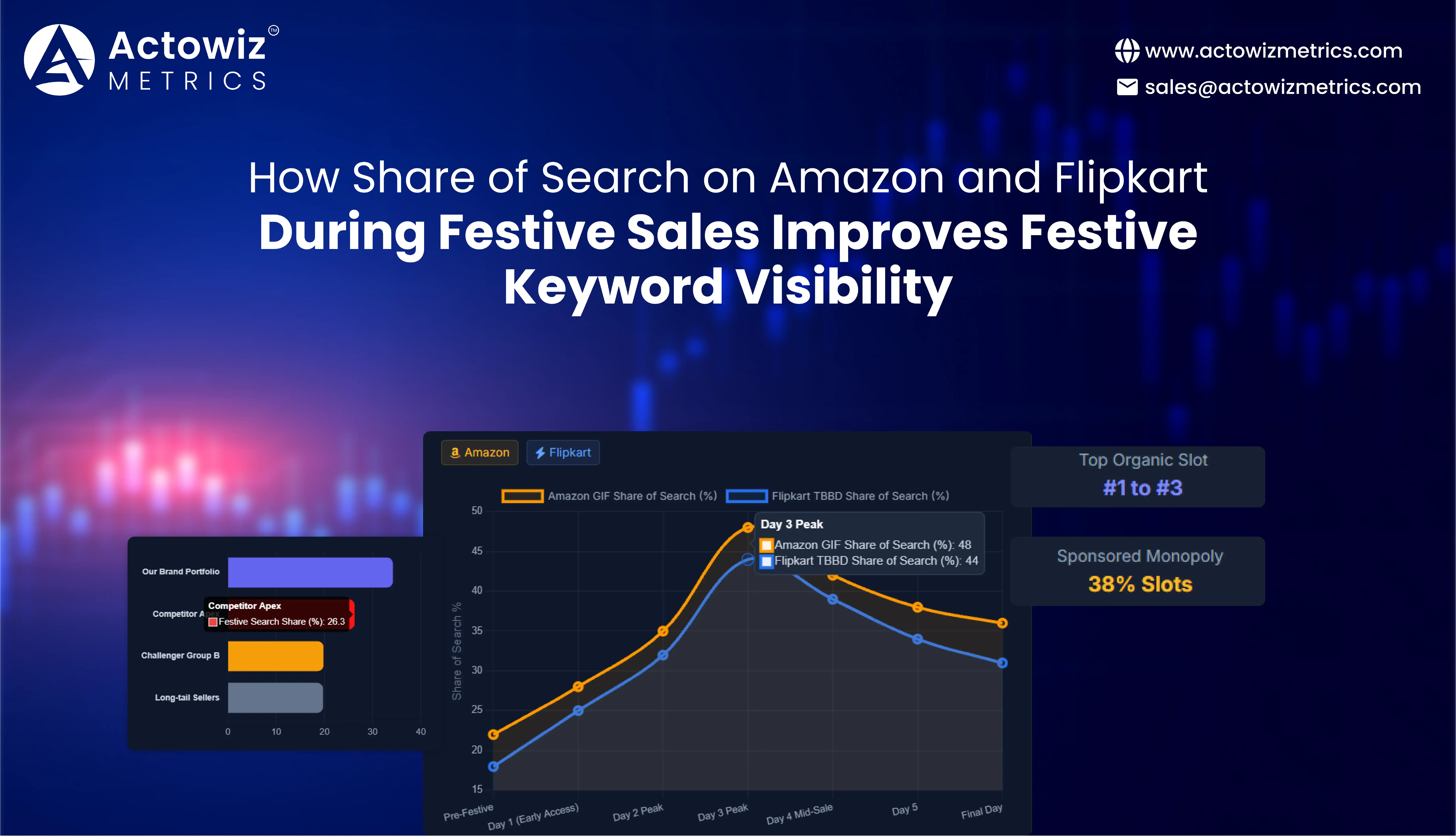
Amazon and Flipkart Share of Search Tracking helps brands understand their visibility for important category and product queries. Teams can monitor whether a product appears in relevant search results, its observed position, sponsored versus organic placement where identifiable, and how visibility changes over time. Festive Season Digital Shelf Readiness includes this search layer because a well-priced, well-stocked product can still miss demand if shoppers cannot discover it.
Build a keyword set around purchase intent. For electronics, include model names, specifications, and common comparison terms. For beauty, use brand, product type, skin or hair concern, and size. For fashion, include category, occasion, style, and relevant attributes. Track a consistent set of queries across dates and platforms; search results can vary by location, personalization, sponsored placement, and availability, so record the conditions of each observation.
| Year | Platform | Reported result | Implication for search and shelf monitoring |
|---|---|---|---|
| 2020 | Amazon India | Amazon reported orders from 99.3% of India's pin codes during the Great Indian Festival. | Consider regional differences in assortment and discoverability. |
| 2022 | Flipkart | More than one billion customer visits were reported during Big Billion Days. | Establish a baseline for priority search queries before peak traffic. |
| 2023 | Flipkart | Flipkart reported 1.4 billion customer visits during Big Billion Days. | Monitor product discovery and listing quality during the campaign, not only before it. |
| 2024 | Myntra | The Big Fashion Festival recorded 627 million visits, compared with about 460 million in 2023. | Fashion brands should monitor relevant searches, styles, and size variants. |
| 2025 | Meesho | Meesho reported a 75% increase in orders and 60% growth in transacting customers on the first day of its 2026 festive sale, according to Financial Express. | Strong marketplace activity reinforces the need to track product discovery and availability on value-led platforms. |
| 2026 | Flipkart | Flipkart reported 6.3 million concurrent users in a minute as its Big Billion Days event opened. | Prioritize high-intent queries and critical listings during the opening rush. |
The Meesho figure in the 2025 row refers to the opening day of its 2026 festive sale as reported in October 2026; it is shown under the reporting year to avoid misrepresenting the event period.
Share of search should be interpreted as a visibility measure, not as a direct substitute for market share or sales. Search ranking can be influenced by advertising, relevance, inventory, shopper context, and platform algorithms. To make the metric actionable, connect observed visibility with product availability, pricing, content quality, and the brand's campaign activity.
A practical weekly or daily report should show priority queries, products found, observed rank, sponsored placement when identifiable, competitor products appearing nearby, and listing issues. During the most intense sale periods, increase checks for hero products and high-value queries. Use the resulting evidence to decide whether to improve content, adjust campaign bids, correct attributes, or resolve a stock problem.
Quick Commerce Product Visibility and Stock Monitoring is increasingly relevant for brands selling groceries, snacks, beverages, beauty, personal care, gifting products, and household essentials. Shoppers use platforms such as Blinkit, Zepto, Swiggy Instamart, and Flipkart Minutes for urgent and last-minute purchases. In these categories, availability can differ by neighbourhood, dark store, time of day, and selected variant. A product that appears in one location may not be available in another.
Brands should record the product listing, displayed price, pack size, promotion, local availability, and delivery estimate where visible. Check whether the correct item appears under relevant category pages or search queries. For festive products, review the assortment before demand spikes: diyas, sweets, dry fruits, gifting packs, cleaning supplies, beauty products, and party essentials can have short selling windows.
| Period | Platform or market | Reported result | Practical implication |
|---|---|---|---|
| 2024 | Indian quick commerce | Datum Intelligence later estimated quick commerce accounted for 8% of festive online sales in 2024. | Use this as a historical market estimate, not a measure of any single platform. |
| 2025 | Indian quick commerce | Datum Intelligence estimated its festive online sales share rose to 12%, with estimated festive net order value of $1.6 billion. | Expand monitoring beyond traditional marketplaces for relevant products. |
| 2025 | Blinkit, Swiggy Instamart, and Zepto | A WPP Media and Meta report cited by Business Standard attributed approximately 45% of festive purchases to quick commerce; Blinkit, Instamart, and Zepto accounted for most of the segment in that report. | Treat quick commerce as a distinct channel, and check the report's definition before comparing its figure with GMV-based estimates. |
| 2026 | Flipkart Minutes | Flipkart announced availability of more than 77,000 products across 1,400-plus categories in 150-plus cities for its festive offering. | Include location-specific assortment and stock checks for relevant categories. |
| 2026 | Indian quick commerce | Unicommerce reported 51.1% year-over-year growth in quick-commerce orders at the onset of the festive season in its platform data. | Use channel-level growth as a reason to review readiness, while validating individual product availability directly. |
These reports use different methodologies and definitions. They should not be combined into one market-share series. For operational planning, the more useful question is whether a brand's products are discoverable and purchasable in the locations it serves.
Set location-based checks for priority products and record stock status over time. If a key item repeatedly disappears from search or becomes unavailable, review replenishment, assortment allocation, and campaign timing with the relevant platform or fulfilment team. Keep the monitoring process grounded in observed listings rather than assuming that a national campaign or platform-wide growth guarantees local availability.
Actowiz Metrics can help brands turn marketplace observations into a structured monitoring process across product content, pricing, availability, and search visibility. Digital Shelf Analytics is most valuable when teams can see not only whether a product page has a problem, but also which issue needs attention first and who should resolve it.
With Festive Season Digital Shelf Readiness, brands can establish a consistent view of product performance across Amazon India, Flipkart, Myntra, Meesho, and relevant quick-commerce platforms. A practical programme can support:
To get started, brands should define their highest-priority products, target marketplaces, competitor set, and business rules. They can then establish a baseline and measure data coverage, freshness, product-matching accuracy, issue resolution time, and changes in visibility or availability.
Actowiz Metrics can help teams organize these signals so marketplace managers, e-commerce leaders, and category teams can focus on commercially meaningful issues rather than manually checking every listing. The final business impact should be measured through outcomes such as listing completeness, product availability, search visibility, conversion, and margin performance—not assumed from monitoring alone.
A successful festive campaign requires more than a discount calendar. Brands need accurate product content, relevant search visibility, competitive offers, and reliable stock across the marketplaces their customers use. Amazon India, Flipkart, Myntra, Meesho, Blinkit, Zepto, Swiggy Instamart, and Flipkart Minutes serve different shopping occasions, so each channel needs a suitable readiness checklist and monitoring approach.
A structured Share of Search programme helps teams understand whether shoppers can discover priority products, while ongoing Festive Season Digital Shelf Readiness checks reveal content gaps, pricing issues, and availability problems that could prevent a purchase. Use real marketplace figures to plan resources, but rely on verified product-level observations to make individual pricing, merchandising, and inventory decisions.
Ready to prepare your marketplace listings for the next festive sales peak? Contact Actowiz Metrics to discuss a digital shelf monitoring strategy tailored to your products, competitors, and target marketplaces!
Expert blogs, research reports and infographics — practical, data-driven reading across e-commerce and quick-commerce.
Most fields are optional — the more you share, the better your sample.
.webp "infographics")
.webp "infographics")