BLOG


Nykaa, Purplle, Tira, and Amazon compete for Indian beauty shoppers through different combinations of product selection, brand access, promotions, digital discovery, and fulfilment. India Online Beauty Marketplace Comparison helps beauty brands and retailers understand these differences, while Beauty & Personal Care E-commerce Analytics turns product-level observations into actionable pricing, assortment, and competitive insights. The central business question is not simply which marketplace offers the lowest price; it is which channel provides the strongest combination of price competitiveness, relevant assortment, product visibility, and reliable availability for a particular brand or category.
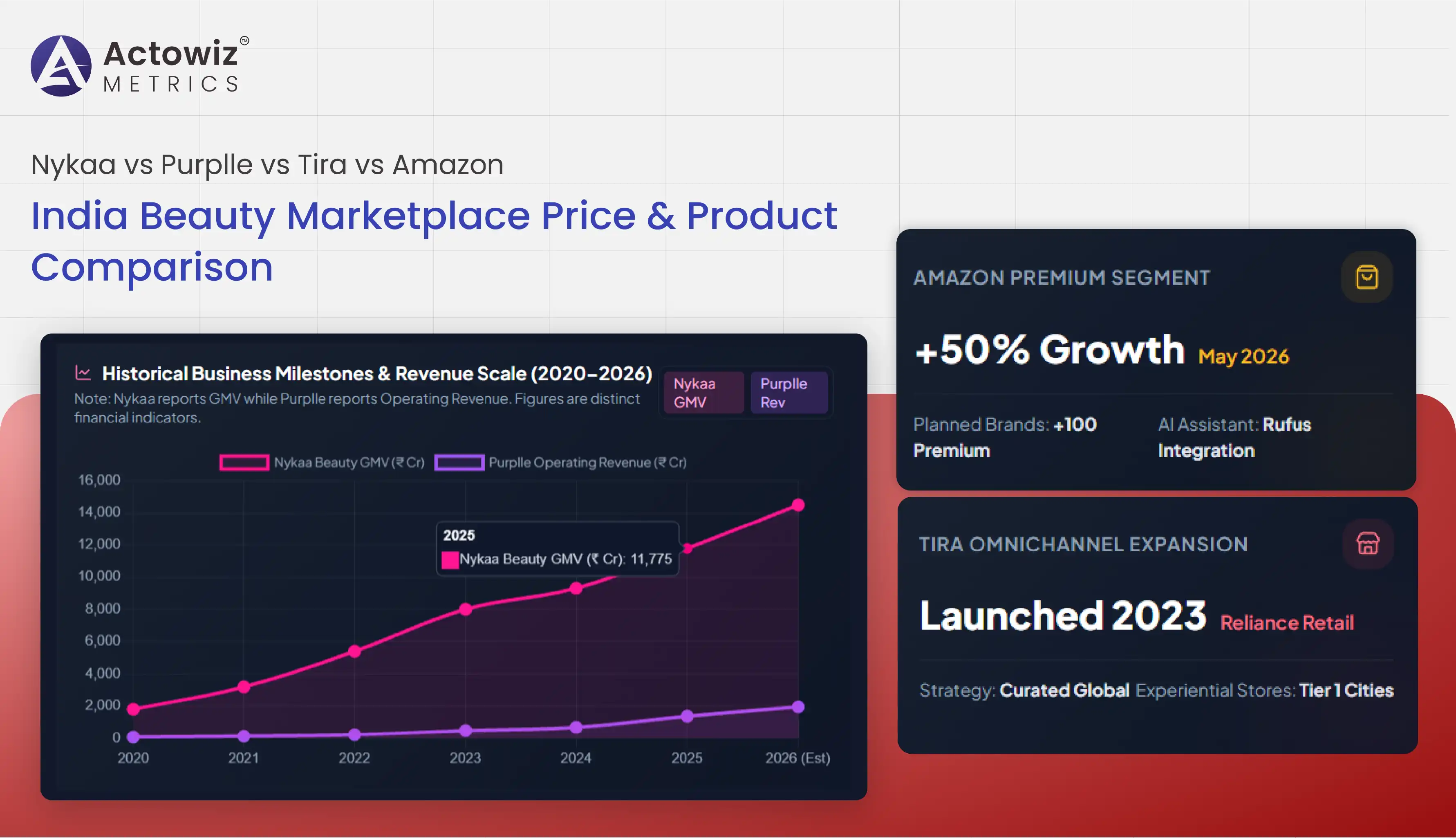
Nykaa reported beauty gross merchandise value (GMV) of ₹11,775 crore in FY2025, while Purplle reported operating revenue of approximately ₹1,367 crore in the same fiscal year. These are different financial measures and must not be treated as directly comparable marketplace sales figures. Tira is Reliance Retail's omnichannel beauty platform, launched in April 2023, while Amazon offers beauty products within its wider e-commerce marketplace.
This report evaluates six dimensions of competition: pricing, discounts, assortment, search visibility, availability, and market trends. It uses published company disclosures and credible industry sources for historical context. Because consistent, independently verified product-level data for all four marketplaces is not publicly available for every year from 2020 to 2026, the report distinguishes reported facts from proposed benchmarking methods rather than inventing historical prices, discounts, rankings, or stock figures.
The available evidence shows a growing digital beauty market, expanding brand portfolios, and increasing investment in premium products and omnichannel shopping. The figures below are reported market estimates or company disclosures, not a unified price or market-share index.
| Year | Verified indicator | Source and interpretation |
|---|---|---|
| 2020 | Nykaa's FY2020 reporting provides a historical company baseline. | Nykaa investor relations |
| 2021 | Purplle reported operating revenue of ₹128 crore for FY2021 in later financial reporting. | Startup Story Media |
| 2022 | Nykaa's annual reports document its beauty and personal care business before Tira's launch. | Nykaa investor relations |
| 2023 | Reliance Retail launched Tira on April 5, 2023, as an omnichannel beauty platform. | Reliance Industries |
| 2024 | Purplle reported ₹679.6 crore operating revenue in FY2024, up from ₹475 crore in FY2023. | The Economic Times |
| 2025 | Nykaa reported beauty GMV of ₹11,775 crore and more than 4,200 beauty and personal care brands as of March 31, 2025. | Nykaa FY2025 Annual Report |
| 2026 | Amazon announced plans to add more than 100 premium beauty brands during 2026 and reported 50% year-on-year growth in its premium beauty segment. | Amazon India, May 2026 |
These milestones demonstrate business development, but they do not establish which platform is cheapest or has the highest conversion rate. That requires standardized, timestamped observations of comparable products and offers.
Nykaa vs Purplle vs Tira vs Amazon Beauty Price Comparison should focus on identical products rather than broad category averages. A cleanser, serum, lipstick, or sunscreen can appear at different prices because of pack size, shade, formulation, seller, promotional eligibility, or delivery conditions. A valid comparison therefore matches the exact brand, product name, variant, quantity, and seller where applicable before calculating a price difference.
For each matched product, the dataset should preserve the displayed list price, current selling price, applicable coupon, payment-related offer, and observation timestamp. The final checkout price should be recorded separately because delivery fees, minimum-order requirements, and conditional offers can change what a shopper actually pays. A displayed maximum retail price should not be mistaken for a verified historical selling price.
Nykaa's FY2025 report recorded beauty GMV of ₹11,775 crore, while Purplle's FY2025 operating revenue was ₹1,367.3 crore. These figures indicate different aspects of their businesses, but they cannot establish price competitiveness. Similarly, Amazon's broad marketplace model and Tira's omnichannel model make it important to distinguish comparable products from differences in fulfilment or service.
| Price metric | How brands should measure it |
|---|---|
| Displayed selling price | Current price shown for the exact product and variant |
| Price difference | Difference between matched listings observed at comparable times |
| Price after coupon | Price after a valid, documented coupon is applied |
| Checkout price | Final payable amount when delivery and payment conditions are verified |
| Historical price movement | Change between actual timestamped observations |
A consistent comparison can help brands identify pricing gaps and investigate whether a product is positioned differently across channels. It should not declare a permanent price winner from a single observation or assume that the lowest displayed price produces the best commercial outcome.
Nykaa, Purplle, Tira & Amazon Beauty Discount Benchmarking requires a clear distinction between product markdowns and additional benefits. A displayed discount may apply to the listed price, while a coupon or bank offer may depend on a minimum spend, payment method, membership, or campaign-specific conditions. Combining these into one discount percentage without documenting the rules can create misleading comparisons.
A useful benchmark captures the displayed list price, selling price, promotion type, eligibility conditions, start and end dates where published, and final price where verifiable. The analysis should also record whether an offer applies to all shoppers or only to eligible accounts. When the checkout price cannot be verified, the result should be labelled as a displayed-price comparison.
Promotional timing matters as well. A beauty product observed during a seasonal sale should not be compared uncritically with its price on an ordinary shopping day. Brands can improve reliability by monitoring the same products at consistent intervals and maintaining separate views for regular trading periods and promotional events.
The Competition Commission of India has examined issues including deep discounts, marketplace transparency, and search ranking in its e-commerce market study. This provides useful regulatory context, but it does not establish which of these four platforms offers the largest average discount.
| Benchmark | What it tells the analyst |
|---|---|
| Product markdown | Difference between the listed and displayed selling prices |
| Coupon offer | Additional saving subject to a valid coupon |
| Payment-linked offer | Saving restricted to eligible payment methods |
| Campaign discount | Offer associated with a defined event or promotional period |
| Effective checkout price | Final price after verified eligible savings and applicable fees |
The practical benefit is greater pricing transparency. Brands can identify recurring promotional patterns, evaluate their own price positioning, and distinguish genuine competitive pressure from temporary campaign effects without relying on unsupported discount averages.
Nykaa, Purplle, Tira & Amazon Beauty Assortment Comparison should measure both assortment breadth and depth. Breadth refers to coverage across skincare, makeup, haircare, fragrances, body care, and other personal care categories. Depth refers to the range of brands, formulations, shades, sizes, and product variants within each category. These measures help brands understand the role each channel could play in their distribution strategy.
Nykaa's FY2025 annual report states that its beauty business offered more than 4,200 brands as of March 31, 2025. Purplle operates a marketplace alongside owned brands, including Good Vibes, Faces Canada, Alps Goodness, Carmesi, NY Bae, and DermDoc, according to company reporting and coverage of its financial results.
Tira's official company information describes a curated portfolio of global and homegrown beauty brands. Its omnichannel approach combines digital shopping with physical retail experiences. Amazon, meanwhile, announced in May 2026 that more than 100 additional premium beauty brands were planned for launch on its Indian platform during the year.
These disclosures illustrate different assortment strategies, but the reported numbers are not directly comparable. Nykaa's brand count cannot be compared with Amazon's planned additions, and Purplle's owned-brand portfolio is not the same measure as total third-party assortment.
| Assortment metric | Recommended approach |
|---|---|
| Unique brands | Count distinct brands in the defined category and observation period |
| Unique products | Deduplicate product listings and variants |
| Variant coverage | Record shades, sizes, formulations, and pack quantities |
| Category coverage | Compare the same beauty categories on all platforms |
| New brand launches | Record verified additions with dates and source evidence |
For brands, the key question is not simply which marketplace lists the most products. It is whether the right products and variants are available to the intended audience, at the relevant price points, with sufficient visibility and reliable fulfilment.
Nykaa, Purplle, Tira & Amazon Beauty Search Visibility Analysis evaluates how easily shoppers can discover a brand through search results, category pages, filters, recommendations, and sponsored placements. A product may be listed on a platform but remain difficult to find for relevant queries. Brands therefore need to monitor discoverability separately from assortment.
A repeatable study should define a set of category and product-related search terms, then record product positions at consistent intervals. Queries could cover skincare concerns, ingredient names, makeup shades, haircare needs, and brand names. The dataset should identify whether a result is sponsored, organic, or featured in another clearly labelled placement. Search results can change according to location, account status, personalisation, and platform algorithms, so these conditions should be documented wherever observable.
Amazon announced in 2026 that its beauty shopping experience would include AI-supported discovery tools, including its Rufus shopping assistant and visual discovery features. This is a documented example of technology being used to support product discovery; it does not prove that Amazon has higher search visibility or conversion than its competitors.
| Visibility metric | Why it matters |
|---|---|
| Search-result position | Records where a product appears for a specific query |
| First-page presence | Shows whether a product appears within a defined initial result set |
| Query coverage | Measures how many relevant queries return the product |
| Sponsored placement | Separates paid placements from organic results |
| Category-page presence | Tracks discoverability through category navigation and filters |
The Competition Commission of India has identified search ranking and transparency as important issues in e-commerce. Brands should therefore keep visibility reporting factual and avoid assuming that a high ranking guarantees sales.
Repeated observations can reveal whether product discoverability is stable or changing. They can also help teams prioritise product content improvements, keyword relevance, and sponsored placement reviews. A single snapshot, however, cannot establish long-term visibility or sales impact.
Nykaa, Purplle, Tira & Amazon Beauty Product Availability Comparison should distinguish a product's presence in the catalogue from its actual purchase availability. A product page may remain online even when a specific shade, size, or pack is unavailable. For beauty products, this matters for foundation shades, lipstick colours, skincare sizes, fragrance formats, and product bundles.
A monitoring system should record product-page status, variant-level availability, delivery eligibility where visible, and the timestamp of each observation. Location-specific checks should be kept separate because delivery coverage and inventory may vary by service area. The system should also distinguish an explicit out-of-stock message from an inaccessible page, a temporary technical error, or a listing that no longer appears in search. These states should not be combined into a single stockout measure.
Nykaa's annual report documents its online business and a physical network of 237 beauty stores across 79 cities as of March 31, 2025. Tira likewise describes an omnichannel model that combines online shopping with stores. These disclosures establish the presence of multiple shopping channels, but they do not reveal real-time product inventory across the four marketplaces.
| Availability indicator | Required evidence |
|---|---|
| Product-page status | Accessible, explicitly unavailable, or inconclusive |
| Variant availability | Status for each observed shade, size, or format |
| Delivery eligibility | Platform indication for a defined delivery location |
| Observation timestamp | Date and time of the recorded status |
| Reappearance rate | Frequency of return to availability based on repeated observations |
Repeated, timestamped observations can help identify persistent gaps, compare variant coverage, and investigate potential lost-sales opportunities. However, an unavailable listing is not proof of a lost sale, and public product pages do not necessarily reveal a platform's complete inventory. Brands should report observed availability rather than claim access to total stock levels.
Nykaa, Purplle, Tira & Amazon Beauty Marketplace Trends point towards expanding premium assortments, technology-assisted discovery, omnichannel retail, and greater competition for customer attention. These trends create opportunities for brands, but their commercial significance should be assessed using published data and actual marketplace observations rather than assumptions about consumer demand.
Nykaa's FY2025 annual report recorded beauty GMV of ₹11,775 crore, a 30% year-on-year increase, and more than 4,200 beauty and personal care brands. Purplle's FY2025 operating revenue rose to approximately ₹1,367 crore from ₹679.6 crore in FY2024. These results indicate substantial business growth, but GMV and operating revenue are different financial measures and should not be used to rank the companies directly.
In May 2026, Amazon reported 50% year-on-year growth in its premium beauty segment and announced plans to introduce more than 100 premium brands on Amazon.in during the year. The company also reported nearly doubling year-on-year demand for Korean beauty and French pharmacy products on its platform. These are Amazon-reported results, not independent estimates of the entire Indian beauty market.
Tira's official website highlights its omnichannel approach and its expansion across major Indian cities. This illustrates a strategy that combines digital discovery with in-person shopping and personalised experiences.
| Year | Verified development | Relevance to marketplace analysis |
|---|---|---|
| 2020 | Nykaa's published annual reporting provides a pre-expansion baseline for its beauty business. | Establishes a historical company reference point |
| 2021 | Purplle reported ₹128 crore in operating revenue for FY2021 in later financial coverage. | Provides a historical financial benchmark |
| 2022 | Nykaa's investor relations archive documents continued development of its beauty business. | Supports historical trend research |
| 2023 | Tira launched its online platform and first flagship store in April. | Marks the entry of a new omnichannel competitor |
| 2024 | Purplle's operating revenue reached ₹679.6 crore in FY2024. | Demonstrates reported business growth |
| 2025 | Nykaa reported ₹11,775 crore in beauty GMV and more than 4,200 beauty brands. | Provides a recent beauty business and assortment benchmark |
| 2026 | Amazon announced premium assortment expansion and reported growth in premium beauty. | Highlights current platform investment and category trends |
Sources: Nykaa investor relations, Purplle FY2024 reporting, Tira launch announcement, and Amazon India 2026 beauty announcement.
For brands, the actionable priority is to monitor category-level price movements, promotional conditions, new product launches, search visibility, and variant availability. These observations can help teams decide where to investigate pricing pressure, improve product content, or expand assortment. Market forecasts and company announcements should provide context, while verified product-level data should support operational decisions.
Nykaa Price, Content & Review Tracking can support a structured approach to examining displayed prices, product descriptions, ratings, review counts, and listing changes where those fields are available through permitted data-access methods. For beauty brands, monitoring these elements together helps explain how price positioning, product information, and customer feedback appear alongside one another.
For India Online Beauty Marketplace Comparison, Actowiz Metrics can help define consistent benchmarking rules across Nykaa, Purplle, Tira, and Amazon. A practical programme can include product matching, timestamped price observations, discount validation, assortment monitoring, search-position tracking, and variant-level availability checks.
The resulting reports should distinguish observed facts from interpretation. For example, a change in review count is measurable, but it does not by itself establish customer satisfaction. Likewise, a low displayed price is not necessarily the lowest final checkout price, and a product's absence from one search result does not prove that it is unavailable.
Actowiz Metrics can help businesses establish repeatable monitoring and reporting frameworks around these questions. Data collection should use authorised access methods and comply with applicable platform terms, privacy requirements, and legal obligations. Any claims about improvements in sales, conversion, or profitability should be supported by actual business results.
Nykaa, Purplle, Tira, and Amazon compete through different combinations of beauty assortment, pricing, promotions, product discovery, and fulfilment. Public company disclosures show business growth, assortment expansion, and continued investment in digital and omnichannel experiences. However, these disclosures do not establish which platform consistently offers the lowest prices, the highest discounts, or the strongest product availability across every beauty category.
Nykaa Beauty Product Data Analysis provides a useful framework for examining product-level price differences, changes in descriptions and reviews, promotional activity, and availability. Applied consistently across the four marketplaces, this approach can help brands identify competitive gaps, improve product positioning, and prioritise further research.
The most reliable strategy combines credible market evidence with verified, timestamped observations. Brands should compare identical products, document promotional conditions, distinguish catalogue presence from purchase availability, and avoid treating company-reported figures as directly comparable when their definitions differ.
Ready to strengthen your beauty marketplace strategy? Connect with Actowiz Metrics to explore data-driven beauty price monitoring, competitor benchmarking, assortment analysis, and product intelligence solutions for India's online beauty market.
Expert blogs, research reports and infographics — practical, data-driven reading across e-commerce and quick-commerce.
Most fields are optional — the more you share, the better your sample.

.webp "infographics")
.webp "infographics")