BLOG



















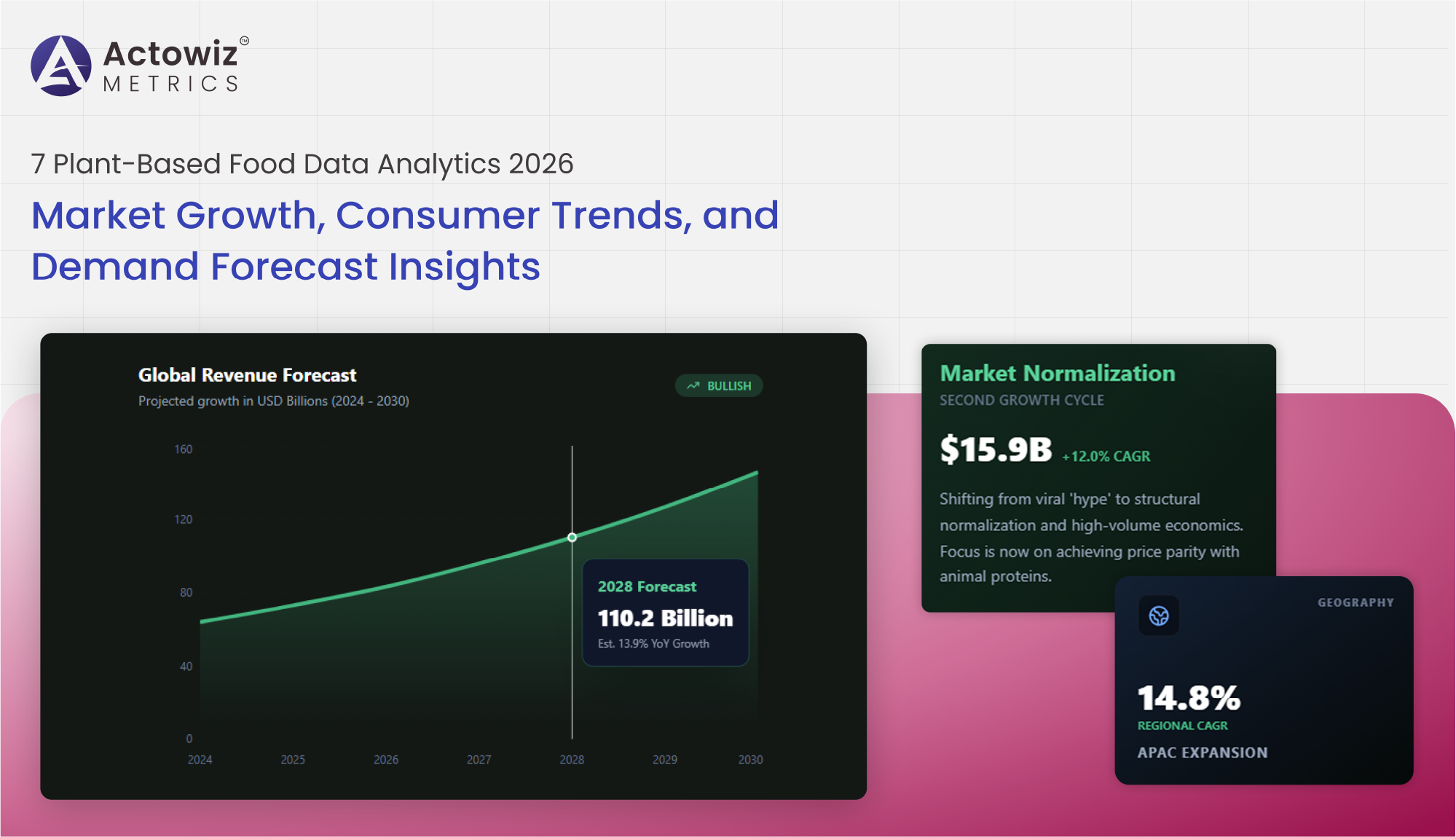
The global food industry is undergoing a structural transformation driven by sustainability concerns, health awareness, and evolving dietary preferences. Plant-based food has moved from a niche category to a mainstream consumption trend across multiple regions. This research report on 7 Plant-Based Food Data Analytics 2026 provides an in-depth analysis of how the market is evolving in terms of consumer demand, pricing strategies, product innovation, and competitive dynamics.
Over the last decade, the rise of flexitarian and vegan lifestyles has significantly accelerated demand for plant-based alternatives. Consumers are increasingly shifting toward healthier protein sources, dairy substitutes, and clean-label food products. At the same time, technological advancements in food processing and alternative protein development have enabled companies to create products that closely mimic animal-based food in taste, texture, and nutrition.
Using Brand Competition Analysis, this report evaluates how leading brands and emerging players are positioning themselves in the plant-based ecosystem. It also highlights how data-driven decision-making, powered by analytics, is transforming the way companies understand demand patterns, forecast market growth, and optimize product portfolios.
Between 2020 and 2026, the plant-based food industry has expanded rapidly across North America, Europe, and Asia-Pacific. Retail penetration has increased, online grocery channels have strengthened distribution, and foodservice adoption has grown significantly. This report explores these trends in detail and provides structured insights into the future of plant-based food analytics.
The plant-based food sector has witnessed remarkable expansion driven by health consciousness, environmental sustainability, and ethical consumption behavior. Through Extract 7 Plant-Based Food Trends 2026, businesses can identify emerging shifts in consumer preferences, while Product Data Tracking enables continuous monitoring of product-level performance across categories and geographies.
From 2020 to 2026, the global plant-based food market has grown at a double-digit rate, driven by increased awareness of climate change and the environmental impact of animal agriculture. Consumers are actively seeking alternatives that reduce carbon footprints while maintaining nutritional value.
| Year | Market Value (USD Billion) | Growth Rate |
|---|---|---|
| 2020 | 29 | 8% |
| 2021 | 34 | 9% |
| 2022 | 42 | 12% |
| 2023 | 50 | 13% |
| 2024 | 60 | 15% |
| 2025 | 72 | 16% |
| 2026 | 85 (Projected) | 18% |
Plant-based meat alternatives remain the fastest-growing category, followed by dairy substitutes and functional plant-based snacks. The increasing adoption of vegan and flexitarian diets has further strengthened market expansion globally.
Retailers and food manufacturers are investing heavily in expanding product availability, improving taste profiles, and reducing production costs. This is helping bridge the gap between plant-based and conventional food products, making them more accessible to mainstream consumers.
Innovation is one of the most critical drivers of growth in the plant-based food industry. Through 7 Plant-Based Food Product Trends Scraper, companies can monitor new product launches, ingredient innovations, and consumer acceptance patterns in real time.
Consumer preferences have shifted significantly between 2020 and 2026. Initially, plant-based foods were primarily consumed by vegans and vegetarians. However, today, a large portion of consumers identify as flexitarians, meaning they actively reduce meat consumption without eliminating it entirely.
| Category | 2020 Adoption | 2026 Adoption |
|---|---|---|
| Plant-Based Meat | 18% | 42% |
| Dairy Alternatives | 25% | 48% |
| Protein Snacks | 20% | 50% |
| Ready-to-Eat Meals | 15% | 45% |
Innovation in taste, texture, and nutritional content has played a major role in increasing adoption rates. Companies are also focusing on fortification with vitamins, minerals, and high-protein ingredients to enhance nutritional value.
Artificial intelligence and food science advancements are enabling faster product development cycles, allowing brands to respond quickly to changing consumer demands.
The plant-based food industry is highly competitive, with global food giants, emerging startups, and private-label brands all competing for market share. Using Food Plant-Based Market Trends Intelligence, businesses can evaluate competitive positioning, pricing strategies, and product diversification across regions.
Between 2020 and 2026, established food brands have expanded their plant-based portfolios, while startups have introduced innovative niche products targeting health-conscious consumers.
| Segment | Market Share |
|---|---|
| Global Brands | 45% |
| Emerging Startups | 30% |
| Private Labels | 25% |
Global brands dominate due to strong distribution networks and brand recognition, while startups are driving innovation in alternative protein technologies and clean-label formulations.
Retail partnerships, foodservice collaborations, and digital marketing strategies are key competitive factors influencing brand success in this sector.
Continuous tracking of consumer behavior is essential for understanding evolving demand patterns. With 7 Plant-Based Food Data Trends Monitoring, businesses can analyze real-time changes in product popularity, pricing sensitivity, and regional consumption differences.
Convenience-based plant foods, such as ready meals and protein snacks, are gaining strong traction due to busy urban lifestyles. Consumers are prioritizing convenience without compromising on nutrition.
| Category | Growth Rate |
|---|---|
| Ready Meals | 65% |
| Snacks | 58% |
| Beverages | 40% |
| Frozen Foods | 52% |
E-commerce platforms and online grocery delivery services have significantly boosted accessibility, allowing consumers to explore a wider range of plant-based products.
Social media influence and influencer marketing have also played a crucial role in shaping consumer perceptions and accelerating product adoption.
Accurate demand forecasting is essential for optimizing supply chains and pricing strategies in the plant-based food industry. Using Extract Plant-Based Product Demand and Pricing Data, businesses can analyze price elasticity, demand sensitivity, and promotional effectiveness.
Between 2020 and 2026, plant-based product pricing has become more competitive due to increased production efficiency and economies of scale.
| Product Type | Price Reduction | Demand Growth |
|---|---|---|
| Plant-Based Meat | -20% | +70% |
| Dairy Alternatives | -15% | +55% |
| Snacks | -10% | +60% |
As prices decline and product quality improves, adoption rates continue to rise among mainstream consumers.
Retailers are also using dynamic pricing strategies and promotional campaigns to attract price-sensitive customers while maintaining profitability.
Data analytics is revolutionizing the plant-based food industry by enabling better forecasting, improved supply chain management, and optimized product development. Through Food Analytics, companies can gain insights into consumer behavior, sales performance, and regional demand variations.
From 2020 to 2026, companies leveraging advanced analytics have achieved significantly higher success rates in product launches compared to those relying on traditional decision-making methods.
| KPI | Improvement |
|---|---|
| Forecast Accuracy | 35% |
| Product Success Rate | 32% |
| Inventory Efficiency | 28% |
| Revenue Optimization | 30% |
Predictive analytics helps companies reduce waste, improve inventory planning, and optimize pricing strategies based on real-time demand signals.
Actowiz Metrics delivers advanced data intelligence solutions tailored for the food and retail industry. Through Digital Shelf Analytics, we help businesses monitor product visibility, pricing trends, and competitor performance across digital platforms.
Our expertise in 7 Plant-Based Food Data Analytics 2026 enables organizations to gain actionable insights into market behavior, optimize product strategies, and enhance competitive positioning. We provide scalable, real-time data solutions that support decision-making across global food supply chains.
The plant-based food industry is experiencing rapid transformation driven by innovation, sustainability, and shifting consumer preferences. As highlighted in 7 Plant-Based Food Data Analytics 2026, the market is expected to continue strong growth, supported by increasing demand for healthier and environmentally friendly food options.
With tools like Price Benchmarking, businesses can better understand competitive positioning, optimize pricing strategies, and enhance product performance. Data-driven insights are now essential for staying competitive in a fast-evolving global food ecosystem.
Actowiz Metrics empowers businesses with cutting-edge analytics solutions to transform complex food industry data into actionable growth strategies. Connect with us today to unlock your competitive advantage and accelerate business success!
Expert blogs, research reports and infographics — practical, data-driven reading across e-commerce and quick-commerce.
Most fields are optional — the more you share, the better your sample.

.webp "infographics")
.webp "infographics")