BLOG
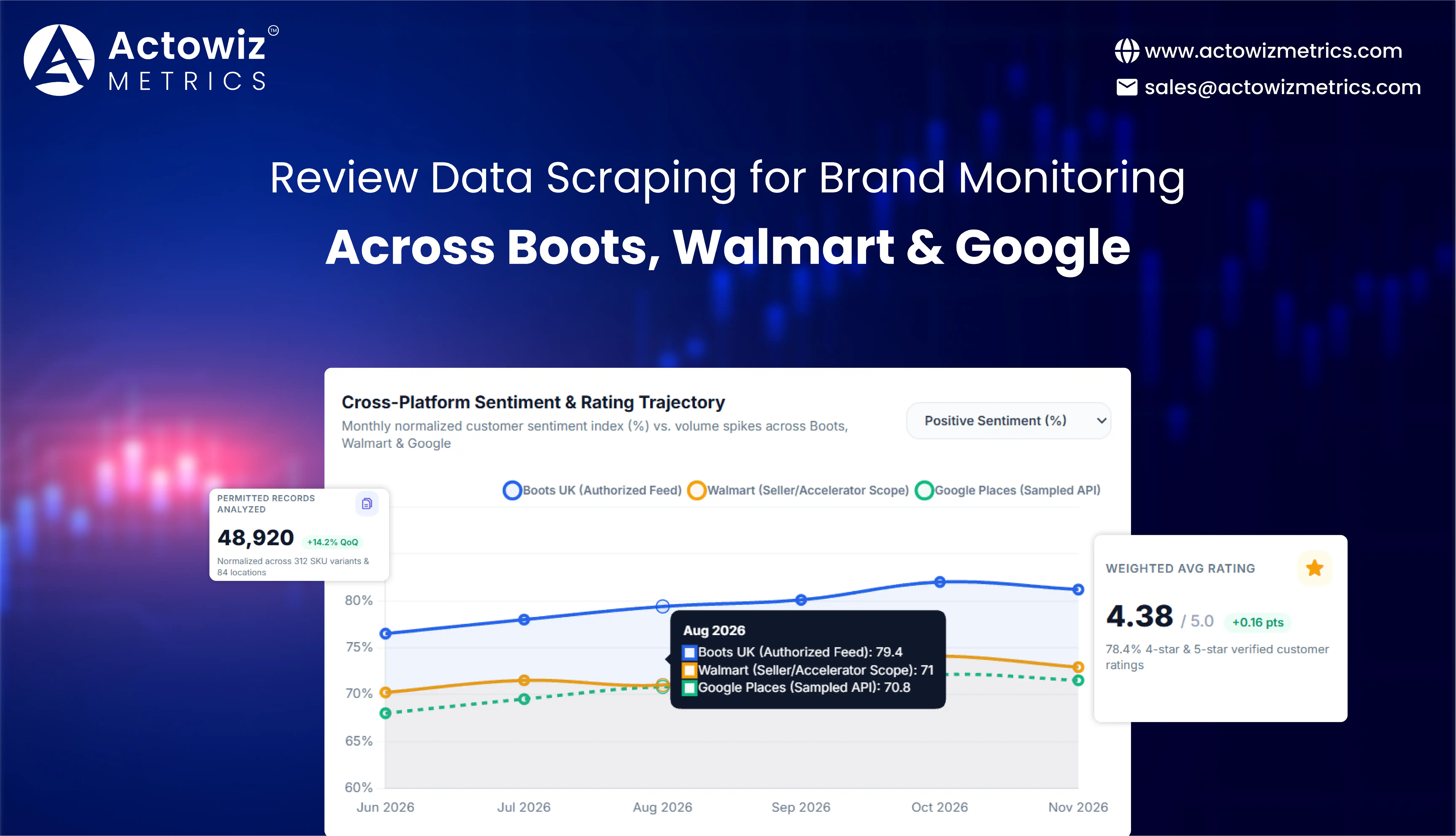


Brands can use review data scraping to organize publicly available customer feedback, identify recurring product complaints, compare customer sentiment, and monitor changes in brand perception across retail and search platforms. For businesses tracking Boots, Walmart, and Google, the key is to build a consistent review intelligence process while respecting each platform’s access rules.
Customer reviews influence how shoppers evaluate products, retailers, and service experiences. A product may receive positive feedback on a retailer’s website but attract complaints about availability, packaging, or customer service elsewhere. Monitoring only one channel can therefore leave important gaps in brand intelligence.
Ratings And Reviews Analysis helps marketing, e-commerce, and product teams understand what customers appreciate, what frustrates them, and how opinions change over time. A structured dataset can include product or business identifiers, rating values, review dates, review text where permitted, verified-purchase indicators, and source information.
The objective is not simply to collect more reviews. It is to transform permitted review information into useful insights that support product improvement, reputation management, competitive research, and customer experience decisions.
Boots Review and Rating Data Collection can help beauty, healthcare, personal-care, and wellness brands understand how customers respond to products sold through the Boots retail ecosystem. Reviews can reveal recurring themes involving product performance, fragrance, texture, packaging, delivery, value, and suitability for different customer needs.
A useful monitoring framework connects each review to the correct product identifier, product name, brand, category, rating, review date, and available review attributes. Product matching is particularly important when similar products have different sizes, formulations, shades, or packaging. Without reliable matching, feedback about one variant may be incorrectly attributed to another.
For brand teams, review data scraping should be treated as a controlled data acquisition process rather than unrestricted automated extraction. Before collecting Boots website content, businesses should review the retailer’s current terms, technical restrictions, and any approved access arrangements. Where automated collection is not permitted, authorized feeds, partner arrangements, or other approved sources should be used instead.
Once access is established, teams can classify feedback into themes such as product quality, skin feel, scent, packaging, value for money, and delivery experience. They can then compare recurring themes across products and time periods. This helps identify whether a complaint is isolated or appears repeatedly across a product range.
The most useful output is a traceable dataset that preserves source context and collection dates. It should distinguish customer statements from analytical labels generated by sentiment models. That distinction makes findings easier to audit and reduces the risk of presenting automated interpretation as a customer’s exact opinion.
Customer Feedback Analytics converts unstructured customer comments into measurable themes that business teams can investigate. Ratings provide a quick indication of satisfaction, but review text often explains the reasons behind a score. A three-star review, for example, may praise product performance while criticizing packaging or delivery. Treating the rating alone as the complete customer experience would miss that distinction.
A practical analytics workflow begins with data quality checks. Duplicate records, incomplete timestamps, inconsistent product names, and mismatched variants should be identified before analysis. Next, feedback can be categorized using a controlled taxonomy. Retail categories might include quality, price, packaging, product availability, ingredients, usability, delivery, and customer support.
Sentiment analysis can help classify comments as positive, negative, or mixed, but automated labels should be validated against a sample of original reviews. Sarcasm, spelling errors, short comments, and category-specific language can reduce model accuracy. Human review is especially useful when the result could influence a product recall investigation, regulatory response, or major brand decision.
A useful analytics dashboard should report more than an average rating. It can track rating distribution, review volume, changes in sentiment, frequently mentioned topics, and the share of feedback associated with each issue. Teams should also separate product feedback from retailer-service feedback. A complaint about late delivery does not necessarily indicate a defect in the product itself.
The business value comes from connecting these findings to action. Product teams can investigate recurring quality concerns, customer service teams can identify unresolved experience problems, and marketing teams can compare customer language with product positioning. Every insight should retain a link or reference to its permitted source record so that analysts can verify the original context.
Google Customer Review Analysis can help organizations understand how customers describe their experiences with stores, service locations, and local business operations. For multi-location retailers, feedback may reveal differences in staff experience, store cleanliness, queue management, service quality, or product availability between locations.
Google’s Places API provides place ratings and a reviews field, but the official documentation states that a Place Details response can return a maximum of five reviews. This is an important limitation for businesses planning large-scale review intelligence. The API should not be represented as a complete historical archive of every review for a business. See the Google Places API reference and Place Details documentation.
Brands must also distinguish between using an approved API and copying content from Google Maps. Google Maps Platform’s terms expressly prohibit scraping Google Maps content for use outside the services, including copying and saving business names, addresses, or user reviews. The applicable terms should be checked before any data collection or storage workflow is designed. See Google Maps Platform terms.
For brand monitoring, the right approach is to use permitted access methods and preserve the limits attached to each source. Where an approved integration provides only a limited set of reviews, the dashboard should state that the sample is limited rather than imply complete coverage. A business can still analyze permitted rating information, monitor approved review responses, and combine it with other independently authorized customer-feedback sources.
With review data scraping, the central operational question is not simply how many reviews can be collected. It is whether the collection method, storage, reuse, and reporting are allowed. A compliant monitoring design protects the reliability of the analysis and reduces the risk of building a business process around data that cannot lawfully or contractually be retained.
Walmart Product Review Data can help brands and sellers understand how shoppers respond to products across categories such as electronics, household goods, personal care, apparel, and groceries. Product reviews may identify recurring concerns about durability, fit, instructions, packaging, product performance, or the difference between customer expectations and actual use.
The first analytical challenge is product identification. A retailer listing may contain a product title, item identifier, seller information, variant details, and review content. These fields should be mapped carefully before comparing products across sellers or time periods. A matching process should account for model numbers, pack sizes, colors, and other attributes that distinguish similar listings.
Walmart provides a Reviews API for its Review Accelerator Program. Its official documentation describes API functions for identifying eligible items, searching by item name or SKU, and managing enrollment in the program. This is a seller-facing program designed to help eligible products generate authentic reviews; it is not documentation for unrestricted bulk extraction of all customer reviews. Access requires program eligibility and enrollment through Walmart Seller Center. See Walmart’s Reviews API overview.
For brand monitoring, this distinction matters. Teams should not assume that the existence of a Walmart API means every review field is available for unrestricted third-party collection. They should confirm the relevant account permissions, program conditions, API scope, and current Walmart policies before implementation.
Once access is authorized, product teams can monitor review themes and compare feedback across product variants. A rise in comments about missing parts, for example, should be investigated against product and fulfillment information before being classified as a manufacturing problem. Review intelligence is most useful when it guides a focused investigation instead of producing an unsupported conclusion.
Boots Product Ratings and Reviews can provide a useful perspective on customer experiences with products in categories such as skincare, cosmetics, haircare, fragrance, and personal care. For a brand selling through multiple retailers, this feedback can be compared with other authorized customer-feedback sources to identify recurring product strengths and weaknesses.
A reliable monitoring system should preserve the product variant and source context. A review about a particular shade, fragrance, formulation, or pack size should not automatically be treated as feedback about every item in the product family. Product catalogs should therefore be normalized using stable identifiers wherever possible, with manual review for uncertain matches.
Teams can monitor rating distributions rather than relying only on average scores. A stable average may conceal a growing number of very positive and very negative reviews. Similarly, a change in review volume may reflect a product launch, a retailer promotion, a change in review collection practices, or a genuine shift in customer engagement. Analysts should avoid assuming that a higher volume automatically indicates improved sales or satisfaction.
Using review data scraping as a brand-monitoring concept, businesses can design repeatable processes for collecting or receiving feedback through permitted channels, validating records, classifying themes, and reporting changes. The process should include source-specific rules for access, retention, attribution, and reuse.
A useful alert system can flag sudden changes in ratings, repeated mentions of a specific defect, or a new complaint category. Alerts should trigger investigation rather than automatically declare a product failure. Analysts should check sample size, product variant, review dates, and possible changes in the source before escalating an issue.
The outcome is a more dependable feedback loop between customer experience, product quality, and brand management. It allows teams to identify what customers are saying while keeping the limits of the underlying data visible.
Reviews Data at Scale for Retail Businesses and Brands requires more than collecting records from multiple websites. It requires a repeatable system for source authorization, product and location matching, data validation, analysis, and reporting. Without these controls, a large review dataset can become difficult to compare and may produce misleading conclusions.
A scalable architecture typically separates the workflow into five stages:
The following published consumer research provides context for why review monitoring matters. These figures describe consumer survey responses, not the number of reviews available on Boots, Walmart, or Google.
| Year | Verified consumer-review finding | Source |
|---|---|---|
| 2020 | 60% of consumers said they always or regularly read online reviews when browsing for local businesses. | BrightLocal 2022 survey |
| 2021 | 77% said they always or regularly read reviews; 81% used Google to evaluate local businesses. | BrightLocal 2022 survey |
| 2022 | 76% regularly read reviews; 87% used Google to evaluate local businesses. | BrightLocal 2023 survey |
| 2023 | 76% regularly read reviews, compared with 77% in 2021. | BrightLocal 2023 survey |
| 2024 | 75% always or regularly read reviews; 73% said they had written a review in the past year. | BrightLocal 2024 survey |
| 2025 | 40% said they use at least two review websites when researching a local business; 42% trusted reviews as much as personal recommendations. | BrightLocal 2025 survey |
| 2026 | 97% said they read reviews for local businesses; the average consumer used six review sites when choosing businesses. | BrightLocal 2026 survey |
How should businesses interpret these figures? The surveys indicate that online reviews remain an important part of consumer research, while the platforms and habits people use can change. The studies are not a continuous measure of review volume, and the survey questions and samples are not identical in every year. They should therefore be used as consumer-behavior context, not as a direct year-on-year measure of brand sentiment or retailer review activity.
Legal and platform requirements also changed during this period. In the United States, the Federal Trade Commission’s Consumer Reviews and Testimonials Rule took effect on October 21, 2024. It addresses practices including fake reviews, certain undisclosed insider testimonials, and review suppression. In the United Kingdom, the Digital Markets, Competition and Consumers Act 2024’s unfair commercial practices provisions came into force on April 6, 2025, with CMA guidance explaining businesses’ responsibilities concerning fake reviews. See the FTC rule in the Federal Register and CMA fake-review guidance.
For retail brands, the practical lesson is to make compliance part of the data design. A review-monitoring system should not encourage fake reviews, selectively hide negative feedback, or present manipulated ratings as genuine customer opinion. It should also distinguish original review text from summaries or sentiment labels generated by software.
Competitor Analysis helps brands understand how their products and customer experiences compare with competing offerings. When supported by authorized review data, it can reveal differences in customer priorities, recurring complaints, perceived product value, and satisfaction across retail channels.
Actowiz Metrics can support this process through structured data intelligence workflows designed around a brand’s approved sources and business objectives. The work can include source assessment, data-field planning, product and location matching, data cleaning, review categorization, sentiment analysis, and reporting. Each source should have its own documented access conditions so that data collection and reuse remain aligned with platform requirements.
With review data scraping, the objective is to make permitted customer feedback easier to analyze—not to bypass platform restrictions. For Boots and Walmart, this means confirming available access methods and permissions before building a collection workflow. For Google, it means following the applicable Maps Platform terms and using approved API functionality within its documented limits.
Actowiz Metrics can help businesses develop dashboards that track rating distributions, review trends, frequently mentioned topics, and changes in customer sentiment. Reports can separate product-related complaints from retailer or store-service issues, helping teams send findings to the right departments.
The resulting intelligence can support product improvement, brand positioning, customer experience planning, and competitive research. Businesses receive a more organized view of customer feedback while retaining source context and data-quality controls.
Review monitoring helps brands understand customer expectations across retail and local-search channels. By analyzing permitted feedback from sources such as Boots, Walmart, and Google, businesses can identify recurring product concerns, compare rating patterns, monitor reputation signals, and prioritize improvements.
The strongest approach combines accurate product matching, consistent data validation, transparent sentiment analysis, and source-specific compliance checks. It also recognizes that platform coverage differs: Google Places API, for example, documents a maximum of five reviews in a Place Details response, while Walmart’s documented Reviews API is associated with its Review Accelerator Program. These limitations should be reflected in reports rather than hidden behind claims of complete coverage.
For businesses looking to make customer feedback more actionable, review data scraping should be part of a governed review-intelligence strategy.
Partner with Actowiz Metrics to build structured, permission-based review intelligence workflows that help your team understand customer feedback, strengthen brand monitoring, and make better data-driven decisions!
Expert blogs, research reports and infographics — practical, data-driven reading across e-commerce and quick-commerce.
Most fields are optional — the more you share, the better your sample.
.webp "infographics")
.webp "infographics")