BLOG
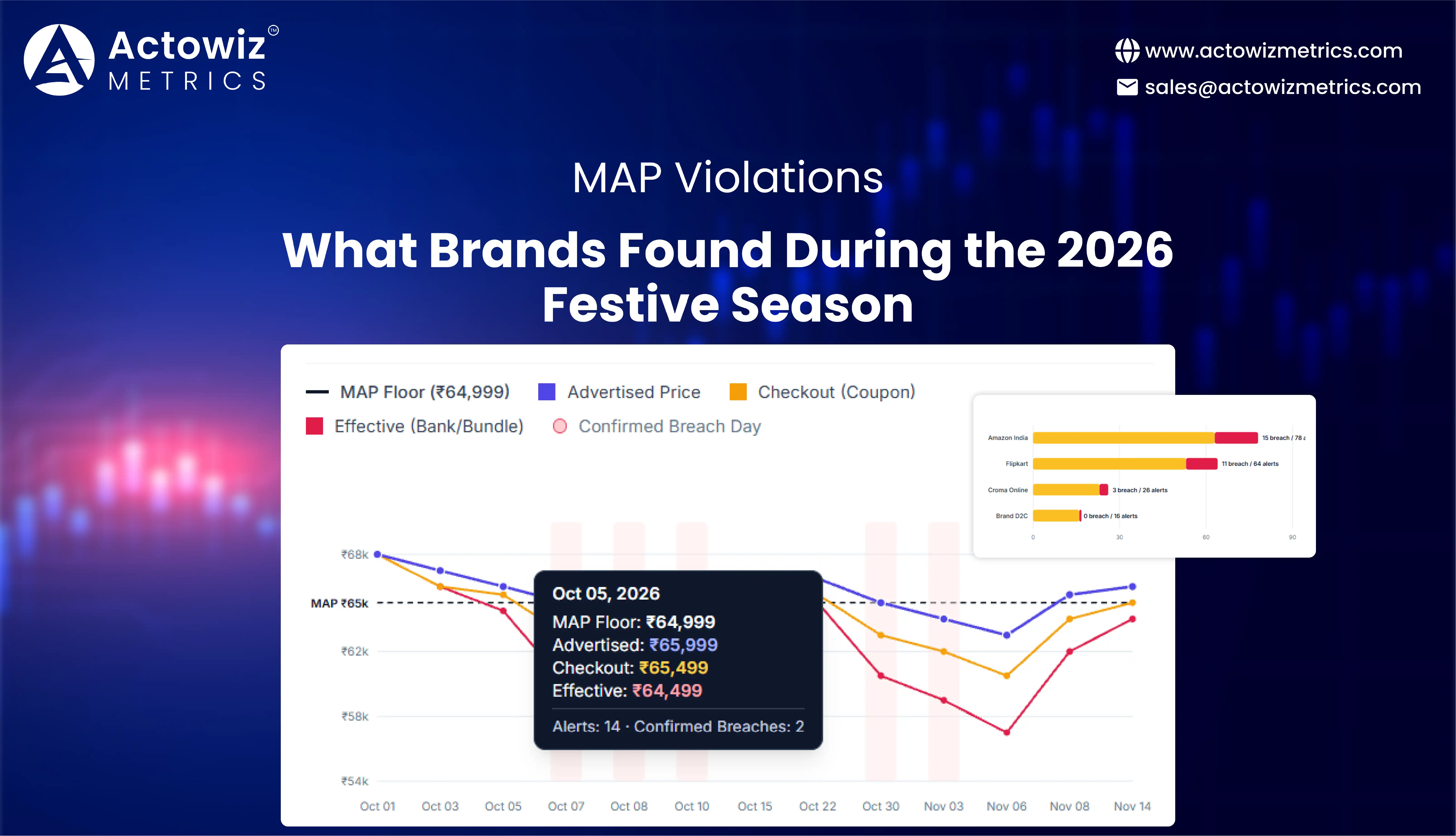


Brands monitoring festive-season pricing need to look beyond discounts. MAP violations can occur when advertised prices fall below a brand’s minimum advertised price policy, where such a policy is lawful and applicable. Effective MAP monitoring helps identify suspicious price changes, compare seller activity, and investigate whether promotions comply with agreed pricing rules.
During major shopping periods, including Diwali and other seasonal campaigns, brands may face a complex mix of marketplace promotions, seller-funded discounts, coupons, bundles, and retailer offers. A low displayed price does not automatically prove a violation: the brand must check the policy wording, product match, seller relationship, promotion conditions, and applicable law.
This article explains how brands can assess pricing activity during the 2026 festive season, what evidence they should collect, and how to build a reliable monitoring process without confusing a pricing signal with a confirmed violation.
Minimum advertised price compliance monitoring for ecommerce brands begins with a clearly documented policy. A minimum advertised price, or MAP, generally refers to the lowest price at which a reseller may advertise a product under a supplier’s policy. It is not automatically the same as a minimum resale price: a MAP policy may concern the advertised price, while resale price maintenance concerns the price at which a reseller actually sells.
That distinction matters during festive promotions. A product might appear at its regular advertised price while a coupon reduces the checkout amount. Alternatively, a marketplace may display a bank-funded offer, seller-funded discount, or platform-funded incentive. Whether any of these situations falls within a MAP policy depends on the policy’s exact wording and the applicable legal framework.
Brands should define which products, sellers, channels, territories, and advertising formats are covered. They should also specify how coupons, bundles, loyalty rewards, shipping charges, and limited-time promotions are treated. A policy that does not explain these conditions can generate false alerts and disputes with authorized sellers.
Legal review is essential before enforcement. The US Federal Trade Commission explains that unilateral manufacturer pricing policies are treated differently from agreements between manufacturers and retailers. In the European Union, the European Commission explicitly identifies minimum advertised prices as a possible indirect form of resale price maintenance under its vertical-restraints guidance. India’s Competition Commission also identifies resale price maintenance as a vertical restraint requiring competition-law assessment. FTC guidance · EU guidelines · CCI overview.
MAP compliance analytics for brands selling across marketplaces should combine price observations with seller, product, promotion, and timing information. A low advertised price alone is not enough to establish non-compliance. Analysts need to verify that the listing represents the correct product, that the seller is covered by the policy, and that the observed price is calculated according to the policy’s rules.
A strong monitoring dataset should include product identifiers such as GTIN, UPC, EAN, or manufacturer part number; marketplace and listing URLs; seller identity; displayed price; currency; timestamp; promotion details visible to the customer; and the applicable policy threshold. It should preserve the original observation so an analyst can review the evidence later.
Brands should also distinguish between advertised price, checkout price, and effective price after conditional incentives. These can differ significantly. A bank offer available only to eligible cardholders, for example, may not be equivalent to a seller-funded markdown. The policy must define which price types are relevant before an automated alert is triggered.
A useful dashboard can track the number of below-threshold observations, affected products, seller recurrence, duration, and changes by marketplace. It should also show unresolved cases separately from confirmed policy breaches. This prevents a temporary display error or an incorrectly matched product from being reported as a proven violation.
For seasonal campaigns, compare observations before, during, and after promotional events. That timeline helps teams distinguish short-lived promotional activity from repeated pricing patterns that require a closer review.
The 2026 festive period has highlighted the commercial pressure surrounding discounts, inventory, and promotional timing. MAP Violation Monitoring During Festive Season should therefore focus on evidence, not assumptions: market-wide discount activity can explain why brands need closer oversight, but it does not prove that a particular seller breached a pricing policy.
Indian online festive sales were estimated at ₹29,800–₹30,900 crore between October 7 and 10, 2026, down 7–10% from ₹33,200 crore during the comparable period in 2025, according to Datum Intelligence figures reported by Moneycontrol. The report linked weaker early performance partly to higher smartphone and laptop prices. Moneycontrol, October 13, 2026.
The Economic Times also reported that average discounts during the 2026 festive sales were 35–40% lower than the previous year, based on comments from brand founders and executives. Some companies were concentrating deeper discounts into shorter promotional windows because of rising input costs and margin pressure. ETtech, October 19, 2026.
These findings point to three monitoring priorities. First, brands need to distinguish authorized campaign discounts from seller-initiated price changes. Second, they should check whether the same product is advertised differently across marketplaces. Third, they should record when promotions begin and end, because a short-lived campaign and a persistent below-policy listing may require different investigations.
MAP violations should only be confirmed after the brand checks the applicable policy, seller coverage, product match, price calculation, and relevant legal requirements. Market reports about discounts are useful context, not evidence against an individual retailer.
Festive Season MAP Compliance Monitoring 2026 requires a campaign-specific process because promotional conditions can change throughout the shopping period. In India, Diwali falls on November 8, 2026, so the festive trading window is still underway as of October 30. Full-season results are not yet available and should not be presented as final.
Early market reporting shows why a single price snapshot is insufficient. The first four days of online festive sales were reported as weaker year on year, while other reporting highlighted strong opening activity on individual platforms. Amazon, for example, reported that customers ordered more than 100% more products year on year during the opening days of its 2026 Great Indian Festival. This is a company-reported platform result, not an independent measure of the entire Indian market. Amazon India.
Brands should monitor the following campaign variables:
The aim is to create a defensible record of what a customer could see at a particular time. A screenshot or archived page, where collection and retention are permitted, can help an analyst verify the observation. Teams should also retain the source URL and timestamp and record any limitations in the evidence.
MAP Monitoring Services for Seasonal E-commerce Compliance should help brands investigate pricing signals consistently rather than automatically penalize sellers. During a major promotion, a marketplace listing can change several times in a day. A monitoring system that captures only one observation may miss the campaign context or incorrectly classify a temporary display as a persistent issue.
The first step is to establish a baseline. Brands should record their applicable policy thresholds, covered products, authorized sellers, and planned promotions before the campaign begins. They can then compare observed prices against the correct policy version. If the threshold changes during a campaign, the system must retain the effective dates so historical observations are not judged against a later rule.
The next step is exception handling. A useful workflow separates potential alerts into categories such as product mismatch, seller not covered, conditional promotion, missing price context, and possible below-threshold advertising. Analysts can prioritize repeated observations, high-volume products, and listings that remain visible over multiple checks.
A documented investigation should include the original observation, the policy clause being assessed, the relevant promotion terms, and the analyst’s conclusion. Sellers should have an appropriate process to clarify pricing or promotion details before the brand reaches an enforcement decision. This improves consistency and reduces avoidable channel conflict.
Brands operating internationally must also review local competition rules. The EU’s 2022 Vertical Guidelines identify minimum advertised prices as an indirect means of resale price maintenance. The FTC describes a different federal approach in the United States, while noting that state laws may vary. Australia’s ACCC, by contrast, says suppliers must not impose minimum resale prices. A global brand should never assume one MAP enforcement model is lawful in every market. European Commission · FTC · ACCC.
Retail media intelligence can give brands a broader view of the relationship between advertised prices, promotional activity, and marketplace visibility. It should not be treated as proof of a pricing-policy breach. Instead, it helps teams understand the commercial context around an observed price and decide which cases deserve investigation.
For example, a brand may compare advertised prices with campaign dates, sponsored placements, product availability, seller identity, and promotion terms. If a product appears in a high-visibility campaign at a price below the brand’s stated threshold, the team can check whether the promotion is covered by an approved exception. If a listing is duplicated across sellers, product matching can help prevent unrelated offers from being grouped together.
The wider market data also shows why brands need to distinguish sales growth from price changes. Redseer’s report on India’s festive e-commerce market recorded first-leg gross merchandise value (GMV) of $3.1 billion in 2020, rising to $6.2 billion in 2024. These figures refer to the first leg of festive sale events, not the full festive season. Redseer’s 2024 report.
| Year | Published festive e-commerce measure | Interpretation |
|---|---|---|
| 2020 | $3.1 billion | First-leg online retail festive GMV |
| 2021 | $3.8 billion | First-leg online retail festive GMV |
| 2022 | $4.7 billion | First-leg online retail festive GMV |
| 2023 | $5.5 billion | First-leg online retail festive GMV |
| 2024 | $6.2 billion | First-leg online retail festive GMV |
| 2025 | ₹1.20 lakh crore | Full-season online festive sales reported by Datum Intelligence |
| 2026 | ₹1.50–1.55 lakh crore | Full-season forecast by Datum Intelligence; not a final result |
Sources: Redseer 2024 report and Datum Intelligence 2025 festive report, Datum Intelligence 2026 outlook.
The table combines different reporting periods and measures for 2025 and 2026; those two rows should not be directly compared with the first-leg GMV series. Datum’s 2026 figure is a forecast, not a verified final outcome. None of these GMV figures measures the number of pricing-policy breaches. They provide market context for the growing scale and intensity of festive retail.
For commercial teams, the actionable insight is to connect price observations with campaign context. This can help pricing, sales, and marketplace teams understand whether a change reflects a promotion, a seller decision, a platform-funded offer, or a data-quality issue.
Price & promotion intelligence helps brands understand how advertised prices and promotional offers change across marketplaces, sellers, and seasonal campaigns. Actowiz Metrics can support businesses by organizing authorized pricing observations into structured datasets that are easier to validate, compare, and investigate.
A monitoring workflow can be designed around each brand’s product catalog, seller network, marketplace coverage, and approved pricing policies. Depending on source permissions and availability, the process can include:
Actowiz Metrics can help brands organize MAP violations investigations through structured reporting, source traceability, and exception categorization. The final assessment should remain with the brand’s authorized commercial and legal teams, particularly where competition-law requirements differ across countries.
The objective is to provide a clearer view of marketplace pricing activity, reduce manual checking, and help decision-makers prioritize the issues that need attention.
The 2026 festive season demonstrates why brands need more context when reviewing marketplace prices. Early Indian market reports show changing discount strategies, pressure on product margins, and uneven performance across shopping periods. These conditions make it important to distinguish ordinary promotional activity from a genuine breach of an applicable policy.
Effective monitoring requires accurate product matching, seller identification, promotion-level context, timestamped evidence, and clear investigation rules. It also requires legal review: minimum advertised price arrangements can receive different treatment across jurisdictions, and a brand should not assume that a policy enforceable in one market is automatically valid in another.
Most importantly, MAP violations should be treated as findings that require verification, not conclusions generated from a single low-price observation. Brands that combine reliable pricing data with documented review procedures can make better-informed decisions about marketplace relationships and promotional strategy.
Partner with Actowiz Metrics to build structured price and promotion intelligence workflows, monitor marketplace activity, and turn seasonal pricing data into actionable business insights!
Expert blogs, research reports and infographics — practical, data-driven reading across e-commerce and quick-commerce.
Most fields are optional — the more you share, the better your sample.
.webp "infographics")
.webp "infographics")