BLOG
HALLOWEEN SPECIAL OFFER
Data Analytics & Intelligence Solutions
Turn Data into Smarter Business Decisions!
Offer Terms & Conditions Apply


















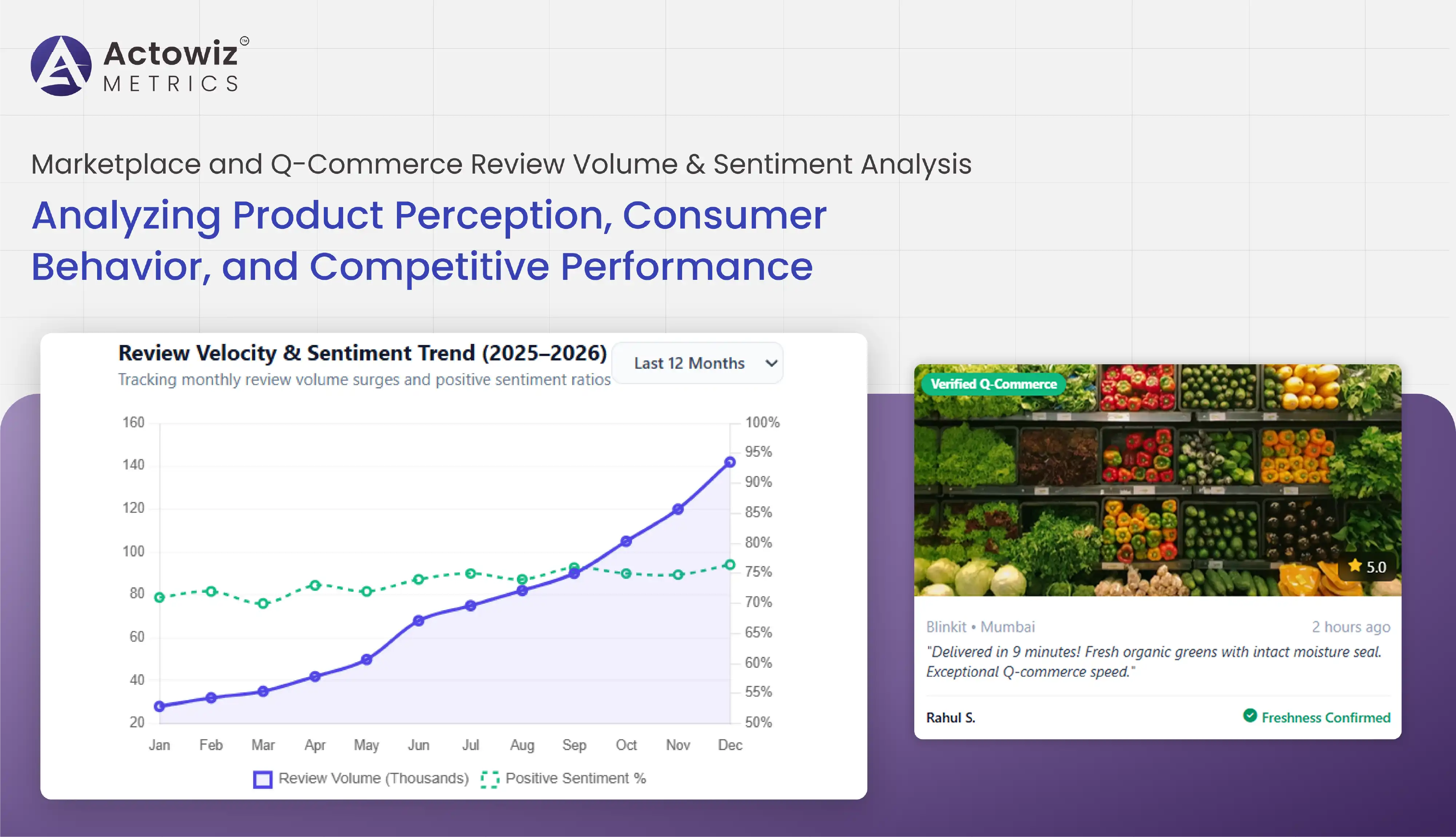
Customer reviews have become one of the most valuable sources of unstructured market intelligence across marketplaces and quick-commerce platforms. Product ratings, written reviews, review frequency, recurring complaints, positive experiences, and changes in sentiment can reveal how consumers perceive products beyond conventional sales metrics.
The Marketplace and Q-Commerce Review Volume & Sentiment Analysis framework helps brands and retailers understand what customers are saying, how frequently they are saying it, and whether consumer perception is improving or deteriorating. Review data can reveal issues involving product quality, packaging, freshness, delivery, value, availability, sizing, product authenticity, and service experience.
The importance of this information has increased alongside digital commerce. India's e-commerce market was valued at approximately $125 billion in 2024 and is projected to reach $345 billion by 2030, according to IBEF. The country's quick-commerce segment reached approximately $7–8 billion in FY25 and has been expanding at a very rapid rate.
Consumer reliance on reviews is also substantial. ConsumerAffairs' 2026 review research found that 77% of U.S. consumers consider online reviews important when making purchasing decisions, while about one-third will not purchase without reading reviews first.
This makes Ratings and Reviews Analysis an increasingly important component of digital commerce intelligence. Review volume can indicate product popularity or customer engagement, while sentiment and rating trends can reveal changes in perceived product quality and customer satisfaction.
The growth of marketplaces has created an enormous volume of customer-generated content. During 2020 and 2021, the pandemic accelerated online purchasing and increased the importance of digital product information. Consumers who could not easily visit physical stores increasingly relied on product descriptions, ratings, images, and reviews before purchasing.
By 2022, marketplaces had become important discovery and purchasing destinations across categories ranging from electronics and fashion to beauty, grocery, and household products. Between 2023 and 2024, the expansion of quick commerce added another layer of consumer feedback, particularly around freshness, delivery speed, packaging, availability, and product quality.
By 2025–2026, review datasets had become increasingly useful for competitive analysis because brands can compare not only average ratings but also review velocity, recurring topics, sentiment distribution, and competitor performance.
Marketplace review data scraping can help organizations collect publicly accessible review information, subject to applicable laws, platform terms, and technical restrictions. Relevant fields can include review text, rating, review date, product identifier, verified-purchase indicators where available, reviewer metadata exposed by the platform, and response information.
| Year | India E-Commerce Market |
|---|---|
| 2021 | $67B |
| 2022 | $84B |
| 2023 | $102B |
| 2024 | $125B |
| 2025F | $145B |
| 2026F | $163B |
| 2030F | $345B |
Source: IBEF.
A structured review dataset allows businesses to calculate review volume by SKU, category, marketplace, brand, city, and time period. It also enables companies to identify products with unusually rapid review growth.
Review velocity is especially useful because two products with identical four-star ratings can have very different levels of consumer engagement. One may have accumulated thousands of reviews over several years, while another may have reached the same rating after only a few weeks.
Quick commerce introduces a unique review environment because customers evaluate not only products but also the speed and quality of fulfilment. A grocery product can receive a positive review because it arrived fresh and quickly, while another customer may report damaged packaging, missing items, incorrect substitutions, or poor freshness.
India's quick-commerce market has expanded dramatically. Redseer reported that the segment surpassed $10 billion in GMV and 30 million monthly users in 2025, with metro markets contributing more than 80% of GMV. Redseer's 2024 analysis reported that monthly ordering frequency reached nearly six orders per user in FY24, compared with 4.4 in FY21.
Q-commerce review monitoring is therefore becoming increasingly important for FMCG brands, grocery companies, retailers, and quick-commerce operators.
| Period | Key Development |
|---|---|
| 2020 | Pandemic accelerates online grocery adoption |
| 2021 | Early habit formation |
| 2022 | Dark-store networks expand |
| 2023 | Q-commerce GMV grows 77% YoY |
| 2024 | Monthly ordering reaches ~6 per user |
| 2025 | $10B+ GMV and 30M+ monthly users |
| 2026 | Expansion and profitability become major priorities |
Redseer reported that Q-commerce GMV grew 77% in 2023 and projected approximately $6 billion GMV for FY25.
Review monitoring in this environment can capture product-level problems that conventional sales reports may not explain. If a SKU experiences a sudden increase in negative reviews, the underlying cause may be a packaging change, batch issue, damaged delivery, substitution problem, or change in product quality.
For platforms, review trends can also help identify operational issues. A cluster of negative reviews associated with delivery or packaging can indicate a problem that requires intervention even when order volumes remain strong.
Customer feedback is valuable because it contains information that structured transactional datasets often miss. A sales dashboard can show that a product's sales declined, but customer comments may explain why.
During 2020–2022, many businesses treated reviews primarily as reputation-management content. By 2023, brands increasingly recognized reviews as a source of product and customer intelligence. During 2024–2025, natural-language processing and generative AI made it easier to classify thousands of reviews according to themes and sentiment.
E-commerce customer feedback analytics can transform unstructured comments into structured categories such as product quality, packaging, delivery, price, size, taste, performance, authenticity, customer support, and value for money.
| Data Signal | Potential Insight |
|---|---|
| Average rating | Overall perception |
| Review volume | Customer engagement |
| Review velocity | Emerging popularity or issue |
| Positive sentiment | Product strengths |
| Negative sentiment | Customer pain points |
| Topic frequency | Recurring issues |
| Rating distribution | Perception consistency |
| Sentiment change | Emerging trend |
For example, a product maintaining a four-star average may still experience a sudden increase in negative comments about packaging. The overall rating may not immediately change because older positive reviews continue to influence the average.
Topic-level analysis can detect this shift much earlier.
The scale of digital commerce makes automation essential. India's online retail market reached approximately $80 billion in FY26, growing 21% year over year, according to Redseer. As transaction volumes increase, the corresponding volume of customer feedback also becomes more difficult to process manually.
Automated classification can help businesses identify whether complaints are concentrated around specific SKUs, suppliers, cities, fulfilment centers, or product categories. These findings can then feed product-development, quality-control, merchandising, and customer-experience teams.
Product reviews provide a direct window into customer experience. For brands, they can reveal whether marketing claims match real-world expectations. For retailers, they can reveal which products consistently deliver positive experiences.
Q-commerce product review intelligence is especially valuable for frequently purchased categories. Grocery, beverages, personal care, household products, and packaged food can generate feedback related to freshness, packaging, quantity, taste, expiration dates, and value.
From 2020 through 2022, the rapid adoption of online grocery created new expectations around convenience and availability. During 2023–2024, customers became increasingly accustomed to ordering everyday products through quick-commerce applications. By 2025–2026, the channel was becoming a significant retail destination rather than simply an emergency top-up service.
| Category | Common Review Themes |
|---|---|
| Grocery | Freshness, quality, packaging |
| FMCG | Value, quantity, product performance |
| Beauty | Effectiveness, authenticity, skin feel |
| Electronics | Performance, durability, features |
| Fashion | Fit, quality, appearance |
| Household | Effectiveness, packaging, value |
The rapid growth of Q-commerce increases the importance of these signals. IBEF estimates that India's Q-commerce market reached $7–8 billion in FY25 and could reach $65–70 billion by 2030.
Review intelligence can also identify differences between customer expectations and product positioning. A premium product receiving repeated comments about poor value may require pricing or positioning adjustments. A budget product receiving consistent praise for quality can present an opportunity for broader distribution.
The most valuable insight often comes from recurring themes rather than individual reviews. One negative comment may be isolated. Hundreds of comments mentioning the same issue indicate a potentially systematic problem.
A single sentiment score provides only a snapshot. Businesses increasingly need to understand how sentiment changes over time and how their performance compares with competitors.
Review sentiment trends across marketplaces can show whether customer perception is strengthening, weakening, or remaining stable. Analysts can calculate positive, neutral, and negative review shares and compare them by month, quarter, product, marketplace, and category.
This becomes particularly important when product formulations, packaging, pricing, or fulfilment processes change.
| Metric | Business Purpose |
|---|---|
| Average rating | Overall customer perception |
| Positive-review share | Customer advocacy |
| Negative-review share | Pain-point identification |
| Rating change | Perception movement |
| Review velocity | Emerging customer engagement |
| Topic sentiment | Issue-specific perception |
| Competitor sentiment gap | Market positioning |
| Response rate | Reputation management |
The broader marketplace environment is expanding rapidly. IBEF's 2025 e-commerce data places India's market at $145 billion for 2025 and forecasts $163 billion for 2026.
This expansion increases the competitive value of customer feedback. A brand may have strong sales but weakening sentiment, suggesting a future risk. Conversely, a product with modest sales but rapidly improving reviews may represent an emerging opportunity.
Sentiment should also be analyzed alongside review volume. A product with 90% positive sentiment across 20 reviews is not directly comparable with a product showing 85% positive sentiment across 20,000 reviews.
Review velocity adds another dimension. A sudden surge in reviews can indicate a promotional campaign, product launch, viral discovery event, or marketplace visibility increase.
Competitive sentiment analysis can therefore provide early warning signals before traditional market-share data becomes available.
Review intelligence becomes most valuable when combined with pricing, assortment, availability, product attributes, and competitive performance. A negative review about product quality becomes more useful when analysts can determine whether competitors are experiencing the same problem.
The Marketplace intelligence, Marketplace and Q-Commerce Review Volume & Sentiment Analysis approach brings these signals together.
The scale of quick commerce illustrates the opportunity. Redseer reported that the sector grew approximately 150% year over year during the first five months of 2025, while leading platforms expanded to more than 100 cities. However, more than 90 non-metro cities outside the eight major metros contributed only slightly over 20% of Q-commerce GMV.
| Metric | Strategic Use |
|---|---|
| Review volume | Demand and engagement proxy |
| Review velocity | Product momentum |
| Rating | Perceived quality |
| Sentiment | Customer perception |
| Complaint frequency | Risk detection |
| Topic share | Issue prioritization |
| Competitor sentiment | Relative positioning |
| City-level sentiment | Geographic experience |
Combining review data with sales and pricing information can reveal deeper patterns.
For instance, a product may experience declining sentiment after a price increase. Another SKU may gain positive sentiment following a packaging improvement. A competitor may have lower prices but substantially higher negative sentiment around quality.
These insights can support assortment planning, product development, customer-experience programs, brand management, and competitive strategy.
For quick-commerce brands, review data can also reveal location-specific problems. A product may receive positive feedback in one city but negative comments in another due to differences in handling, storage, delivery, or availability.
The objective is to create a continuous feedback loop: collect reviews, classify sentiment, identify topics, compare competitors, detect changes, and convert those findings into business action.
Actowiz Metrics can help organizations transform large volumes of customer-generated content into structured, decision-ready intelligence. Rather than treating reviews as isolated comments, businesses can use historical datasets to identify patterns across products, marketplaces, categories, cities, and time periods.
Quick-commerce analytics can complement review intelligence by connecting customer feedback with product availability, pricing, promotions, assortment, and competitive movements.
For organizations studying the Marketplace and Q-Commerce Review Volume & Sentiment Analysis, Actowiz Metrics can support structured data collection, review normalization, historical monitoring, sentiment classification, topic analysis, and competitive benchmarking.
A comprehensive approach can help businesses identify products receiving unusually high review volumes, detect sudden changes in ratings, uncover recurring complaints, and compare customer sentiment with competing products.
The value extends beyond reputation management. Review data can support product-quality investigations, merchandising decisions, pricing strategy, assortment optimization, campaign measurement, and customer-experience improvement.
As online retail and quick commerce continue expanding, the volume of customer feedback will also increase. Businesses that can convert this unstructured information into measurable signals will be better positioned to understand consumer expectations and respond to market changes.
The Marketplace and Q-Commerce Review Volume & Sentiment Analysis landscape demonstrates how customer-generated content has evolved into a strategic source of market intelligence. Between 2020 and 2026, the expansion of online marketplaces, mobile commerce, and quick commerce significantly increased the volume and commercial importance of customer reviews.
India's e-commerce market is projected to reach approximately $163 billion in 2026, while quick commerce is becoming a major component of online retail growth. The growth of these channels means brands increasingly need automated methods to monitor ratings, review volumes, sentiment, and recurring customer concerns.
Review volume can provide an indication of engagement and product momentum. Ratings can indicate overall satisfaction. Sentiment analysis can reveal positive and negative perception, while topic classification can explain the reasons behind that sentiment.
The strongest approach combines these signals with pricing, availability, assortment, and competitor data. This creates a comprehensive view of how products are performing and how consumers perceive them across digital channels.
For marketplaces and Q-commerce platforms, review intelligence can also identify operational problems, emerging product trends, and changing customer expectations. For brands, it can provide early signals of quality issues, competitive opportunities, and product-positioning gaps.
Want to turn marketplace and quick-commerce reviews into actionable competitive intelligence? Partner with Actowiz Metrics to monitor review volume, ratings, sentiment, product perception, and emerging customer trends at scale!
Expert blogs, research reports and infographics — practical, data-driven reading across e-commerce and quick-commerce.
Most fields are optional — the more you share, the better your sample.
.webp "infographics")
.webp "infographics")