BLOG


Carrefour's European strategy increasingly combines price competitiveness, private-label expansion, e-commerce, data, and artificial intelligence. Carrefour Marketing and Competitive Strategy Analysis shows why these areas matter to brands competing for visibility, shoppers, and shelf space across European grocery markets.
For FMCG manufacturers, retailers, and consumer brands, the challenge is not simply knowing Carrefour's prices. They need to understand Carrefour Online Price & Availability Tracking across products, pack sizes, promotions, categories, and locations to identify competitive movements and digital-shelf opportunities.
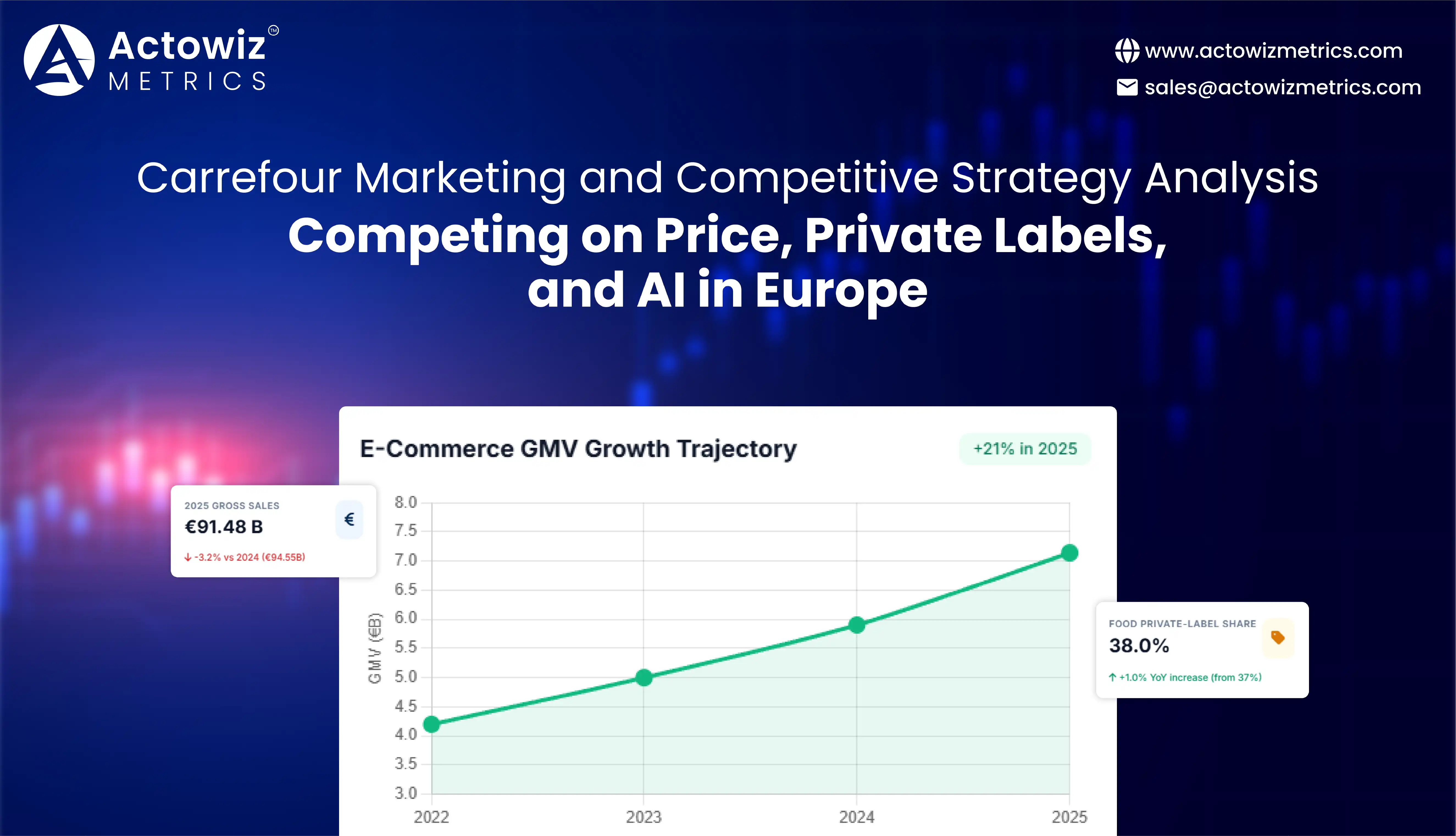
Carrefour reported €91.484 billion in 2025 gross sales, with private-label products accounting for 38% of Group food sales. Its e-commerce GMV increased 21% in 2025, while the company continued expanding its use of technology, data, and AI.
For brands, these developments create a practical data challenge: how can they continuously monitor price positioning, private-label competition, product availability, assortment, and digital visibility without relying on manual checks?
The answer is structured retail intelligence. By collecting product-level information and converting it into comparable historical datasets, brands can identify changes faster and build evidence-based competitive monitoring workflows.
Price is central to grocery competition because consumers can compare similar products across retailers with increasing ease. For brands selling through Carrefour, monitoring prices requires more than checking a single product page.
A useful monitoring program compares equivalent SKUs, pack sizes, promotional prices, standard prices, and competitor products. Brands can then calculate price gaps and identify when a product moves from regular pricing to promotion.
Carrefour itself has emphasized price competitiveness through Carrefour Price Monitoring and Competitive Intelligence. Its 2024 annual reporting stated that European price investments improved its price image and customer satisfaction, while its 2025 reporting described continued investment in competitiveness and a reduction in the price gap versus the market in France.
| Indicator | 2024 | 2025 |
|---|---|---|
| Group gross sales | €94.550bn | €91.484bn |
| Food private-label share | 37% | 38% |
| E-commerce GMV growth | +18% | +21% |
| Group stores & e-commerce sites | 15,244 | 15,719 |
| Annual customer households | 80m | 80m |
Source: Carrefour 2024 Universal Registration Document and Carrefour 2025 Universal Registration Document.
From 2020 onward, European grocery competition became increasingly data-driven. In 2020, pandemic-driven changes in shopping behavior accelerated the importance of online grocery channels and made product availability and pricing more visible digitally. During 2021, Carrefour positioned itself as a "Digital Retail Company," establishing a data-centric and digital-first transformation around e-commerce, data and retail media, digital financial services, and digitally enabled store operations. Carrefour has described this transformation as beginning with its November 2021 Digital Day.
In 2022, inflation and household purchasing-power pressure increased the importance of price positioning across grocery categories. In 2023, Carrefour introduced Hopla, a ChatGPT-integrated chatbot designed to help shoppers compose baskets according to budgets and dietary constraints.
In 2024, Carrefour reported €5.9 billion in global e-commerce GMV, up 18% from 2023, while its digital operations increasingly incorporated personalization, price-checking, catalog digitization, and AI-supported store operations.
In 2025, e-commerce GMV grew another 21%, private-label food sales reached 38%, and Carrefour expanded AI applications for assortment, forecasting, pricing opportunities, and product availability.
By 2026, Carrefour's disclosed strategy includes continued technology and AI investment, including a stated €100 million annual AI investment and deployment of Vusion technology across French hypermarkets and supermarkets.
For brands, this six-year evolution means price monitoring increasingly needs to be continuous, SKU-specific, and connected with availability and promotional signals rather than treated as a periodic manual exercise.
E-commerce creates a continuously changing product environment. Prices, promotional messages, pack sizes, availability, product descriptions, and assortment can change without producing an obvious change in a brand's overall market position.
Carrefour Ecommerce Price and Product Monitoring allows brands to create structured records for these changes. A monitoring workflow can capture product title, brand, SKU, pack size, price, discount, availability, product URL, category, and timestamp.
Carrefour's 2024 reporting provides a useful example of how digital retail is becoming integrated into its broader commercial model. Its e-commerce GMV reached €5.9 billion in 2024, up 18% year over year, and the Group reported features such as Price Checker and personalized online experiences, highlighting the growing relevance of Carrefour private label data scraping for understanding product visibility, pricing, and digital assortment.
| Monitoring Dimension | Why It Matters |
|---|---|
| Current selling price | Measures market positioning |
| Promotional price | Identifies discount activity |
| Pack size | Enables like-for-like comparison |
| Availability | Detects potential stock gaps |
| Product title | Tracks listing changes |
| Product category | Supports assortment analysis |
| Product URL | Maintains traceability |
| Timestamp | Builds historical evidence |
These fields are recommended monitoring dimensions, not claims about Carrefour's proprietary data structure.
Between 2020 and 2026, the importance of online product monitoring expanded alongside Carrefour's digital transformation. In 2020, online grocery shopping became more prominent and created a stronger need for digital product visibility. In 2021, Carrefour formally described its transformation around a data-centric, digital-first model, linking e-commerce growth with data and retail-media activities.
During 2022, online product and price information became increasingly relevant to brands responding to inflation and consumer price sensitivity. In 2023, Carrefour's launch of Hopla demonstrated how conversational technology could become part of online shopping experiences.
In 2024, the company reported strong e-commerce growth and introduced or expanded digital capabilities including product-page integration, direct add-to-cart functionality, Price Checker, and personalized customer experiences.
In 2025, Carrefour reported a further 21% increase in e-commerce GMV and continued to expand technology, data, AI, and retail-media capabilities.
Looking toward 2026, the company's AI and digital strategy increasingly connects online and physical retail. Its disclosed plans include AI-enabled customer experiences and Universal Commerce Protocol integration with Google.
For FMCG brands, the implication is practical: online monitoring should preserve historical records instead of showing only today's price. Grocery & FMCG Digital Shelf Analytics enables teams to use historical snapshots to determine whether a change is temporary, promotional, seasonal, or part of a sustained competitive movement.
Private labels can directly influence how national brands compete for price-sensitive consumers. Monitoring private-label products alongside branded alternatives allows manufacturers to examine price gaps, pack-size differences, promotional positioning, and assortment overlap.
Carrefour reported that private-label products represented 37% of Group food sales in 2024 and increased to 38% in 2025.
This is an important measurable indicator for brands because private-label expansion can affect category structure and the competitive set visible to shoppers.
Carrefour has also described its own-brand strategy around quality, price, health, and product testing. In 2024, the Group stated that its Carrefour brand had been voted best private label for the fourth consecutive year and described consumer testing involving panels of 4,000 participants.
| Metric | 2024 | 2025 |
|---|---|---|
| Private-label share of food sales | 37% | 38% |
| Year-over-year change | +1 percentage point | +1 percentage point |
| Consumer households | 80m | 80m |
Source: Carrefour 2024 and 2025 Universal Registration Documents.
From 2020 to 2026, private-label competition became increasingly important within a broader European grocery environment shaped by inflation, purchasing-power concerns, and changing consumer expectations. During 2020, brands faced unusual demand and supply conditions, while retailers had to manage availability across essential categories. In 2021, digital shopping made it easier for consumers to compare products, prices, and alternatives.
In 2022, cost-of-living pressures made value positioning particularly relevant to grocery retailers and manufacturers. During 2023, brands increasingly needed to evaluate not only direct branded competitors but also retailer-owned alternatives occupying similar category positions.
In 2024, Carrefour reported private labels at 37% of food sales, alongside a strategy emphasizing quality, affordability, and product testing.
In 2025, private-label penetration increased to 38% of food sales, while Carrefour stated that private-label deployment was part of the commercial integration of Cora & Match stores.
By 2026, the strategic significance is clear from the continuing emphasis on own-brand development within Carrefour's transformation plan. For brands, monitoring private-label products therefore needs to extend beyond price. Product attributes, pack sizes, promotional frequency, availability, ratings where available, and assortment placement can all provide useful competitive context.
SKU-level monitoring gives brands a consistent unit for comparing products over time. Instead of analyzing broad categories alone, businesses can monitor individual products and their corresponding commercial attributes.
When brands Scrape Carrefour SKU-level product data, they can organize observations around product identifiers, product names, brands, pack sizes, prices, discounts, availability, categories, and timestamps.
| SKU-Level Attribute | Application |
|---|---|
| SKU/product identifier | Product matching |
| Brand | Competitive grouping |
| Product name | Listing identification |
| Pack size | Like-for-like comparison |
| Current price | Price benchmarking |
| Discount | Promotion monitoring |
| Availability | Stock visibility |
| Category | Category benchmarking |
| Timestamp | Historical tracking |
The table describes a practical analytical framework rather than a claim that every field is publicly available for every Carrefour listing.
The move toward SKU-level analysis developed alongside the broader digitization of grocery retail. In 2020, many competitive checks were still dependent on manual research and periodic store observations. As e-commerce became more important in 2021, online product pages created a richer source of structured product information. During 2022, pricing volatility increased the need to compare equivalent products at more granular levels. In 2023, brands increasingly needed to understand not only whether a category had changed but which exact SKUs were responsible for those changes.
By 2024, Carrefour's digital transformation included catalog digitization, product-page integration, and capabilities designed to improve price and shopping visibility.
In 2025, Carrefour reported more than 3 billion annual transactions feeding its data environment and described AI applications for assortment, supply forecasting, and price-renegotiation opportunities.
By 2026, SKU-level datasets can therefore provide a practical bridge between online retail observation and brand decision-making. Brands can use historical SKU records to identify persistent price gaps, detect listing changes, compare pack sizes, and investigate availability patterns. The key is consistency: the same product attributes should be captured repeatedly so that changes can be measured rather than merely observed.
Price alone does not explain retail performance. A product cannot compete effectively if shoppers cannot find it or if its online listing is unavailable.
Grocery Product Availability and Assortment Monitoring helps brands track whether products remain listed, available, promoted, or represented across selected categories and locations.
Carrefour reported in its 2025 Universal Registration Document that it was deploying cameras and smart rails to better monitor product availability and placement in stores. It also stated that AI-supported systems were being used to adapt assortments and improve supply forecasting.
This makes availability monitoring particularly relevant for brands because retailer-side investment in availability intelligence increases the importance of having comparable brand-side data.
Between 2020 and 2026, product availability became increasingly connected to digital and operational retail systems. In 2020, supply disruptions and changes in shopping patterns made availability a critical retail concern. During 2021, online grocery catalogs provided consumers and brands with a more visible way to observe whether products were listed or unavailable. In 2022, availability and pricing increasingly needed to be analyzed together because an apparently competitive price was less meaningful if the product could not be purchased.
In 2023, digital retail infrastructure continued expanding, creating more opportunities for structured assortment monitoring. During 2024, Carrefour reported digitalization of store operations and initiatives intended to improve stock management, product availability, and product placement.
In 2025, Carrefour described the deployment of cameras and smart rails for monitoring availability and merchandising execution, alongside AI-supported assortment and supply forecasting.
By 2026, availability monitoring can therefore become a multi-dimensional exercise covering online listing status, store-level availability where observable, assortment presence, and historical changes. For brands, combining availability with price and promotional information helps distinguish a genuine competitive price movement from a temporary stock or listing issue.
Digital shelf analysis brings product visibility, pricing, availability, content quality, promotions, and assortment into one analytical framework.
For an FMCG brand, useful measures can include:
Digital shelf intelligence developed rapidly between 2020 and 2026 as grocery shopping increasingly connected physical retail with e-commerce. In 2020, online visibility became especially important as consumers relied more heavily on digital shopping channels. During 2021, Carrefour's Digital Retail Company strategy placed e-commerce, data, retail media, and digitally enabled operations within a unified transformation framework.
In 2022, rising competition and purchasing-power pressure made digital price and promotion visibility increasingly relevant to FMCG brands. In 2023, conversational commerce and digital personalization began creating additional dimensions of online product discovery. Carrefour launched Hopla in 2023 as a ChatGPT-integrated shopping assistant.
In 2024, Carrefour reported €5.9 billion in e-commerce GMV and continued expanding catalog personalization, product-page integration, and digital operational capabilities.
In 2025, e-commerce GMV grew 21%, while Unlimitail, Carrefour's retail-media joint venture with Publicis, reached 35 partners across 21 countries. Carrefour also reported increasing use of AI and data across retail operations.
By 2026, Carrefour's stated ambition is to become a leading retail-AI player in Europe, supported by a planned €100 million annual AI investment and expanded AI-enabled retail infrastructure.
For FMCG brands, digital shelf analytics can therefore move beyond price tracking. The objective is to understand whether products are visible, available, competitively positioned, properly represented, and supported by effective digital content.
Actowiz Metrics can help brands convert Carrefour retail observations into structured datasets for recurring competitive monitoring. The workflow can be designed around the specific products, categories, retailers, locations, and metrics a brand needs to track.
For organizations conducting Competitor Analysis for Brands, useful datasets can include:
A structured monitoring system can help answer practical questions:
Is the brand priced above or below comparable products?
Has a private-label alternative entered the same category?
Which SKUs are unavailable or missing from the online assortment?
How frequently does a competitor change promotional pricing?
Are pack sizes comparable across competing products?
Has Carrefour's online assortment changed over time?
For brands operating across multiple European markets, the same framework can be extended to additional retailers and marketplaces, allowing standardized competitive datasets to be built across channels.
The broader Carrefour Marketing and Competitive Strategy Analysis becomes more actionable when strategic developments are connected to observable product-level evidence. Carrefour's public disclosures show significant movement in price competitiveness, private labels, e-commerce, data, and AI; brand-side monitoring can help quantify how those changes appear at the product and category level.
Carrefour's European strategy increasingly connects price competitiveness, private-label growth, e-commerce, data, retail media, and AI. Its disclosed results provide measurable evidence of this transformation: private labels reached 38% of food sales in 2025, e-commerce GMV grew 21%, and Carrefour continued expanding AI applications across pricing, assortment, availability, supply forecasting, and customer experiences.
For FMCG manufacturers and consumer brands, the key challenge is turning these strategic developments into measurable competitive intelligence. Product-level monitoring can reveal price movements, assortment changes, availability gaps, promotional activity, and private-label competition that broad market reports cannot show at SKU level.
A structured Carrefour Marketing and Competitive Strategy Analysis program can therefore help brands connect Carrefour's strategic direction with real product-level observations.
Want to monitor Carrefour prices, products, availability, private labels, and digital-shelf movements? Talk to Actowiz Metrics to build a customized retail intelligence dataset for your brand!
Expert blogs, research reports and infographics — practical, data-driven reading across e-commerce and quick-commerce.
Most fields are optional — the more you share, the better your sample.
.webp "infographics")
.webp "infographics")