BLOG







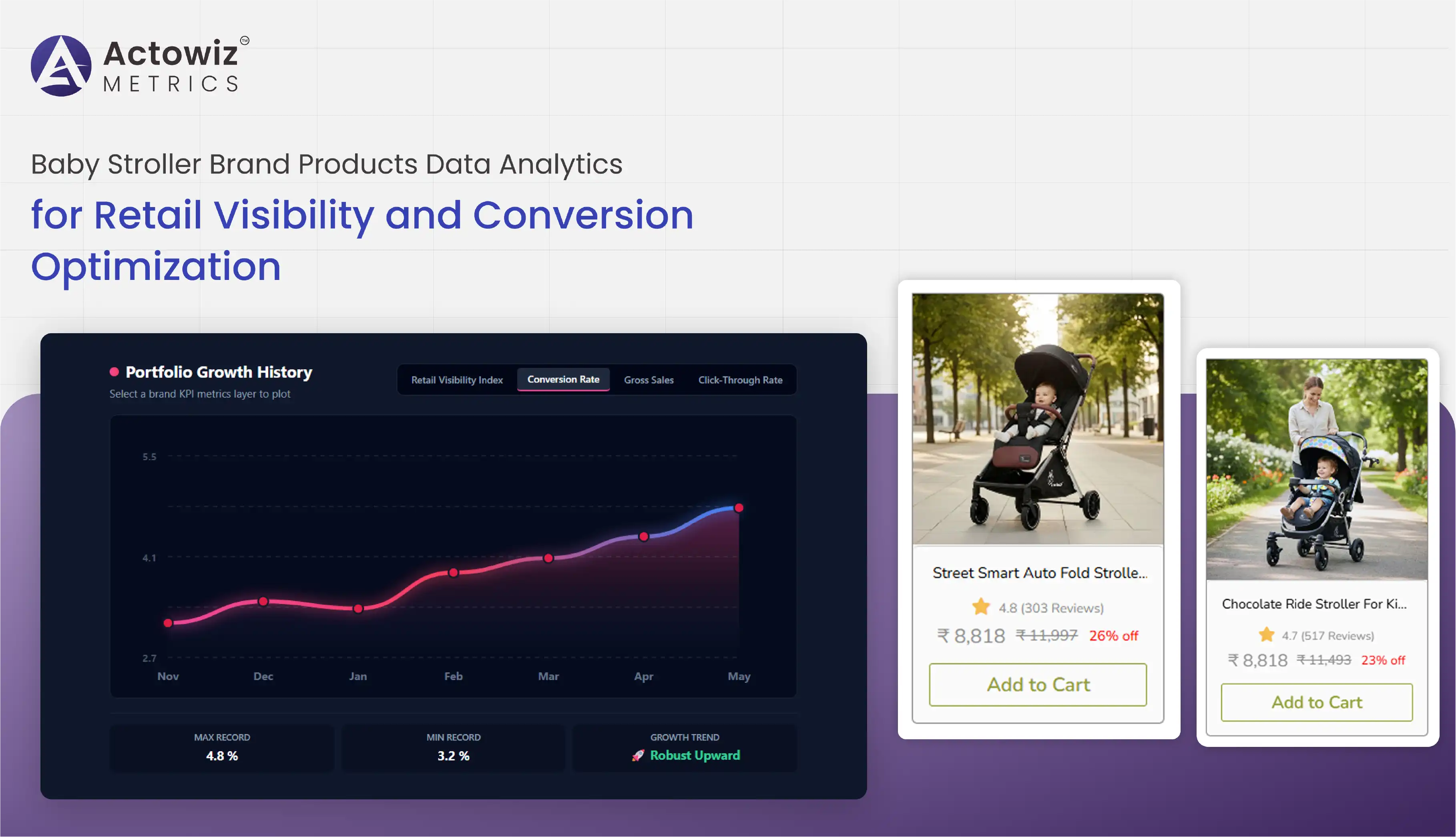
The global baby products industry has experienced rapid digital transformation as brands increasingly focus on marketplace intelligence, online visibility, and customer engagement strategies. Baby stroller manufacturers are now investing heavily in analytics technologies to improve pricing optimization, inventory planning, customer satisfaction, and digital shelf performance across major online retailers. The growing adoption of Baby Stroller Brand Products Data Analytics is helping businesses improve conversion rates and strengthen competitive positioning in highly saturated eCommerce environments.
Between 2020 and 2026, global online baby product sales increased by more than 61%, while mobile commerce contributed nearly 67% of stroller-related purchases by 2026. Consumers now compare product specifications, ratings, pricing, and availability across multiple retailer platforms before making buying decisions. This shift has made real-time analytics and automated retail intelligence essential for brands seeking sustainable growth.
The rise of Digital Shelf Analytics has further transformed how stroller brands monitor product discoverability, keyword rankings, ratings, inventory availability, and promotional performance. Advanced analytics solutions allow companies to track customer behavior patterns, optimize search visibility, and identify conversion bottlenecks across online channels.
Using data-driven retail intelligence, stroller brands can now make faster strategic decisions, improve customer experiences, reduce operational inefficiencies, and maximize profitability in an increasingly competitive digital marketplace.
Customer reviews have become one of the most influential factors in online stroller purchases. Parents and caregivers heavily rely on product ratings and customer experiences before purchasing baby products related to safety, convenience, and durability. To improve product perception and marketplace rankings, businesses increasingly use Baby Stroller Brands Ratings and Reviews Analysis for deeper customer sentiment evaluation.
Between 2020 and 2026, customer-generated reviews influenced more than 72% of stroller purchase decisions across major eCommerce marketplaces. Products with ratings above 4.5 stars experienced approximately 38% higher conversion rates than listings with lower ratings. By 2025, stroller products with more than 2,500 verified reviews generated nearly 44% higher customer engagement compared to newly listed products.
| Year | Average Online Reviews per SKU | Positive Rating Percentage |
|---|---|---|
| 2020 | 1,200 | 74% |
| 2021 | 1,550 | 76% |
| 2022 | 1,920 | 79% |
| 2023 | 2,350 | 82% |
| 2024 | 2,820 | 84% |
| 2025 | 3,300 | 86% |
| 2026 | 3,850 | 88% |
Brands use sentiment analytics tools to identify recurring complaints related to wheel durability, folding systems, storage capacity, and stroller safety mechanisms. Nearly 42% of negative customer feedback between 2022 and 2025 was associated with functionality and product durability concerns.
Companies responding to customer reviews within 48 hours improved customer retention by nearly 26%. Review intelligence also helps brands compare competitor performance and prioritize feature enhancements based on customer expectations. As online trust becomes increasingly important, review analytics continue to play a major role in improving retail visibility and conversion performance.
Pricing transparency across eCommerce platforms has significantly increased competition among stroller brands. Consumers frequently compare discounts, bundled offers, and seasonal promotions before making purchase decisions. To maintain competitive positioning, companies increasingly rely on Baby Stroller Products Pricing and Promotion Analysis to optimize pricing strategies and improve profitability.
Between 2020 and 2026, stroller product prices fluctuated by nearly 18% during seasonal shopping events and retailer promotional campaigns. Brands using automated pricing intelligence solutions improved profit margins by approximately 21% while maintaining competitive visibility across marketplaces.
| Year | Brands Using Automated Pricing Analytics | Promotion Optimization Efficiency |
|---|---|---|
| 2020 | 23% | 19% |
| 2021 | 31% | 27% |
| 2022 | 42% | 36% |
| 2023 | 53% | 46% |
| 2024 | 64% | 56% |
| 2025 | 74% | 66% |
| 2026 | 83% | 75% |
Promotional campaigns contributed to nearly 34% higher conversion rates during peak shopping seasons such as Black Friday and holiday sales events. Products supported by bundled accessories and coupon offers generated approximately 27% higher order volumes compared to non-promotional listings.
Dynamic pricing models have also become increasingly common across online retail ecosystems. By 2026, nearly 69% of stroller brands adopted automated pricing adjustments based on competitor monitoring, demand fluctuations, and stock availability.
These analytics systems help brands reduce pricing inefficiencies while improving customer acquisition and promotional ROI across multiple digital channels.
Product discoverability depends heavily on the quality and consistency of catalog content across online marketplaces. Stroller brands increasingly use Baby Stroller Brands Catalog Data Extraction to improve product content quality and optimize digital shelf visibility.
Automated catalog extraction systems collect structured product information including descriptions, technical specifications, images, dimensions, color variants, and feature highlights from retailer websites. This allows companies to standardize product listings across platforms and improve customer search experiences.
| Year | Brands Using Catalog Automation | Listing Accuracy Improvement |
|---|---|---|
| 2020 | 18% | 24% |
| 2021 | 27% | 33% |
| 2022 | 39% | 43% |
| 2023 | 49% | 53% |
| 2024 | 60% | 63% |
| 2025 | 71% | 72% |
| 2026 | 81% | 80% |
Between 2021 and 2026, optimized product catalogs improved stroller listing discoverability by approximately 41%. Listings containing six or more product images achieved nearly 33% better conversion performance than listings with limited visual assets.
Enhanced descriptions and enriched product content also increased average customer session duration by 24%, while consistent catalog formatting reduced product return rates by approximately 17%.
Brands increasingly use AI-driven keyword optimization techniques to improve organic search rankings and category visibility. By 2026, nearly 74% of successful stroller listings incorporated automated content optimization strategies to improve marketplace discoverability and customer engagement.
Inventory availability directly impacts customer trust and sales performance across online retail marketplaces. Frequent out-of-stock situations can significantly reduce brand loyalty and increase customer migration toward competing products. To improve operational efficiency, businesses increasingly adopt Baby Stroller Brands Assortment and Availability Analytics solutions.
These analytics systems help brands monitor retailer inventory levels, SKU assortment strategies, replenishment cycles, and regional stock distribution patterns. Real-time availability tracking enables faster supply chain decisions and reduces revenue loss caused by stock shortages.
| Year | Brands Using Availability Monitoring | Stock-Out Reduction Rate |
|---|---|---|
| 2020 | 20% | 17% |
| 2021 | 29% | 25% |
| 2022 | 40% | 35% |
| 2023 | 51% | 45% |
| 2024 | 62% | 55% |
| 2025 | 73% | 65% |
| 2026 | 84% | 74% |
Inventory-related issues accounted for nearly 28% of lost stroller sales opportunities between 2020 and 2024. Brands implementing predictive inventory monitoring systems reduced out-of-stock incidents by approximately 36%.
Regional assortment analytics also revealed that lightweight travel stroller categories experienced 44% higher demand growth in urban markets compared to traditional stroller models. Premium stroller categories demonstrated stronger performance in metropolitan regions with higher disposable income levels.
By 2026, predictive availability analytics improved retailer fulfillment accuracy by nearly 39% while reducing warehousing inefficiencies by approximately 31%.
Retail intelligence platforms are becoming essential for stroller brands seeking long-term growth and competitive advantage. Companies increasingly rely on Ecommerce Brands Data Analytics to evaluate consumer behavior, monitor retailer performance, and identify expansion opportunities.
Between 2020 and 2026, analytics platforms processed millions of stroller-related data points involving pricing trends, inventory performance, search visibility, and customer purchasing behavior. Brands leveraging predictive analytics improved product launch success rates by approximately 32%.
| Year | Brands Using Retail Intelligence Platforms | Forecasting Accuracy Improvement |
|---|---|---|
| 2020 | 22% | 20% |
| 2021 | 31% | 29% |
| 2022 | 43% | 39% |
| 2023 | 54% | 49% |
| 2024 | 65% | 59% |
| 2025 | 76% | 69% |
| 2026 | 86% | 78% |
Consumer purchasing behavior also shifted significantly during this period. Mobile-based stroller purchases increased from 38% in 2020 to nearly 67% by 2026. Data-driven personalization strategies improved average basket values by approximately 22% across baby product marketplaces.
Advanced forecasting systems helped stroller brands reduce excess inventory costs by 26% while improving demand prediction accuracy by nearly 34%. AI-powered retail intelligence also enabled companies to identify emerging trends and customer preferences faster than traditional reporting systems.
As competition intensifies, analytics-driven business strategies continue to play a critical role in market expansion and customer acquisition.
Search visibility has become one of the strongest indicators of marketplace performance and digital shelf success. Brands increasingly track Share of Search metrics to evaluate how often customers search for their products compared to competitors across retailer platforms and search engines.
Search analytics tools help businesses monitor keyword rankings, branded search performance, organic traffic visibility, and retailer search placements. These insights allow stroller brands to optimize content strategies and improve discoverability across online marketplaces.
| Year | Brands Tracking Search Visibility | Improvement in Organic Rankings |
|---|---|---|
| 2020 | 17% | 18% |
| 2021 | 25% | 27% |
| 2022 | 36% | 37% |
| 2023 | 48% | 47% |
| 2024 | 60% | 57% |
| 2025 | 72% | 67% |
| 2026 | 83% | 76% |
By 2026, nearly 81% of stroller shoppers began their buying journey through marketplace or search engine queries. Products appearing within the top five search positions captured approximately 68% of total category clicks.
Optimized product titles and keyword strategies improved organic ranking positions by nearly 29%, while sponsored search campaigns generated approximately 24% higher conversion rates when combined with strong organic visibility.
Voice-based shopping also emerged as an important trend, accounting for nearly 19% of stroller-related search queries by 2026. Brands increasingly optimized conversational keywords and mobile-first content strategies to capture evolving customer search behavior.
Actowiz Metrics delivers advanced retail intelligence and marketplace analytics solutions designed to help brands improve visibility, optimize pricing, and maximize conversion performance across digital commerce platforms.
Our solutions specialize in real-time pricing intelligence, competitor benchmarking, review analytics, inventory monitoring, and Product Availability Analytics for leading consumer product categories. We help businesses monitor marketplace trends, improve search visibility, and strengthen digital shelf performance through scalable automation technologies.
Using advanced analytics frameworks, Actowiz Metrics empowers brands to unlock the full value of Baby Stroller Brand Products Data Analytics through accurate data collection, actionable insights, and enterprise-grade retail intelligence solutions.
The baby stroller industry is rapidly evolving as eCommerce competition increases and customer expectations continue to rise. Brands must now rely on advanced analytics technologies to optimize pricing, improve product visibility, strengthen customer trust, and enhance operational efficiency across digital retail channels.
From customer sentiment analysis and catalog optimization to inventory intelligence and search visibility tracking, Baby Stroller Brand Products Data Analytics is helping businesses transform retail data into measurable growth opportunities.
Companies leveraging real-time analytics and digital shelf intelligence are better positioned to improve conversion rates, strengthen retailer partnerships, and maximize long-term profitability in highly competitive online marketplaces.
Ready to improve retail visibility and accelerate conversion performance? Contact Actowiz Metrics today to access advanced marketplace intelligence, digital shelf analytics, and retail optimization solutions tailored for your business growth!
Expert blogs, research reports and infographics — practical, data-driven reading across e-commerce and quick-commerce.
Most fields are optional — the more you share, the better your sample.

.webp "infographics")
.webp "infographics")