BLOG


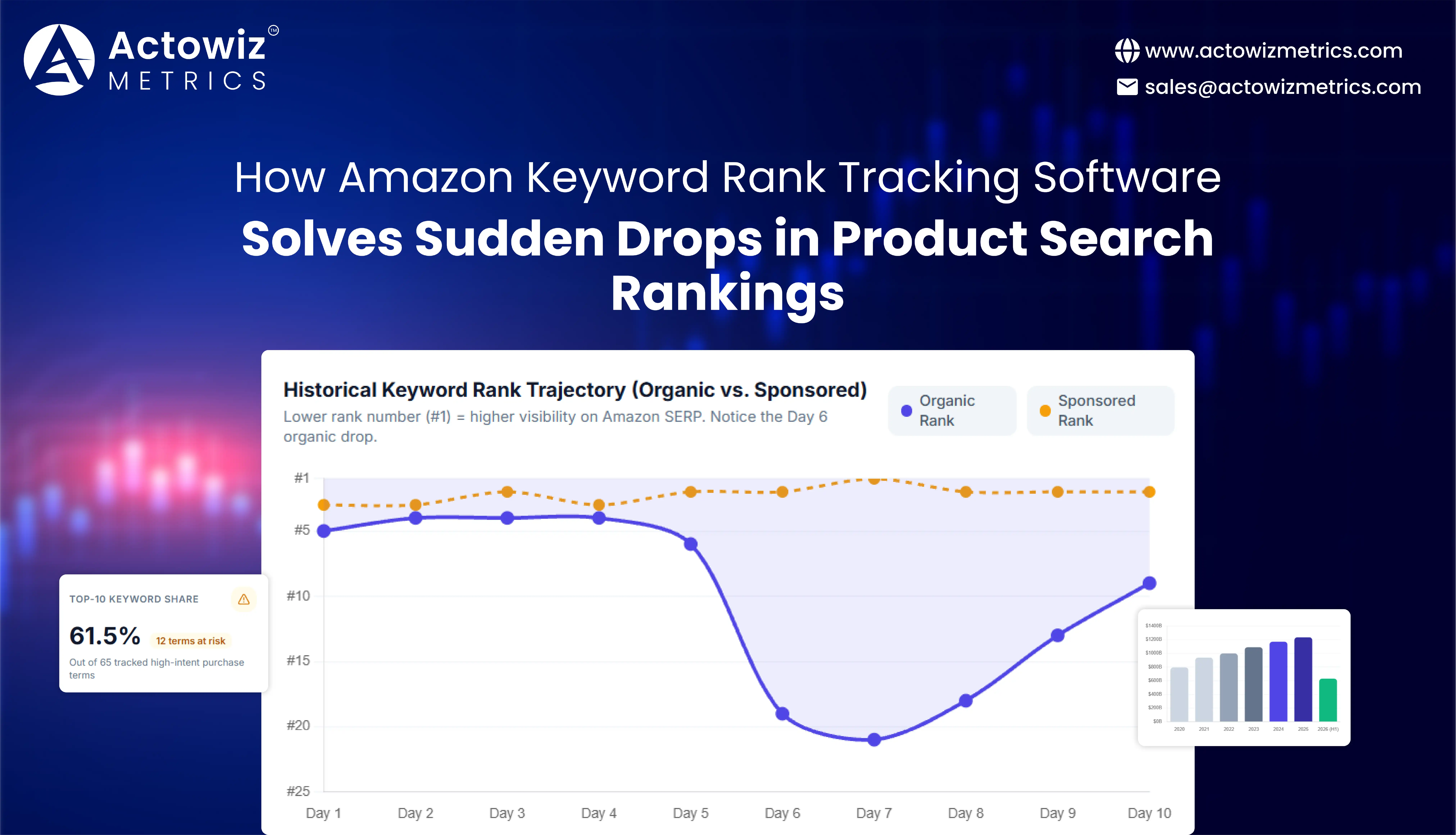
Sudden drops in Amazon product search rankings can reduce product visibility, organic traffic, and sales opportunities. Amazon Keyword Rank Tracking Software helps sellers identify ranking fluctuations, investigate affected search terms, monitor competitors, and detect potential listing or advertising problems before they create prolonged visibility losses. Combined with Digital Shelf Analytics, it gives brands a clearer picture of product performance, pricing, availability, and competitive positioning across Amazon marketplaces.
For Amazon sellers, maintaining search visibility is an ongoing challenge. A product that performs well for a high-volume keyword today may lose positions tomorrow because of changing customer demand, stronger competitor performance, listing suppression, inventory problems, pricing changes, or advertising adjustments. Without consistent monitoring, sellers may notice the consequences only after sales decline.
The challenge is particularly important as online retail continues to expand. According to U.S. Census Bureau data, U.S. retail e-commerce sales reached approximately $1.234 trillion in 2025, increasing 5.4% from 2024. This growing digital marketplace makes product discoverability and competitive monitoring important priorities for online retailers.
A structured rank-tracking approach helps businesses move beyond simply observing ranking changes. It connects keyword positions with product-level performance indicators, allowing sellers to investigate what changed, understand potential causes, and prioritize corrective actions.
Sources: U.S. Census Bureau – Quarterly Retail E-Commerce Sales| Amazon Brand Analytics.
Amazon product visibility depends on several interconnected factors, including search relevance, listing quality, customer engagement, product availability, and competitive activity. A sudden position change should therefore be treated as an investigation signal rather than proof of a single ranking issue.
Amazon Product Keyword Rank Tracking helps sellers measure where individual ASINs appear for selected search terms over time. Instead of checking search results manually, businesses can monitor keyword positions across multiple products, categories, and marketplaces. This makes it easier to distinguish temporary fluctuations from sustained visibility losses.
With Amazon Keyword Rank Tracking Software, sellers can create keyword-level monitoring systems that record historical positions, identify significant movements, and highlight products experiencing repeated declines. For example, if several important search terms lose visibility simultaneously, the seller can investigate listing status, inventory availability, recent content edits, and changes in competitor activity.
Amazon Brand Analytics also provides useful supporting information. Its Search Query Performance dashboard includes impressions, clicks, cart additions, and purchases, while Top Search Terms provides information about popular queries and leading products. These metrics help sellers understand whether a ranking change is accompanied by a change in customer engagement.
The following figures show the expansion of U.S. retail e-commerce, providing market context for the growing importance of digital product visibility.
| Year | U.S. retail e-commerce sales |
|---|---|
| 2020 | $794.6 billion |
| 2021 | $936.0 billion |
| 2022 | $996.6 billion |
| 2023 | $1.087 trillion |
| 2024 | $1.170 trillion |
| 2025 | $1.234 trillion |
| 2026 (H1) | $630.8 billion |
2020–2025 annual figures and 2026 first-half figures are rounded. The 2026 figure represents six months, not a full-year estimate. Source: U.S. Census Bureau data compilation and historical series.
The practical takeaway is that sellers need repeatable monitoring processes as their online catalogs and competitive environments grow. Rank tracking provides the visibility needed to investigate changes systematically rather than relying on occasional manual searches.
A keyword can produce different search results for different products, even when those products belong to the same brand or category. Tracking only broad keyword performance can therefore hide important product-level problems.
Amazon ASIN Keyword Rank Tracking connects search-term performance with individual Amazon Standard Identification Numbers (ASINs). This approach helps sellers identify which products are losing visibility, which are maintaining their positions, and which are gaining ground against competing listings.
For businesses managing multiple variations, parent listings, and large product catalogs, ASIN-level monitoring is particularly useful. A decline affecting one child ASIN may not affect every product variation equally. Similarly, a brand may maintain strong overall visibility while a commercially important product loses positions for its primary purchase-intent keywords.
A structured monitoring process should capture the following information:
Amazon’s Brand Analytics Search Query Performance dashboard supports ASIN-level investigation through its Brand View and ASIN View reporting. It provides query-level information that can help businesses understand how shoppers discover their products.
For sellers, the strongest approach is to combine ASIN-level keyword monitoring with listing-health checks. If a product loses positions across multiple important terms, the team should first verify that its listing remains active, searchable, correctly categorized, and available for purchase.
This prevents businesses from spending time changing keywords when the underlying issue may be product availability or listing compliance.
Source: Amazon – What Is Brand Analytics?.
One common mistake in marketplace reporting is treating sponsored placements and organic search positions as the same performance indicator. A product may appear prominently in sponsored search results while its natural search visibility is declining.
Amazon Organic and Sponsored Rank Tracking helps businesses evaluate these two visibility channels separately. This distinction is important because paid advertising and organic search serve different purposes and follow different measurement approaches.
Amazon Sponsored Products are cost-per-click advertisements that promote individual product listings. Amazon confirms that these ads can appear at the top of, alongside, or within shopping results, as well as on product detail pages. Advertisers select targeting options, manage bids, and monitor campaign performance through Amazon Ads.
Amazon Keyword Rank Tracking Software helps sellers maintain a clearer distinction between paid placements and non-advertising search positions. By comparing both channels, businesses can investigate whether a product’s visibility is being supported primarily by advertising or whether it is also maintaining organic discoverability.
Consider these practical monitoring priorities:
| Observation | Investigation priority | Recommended action |
|---|---|---|
| Organic visibility declines | Listing relevance and competition | Review content and competing products |
| Sponsored visibility declines | Campaign targeting and bids | Inspect campaign settings |
| Both channels decline | Product availability and listing status | Check inventory and listing health |
| Sponsored visibility increases | Advertising dependence | Evaluate organic performance separately |
| Visibility remains stable but purchases decline | Conversion and customer experience | Review price, content, and customer feedback |
The distinction matters because increasing advertising expenditure does not automatically resolve an organic ranking problem. Sellers should investigate the underlying issue before reallocating campaign budgets.
Amazon Ads documentation: Sponsored Products Best Practices.
A single ranking observation provides limited information. A historical record provides much more useful context because it allows businesses to compare current positions with previous performance.
Amazon Keyword Rank History Tracking helps sellers maintain a chronological record of keyword movements. By reviewing historical observations, businesses can identify recurring fluctuations, sustained declines, and changes that coincide with product or campaign updates.
For example, sellers can compare keyword positions before and after a listing-content update. They can also investigate whether visibility changes occurred during inventory shortages, promotional periods, or increased competitor activity. These comparisons help narrow down potential causes without assuming that every decline is an algorithm update.
A useful historical monitoring framework should include:
| Period | Monitoring focus | Business application |
|---|---|---|
| 2020 | Establishing historical benchmarks | Understand earlier online visibility patterns |
| 2021 | Comparing post-pandemic demand changes | Review keyword demand and product performance |
| 2022 | Monitoring competitive market changes | Identify sustained position losses |
| 2023 | Evaluating catalog and campaign performance | Compare keyword groups |
| 2024 | Reviewing listing and competitor movements | Identify recurring visibility problems |
| 2025 | Monitoring seasonal and promotional changes | Improve campaign planning |
| 2026 | Maintaining current performance records | Detect emerging ranking fluctuations |
The table represents a recommended historical monitoring framework, not measured Amazon keyword-ranking results for those years.
Amazon’s Search Query Performance reporting can complement historical keyword observations with impressions, clicks, cart additions, and purchases. This helps sellers determine whether a visibility change also corresponds with a change in customer engagement.
Historical tracking is especially useful for brands with large catalogs because it provides an evidence-based starting point for troubleshooting. Instead of repeatedly changing listing content, teams can investigate the dates and conditions associated with declining performance.
Source: Amazon Brand Analytics – Search Analytics.
A product can lose search visibility even when its own listing has not changed. Competitors may improve their product content, strengthen their advertising campaigns, adjust prices, or become more attractive to shoppers.
Amazon Competitor Keyword Rank Analysis helps sellers understand these competitive movements by comparing product positions for shared search terms. It provides a way to identify competing ASINs gaining visibility while a monitored product experiences a decline.
Amazon Keyword Rank Tracking Software makes this comparison more systematic by maintaining keyword-level competitor records. Businesses can evaluate which competing products repeatedly appear above their listings and identify search terms where competitive pressure is increasing.
This information is particularly important for category managers, e-commerce directors, marketplace analysts, and brand owners responsible for maintaining visibility across multiple products.
Amazon’s Top Search Terms dashboard provides useful competitive context by showing the top-clicked products and brands for search terms, along with click-share and conversion-share information. This allows eligible brand representatives to understand how customer attention is distributed across competing products.
| Competitive signal | What it may indicate | Action for sellers |
|---|---|---|
| Competitor gains organic positions | Stronger relative search performance | Compare listing relevance and performance |
| Competitor gains click share | Increased customer attention | Review product presentation |
| Competitor introduces lower pricing | Greater price competitiveness | Evaluate pricing strategy |
| Competitor gains sponsored exposure | Increased paid promotion | Review campaign positioning |
| Several competitors gain visibility | Broader competitive pressure | Reassess category strategy |
The important distinction is between identifying a correlation and establishing a cause. A competitor’s ranking improvement does not automatically prove that its pricing or advertising caused another product’s decline.
Businesses should validate competitive observations against their own product data, available Amazon reports, and campaign records. This makes competitive intelligence more actionable and reduces the risk of unnecessary listing or pricing changes.
Identifying a ranking decline is only the first step. Businesses also need a consistent process for investigating the issue, assigning responsibility, and evaluating whether corrective measures improve performance.
Amazon Keyword Rank Tracker Features should therefore support more than basic position reporting. The most useful monitoring systems connect keyword observations with ASIN information, historical records, competitor movements, and marketplace performance indicators.
For brands operating across several categories or Amazon marketplaces, these capabilities can make monitoring more organized and scalable.
| Step | Monitoring activity | Expected business outcome |
|---|---|---|
| 1 | Identify the affected keyword | Locate the visibility problem |
| 2 | Verify the ASIN and listing status | Detect listing-related issues |
| 3 | Review inventory and availability | Identify potential stock-related problems |
| 4 | Compare historical positions | Establish when the decline began |
| 5 | Evaluate competitor movements | Understand competitive pressure |
| 6 | Review advertising performance | Separate paid and organic changes |
| 7 | Implement corrective measures | Address verified issues |
| 8 | Monitor subsequent performance | Evaluate whether visibility improves |
A reliable process should also include human review. Automated alerts can identify unusual movements, but sellers still need to investigate the underlying circumstances before changing product content, pricing, or advertising strategies.
Amazon’s Listing Quality Indicator is another useful reference. Amazon explains that it evaluates product-detail-page content and multimedia quality, while noting that its score does not account for dynamic factors such as offer price, fulfillment, or seasonality. This reinforces the need to combine listing-quality checks with broader performance monitoring.
Source: Amazon Seller Central – Listing Quality Indicator.
Actowiz Metrics helps e-commerce businesses strengthen marketplace intelligence through structured product data collection, keyword monitoring, competitor analysis, and digital shelf insights. Its data-driven approach supports sellers looking to understand product visibility changes and make better-informed marketplace decisions.
With Share of Search — Marketplace Visibility & Keyword Rank, businesses can evaluate how their products perform against competitors across important search terms. Combining these insights with Amazon Keyword Rank Tracking Software enables a more organized approach to identifying ranking fluctuations and monitoring product discoverability.
Businesses need more than isolated ranking reports to understand marketplace performance. They need connected information about product visibility, competitor activity, listing conditions, and pricing movements.
Actowiz Metrics helps organizations build a more comprehensive marketplace intelligence framework through scalable data collection and analytics. This enables marketplace teams to make informed decisions, identify emerging competitive pressures, and improve their monitoring processes.
For brands managing extensive product catalogs, structured data intelligence can also reduce manual research and make recurring performance reviews more consistent.
Sudden Amazon ranking drops can result from several interconnected factors, including listing suppression, inventory problems, changing customer demand, stronger competitor performance, and advertising adjustments. Identifying the actual cause requires consistent monitoring rather than reacting to individual ranking changes.
Amazon Price Tracking & Digital Shelf Analytics can complement keyword monitoring by helping sellers understand the wider marketplace conditions surrounding product visibility. When pricing, availability, competitor movements, and search performance are evaluated together, businesses gain a stronger foundation for making corrective decisions.
Implementing Amazon Keyword Rank Tracking Software allows sellers to maintain historical keyword records, distinguish organic and sponsored visibility, identify competitive changes, and investigate potential ranking problems systematically.
Ready to improve your Amazon marketplace visibility?
Partner with Actowiz Metrics to access structured product intelligence, keyword monitoring, competitor insights, and digital shelf analytics.
Contact Actowiz Metrics today to discuss a customized data solution that helps your business monitor product performance, investigate ranking fluctuations, and make smarter marketplace decisions!
Expert blogs, research reports and infographics — practical, data-driven reading across e-commerce and quick-commerce.
Most fields are optional — the more you share, the better your sample.
.webp "infographics")
.webp "infographics")