BLOG






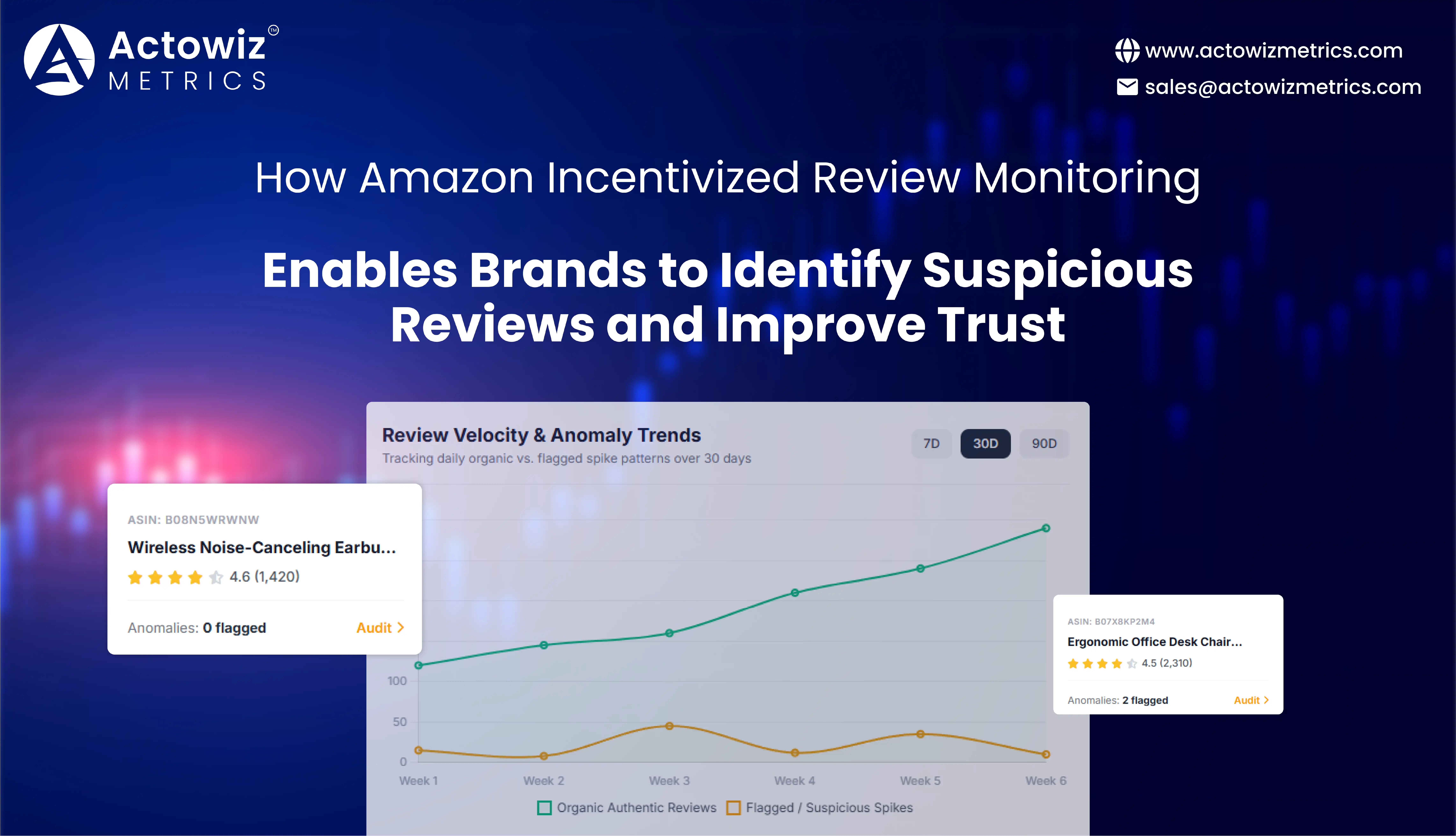
Brands can identify potentially suspicious Amazon reviews by monitoring unusual review patterns, sudden rating changes, abnormal review bursts, repeated language, and signals that may indicate incentives or manipulation. Amazon Incentivized Review Monitoring helps brands continuously evaluate review activity and protect the credibility of their product ratings.
For brands selling on Amazon, reviews influence customer confidence, product discovery, conversion decisions, and marketplace reputation. However, not every unusual review pattern automatically means fraud. A responsible monitoring program should identify signals for investigation rather than label individual reviewers as fraudulent without evidence.
Amazon has strict rules against review manipulation. Amazon seller guidance states that offering incentives such as discounts, free products, refunds, or other compensation in exchange for reviews is prohibited. It also identifies review clubs and services offering free or discounted products tied to reviews as prohibited activities. (Amazon Seller Central)
The regulatory environment has also become stricter. The U.S. Federal Trade Commission's Consumer Reviews and Testimonials Rule became effective on October 21, 2024. The rule prohibits businesses from providing compensation or incentives conditioned on reviews expressing a particular sentiment, whether positive or negative. (Federal Trade Commission)
For marketplace managers, brand protection teams, and e-commerce leaders, the challenge is therefore not simply collecting reviews. It is building a repeatable process for detecting unusual patterns, analyzing sentiment and quality, comparing review activity over time, and escalating potential compliance risks for human investigation.
Amazon Seller Central Brands Ratings and Reviews Analysis can provide the structured intelligence needed to understand how ratings, review volumes, review content, and product-level reputation are changing.
Scrape Amazon Incentivized Reviews Data to create a structured review dataset that can be analyzed for unusual activity. The purpose is not to automatically declare a review incentivized. Instead, brands can use multiple indicators to identify patterns that deserve further investigation.
Amazon Incentivized Review Monitoring can combine review text, rating, review date, reviewer information where publicly available, product identifier, verified-purchase indicators where displayed, and other relevant public attributes.
| Signal | Why It Matters |
|---|---|
| Review date | Detects sudden review bursts |
| Star rating | Measures rating distribution |
| Review volume | Identifies unusual growth |
| Review text | Supports content analysis |
| Repeated phrases | May indicate coordinated content |
| Rating distribution | Detects abnormal concentration |
| Product/ASIN | Connects reviews to specific products |
| Verified-purchase indicator | Provides additional context where displayed |
| Variation information | Helps identify review relationships |
| Historical review count | Shows long-term review growth |
A sudden increase in reviews does not automatically mean manipulation. A legitimate product launch, promotion, viral social-media exposure, seasonal demand, or major sales event can also produce rapid review growth.
The stronger approach is to combine multiple indicators.
For example, a product receiving 500 reviews in one week may deserve attention if it previously received only 10–15 reviews per week, particularly if many reviews also share highly similar wording. But this remains a signal for investigation rather than proof of misconduct.
| Indicator | Low Risk | Medium Risk | High Risk |
|---|---|---|---|
| Review growth | Stable | Increasing | Sudden spike |
| Rating distribution | Mixed | Moderately concentrated | Extremely concentrated |
| Text similarity | Low | Some repetition | Strong repetition |
| Timing | Consistent | Short bursts | Highly concentrated |
| Product context | Normal | Campaign period | Unexplained activity |
This approach gives brand teams a more defensible monitoring framework.
Review integrity became increasingly important between 2020 and 2026 as consumers relied more heavily on digital product information and marketplaces expanded their influence on purchasing decisions. During this period, brands increasingly moved from manually checking individual reviews toward automated monitoring of review volume, rating changes, sentiment, and content patterns. Regulatory scrutiny also increased. The FTC finalized its Consumer Reviews and Testimonials Rule in August 2024, and the rule became effective on October 21, 2024. It addresses fake reviews, deceptive testimonials, review suppression, and incentives conditioned on particular review sentiments. (Federal Trade Commission) By 2025, FTC guidance continued to emphasize that businesses should not provide incentives for only positive reviews. (Federal Trade Commission) In 2026, brands therefore need review intelligence that combines historical monitoring, anomaly detection, content analysis, and compliance-oriented investigation.
Amazon Review Data Scraping for Compliance Monitoring can help brands create an evidence-oriented review monitoring process. Rather than relying on isolated complaints or manual screenshots, teams can maintain structured historical records of review activity.
A compliance-oriented dataset can help answer questions such as:
The FTC specifically states that businesses cannot provide compensation or other incentives conditioned on reviews expressing a particular sentiment. This applies whether the condition is explicit or implied. (Federal Trade Commission)
Importantly, the FTC also explains that incentives for reviews are not categorically prohibited under its rule if they are not conditioned on a particular sentiment, but disclosure and other legal considerations can still apply. Platform-specific rules may be stricter. (Federal Trade Commission)
| Field | Compliance Use |
|---|---|
| Product/ASIN | Product identification |
| Review date | Timeline analysis |
| Rating | Sentiment signal |
| Review text | Content investigation |
| Review volume | Growth monitoring |
| Reviewer information | Pattern analysis where publicly available |
| Verification label | Additional review context |
| Product variation | Review relationship analysis |
| Collection timestamp | Evidence history |
Brands should maintain a clear distinction between monitoring and determining violations. Automated systems can flag unusual activity, but legal or platform-policy conclusions should be made through appropriate review and investigation.
From 2020 through 2026, review compliance moved from being primarily a marketplace policy concern toward a broader consumer-protection and advertising issue. The FTC's 2023 updated Endorsement Guides addressed practices involving incentivized reviews, fake reviews, review suppression, and manipulation of consumer perceptions. (Federal Trade Commission) In August 2024, the FTC finalized its Consumer Reviews and Testimonials Rule, followed by an effective date of October 21, 2024. (Federal Trade Commission) The agency subsequently issued additional guidance explaining that businesses cannot condition incentives on positive reviews and that businesses should consider disclosure requirements where incentives are offered. (Federal Trade Commission) By 2026, compliance teams increasingly benefit from historical datasets because they can compare review activity over time instead of investigating isolated records without context.
Amazon Review Data Extraction & Analysis helps brands transform large volumes of customer feedback into structured information that can be searched, categorized, compared, and analyzed.
Review analysis should go beyond counting five-star and one-star ratings. The text can reveal recurring themes related to quality, packaging, sizing, delivery, functionality, durability, instructions, customer expectations, or product defects.
| Analysis Area | Example Insight |
|---|---|
| Rating distribution | Overall customer perception |
| Sentiment | Positive, neutral, negative themes |
| Topic frequency | Most discussed product attributes |
| Complaint analysis | Recurring customer problems |
| Praise analysis | Strong product attributes |
| Review velocity | Rate of review accumulation |
| Text similarity | Repeated language patterns |
| Trend analysis | Changing customer concerns |
For example, a product may maintain a 4.3-star average while negative reviews increasingly mention packaging damage. The average rating alone might not immediately reveal the issue, but topic analysis could identify packaging as an emerging concern.
Similarly, a sudden increase in comments about product quality could indicate a manufacturing or supplier issue that deserves investigation.
A strong review intelligence system combines numerical and textual information.
Quantitative signals include:
Qualitative signals include:
This combination creates a more complete view of product reputation.
Between 2020 and 2026, review analysis became increasingly automated because the volume of customer-generated content expanded across digital marketplaces. Earlier approaches often relied on manually reading selected reviews, but larger product catalogs made this approach difficult to scale. Natural-language processing and sentiment analysis enabled brands to classify large review collections by topic and sentiment. At the same time, regulators emphasized the importance of authentic consumer feedback. The FTC's 2024 rule specifically addressed fake or false reviews and testimonials and prohibited businesses from buying or procuring certain deceptive reviews. (Federal Trade Commission) The agency also warned that businesses should not suppress legitimate negative reviews or distort consumer perceptions. (Federal Trade Commission) By 2026, review analytics therefore serves two purposes: understanding customers and identifying patterns that may require compliance or reputation-risk investigation.
Amazon Review Policy Compliance Monitoring gives brands a systematic way to compare observed review activity against applicable marketplace requirements and internal compliance standards.
A monitoring program can establish rules for identifying unusual activity, documenting observations, and escalating cases.
For example, a brand might flag:
These indicators should not be interpreted individually. A sudden increase in reviews could be legitimate if a product experiences a major sales increase.
| Layer | Monitoring Objective |
|---|---|
| Product level | Identify affected products |
| Review level | Analyze individual review attributes |
| Time level | Detect unusual periods |
| Text level | Identify repeated language |
| Rating level | Analyze distribution |
| Category level | Compare similar products |
| Historical level | Establish normal behavior |
Historical baselines are particularly valuable.
Suppose a product normally receives 20 reviews per week. If it suddenly receives 300 reviews in three days, the event can be flagged. The system can then compare rating distribution, review wording, sales activity where available, and other contextual information. This creates a more objective investigation workflow.
Brands should avoid automatically labeling reviewers as fraudulent based solely on algorithmic signals. Automated monitoring should prioritize risk identification, while human reviewers or qualified compliance teams determine whether further action is appropriate.
The compliance landscape became significantly more structured during 2020–2026. In 2023, the FTC updated its Endorsement Guides to address deceptive practices involving reviews and endorsements. (Federal Trade Commission) In 2024, the agency finalized a dedicated Consumer Reviews and Testimonials Rule. The rule prohibits fake or false reviews, buying positive or negative reviews, certain insider testimonials without disclosure, and review suppression practices. (Federal Trade Commission) The rule became effective on October 21, 2024. (Federal Trade Commission) In December 2025, FTC warning letters reiterated that fake reviews and incentives for five-star reviews could trigger enforcement actions and civil penalties. (Federal Trade Commission) These developments make documented, historical review monitoring increasingly relevant for brands operating large marketplace catalogs in 2026.
Amazon Seller Review Risk Monitoring can help brands establish a structured early-warning system for product reputation and review integrity. Amazon Incentivized Review Monitoring can be one component of that broader risk framework.
The objective is not simply to find negative reviews. Negative feedback can provide valuable information about genuine customer experiences. The objective is to distinguish normal customer feedback from unusual patterns that require investigation.
| Risk Category | Example Signal |
|---|---|
| Review manipulation | Abnormal review accumulation |
| Reputation risk | Sudden rating decline |
| Product quality | Repeated complaints |
| Listing mismatch | Reviews referencing unexpected attributes |
| Content similarity | Repeated phrases |
| Compliance risk | Potentially incentivized activity |
| Customer experience | Increasing negative sentiment |
A useful monitoring system can assign risk levels based on multiple signals. For example:
Again, a high-risk classification should mean "investigate," not "confirmed violation."
Historical records provide the baseline needed to distinguish normal behavior from anomalies.
Without historical data, a brand may see 200 reviews in a week and have no idea whether that is unusual. With 12 months of history, the brand can determine the normal weekly range and identify deviations.
The importance of review risk management grew as marketplaces became increasingly central to brand discovery and purchasing decisions. During the 2020–2022 period, brands accelerated their digital commerce operations, increasing the importance of marketplace reputation. From 2023 onward, regulatory guidance became more explicit about deceptive review practices. The FTC's updated Endorsement Guides addressed review manipulation, incentivized reviews, and other deceptive practices in 2023. (Federal Trade Commission) The 2024 Consumer Reviews and Testimonials Rule then created enforceable prohibitions around specific review-related practices, including buying positive or negative reviews. (Federal Trade Commission) By 2025, the FTC was actively warning businesses about fake reviews and incentives for five-star reviews, emphasizing potential civil penalties. (Federal Trade Commission) In 2026, brands can use historical review intelligence to create stronger risk baselines and prioritize investigations across large catalogs.
Amazon Review Sentiment & Quality Analysis helps brands understand what customers are actually saying about products while also identifying changes in the quality and composition of review content.
A high average rating does not necessarily mean every product attribute is performing well. Customers may praise design while criticizing durability. They may appreciate price but complain about packaging. Structured sentiment and topic analysis can reveal these differences.
| Dimension | What to Analyze |
|---|---|
| Sentiment | Positive, neutral, negative |
| Relevance | Whether review relates to product |
| Specificity | Presence of meaningful product details |
| Topic | Quality, price, delivery, packaging, etc. |
| Language similarity | Repeated or templated expressions |
| Rating consistency | Relationship between text and stars |
| Recency | Current vs. historical feedback |
Brands can also create topic-level sentiment scores. For example:
| Topic | Sentiment | Business Interpretation |
|---|---|---|
| Product quality | Positive | Strong performance |
| Packaging | Negative | Potential improvement area |
| Value for money | Mixed | Pricing perception varies |
| Durability | Negative | Product-development signal |
| Design | Positive | Competitive strength |
This helps product teams prioritize improvements based on customer feedback instead of relying solely on the overall star rating.
Review sentiment should also be compared with review velocity.
If a product suddenly receives a large number of highly positive reviews and the text is unusually repetitive, the pattern may warrant investigation.
Conversely, a large increase in negative reviews accompanied by a verified product change or known quality issue may represent genuine customer feedback.
The analytical goal is therefore contextual interpretation, not automatic classification.
Review analytics evolved substantially during 2020–2026 as natural-language processing became more accessible for large-scale customer feedback analysis. Brands increasingly moved from simple star-rating averages toward topic-level sentiment, recurring complaint detection, and review-quality analysis. Regulatory developments reinforced the importance of preserving authentic customer feedback. The FTC has stated that businesses should not prevent or discourage consumers from submitting negative reviews and that review systems should not distort what consumers think about a product. (Federal Trade Commission) The FTC's 2024 rule also targeted deceptive reviews and testimonials, strengthening the broader emphasis on authenticity. (Federal Trade Commission) By 2026, combining sentiment, review quality, historical trends, and anomaly detection gives brands a more comprehensive approach to marketplace reputation management.
Actowiz Metrics helps brands transform large-scale marketplace information into structured datasets for monitoring, analytics, and business intelligence. Amazon Seller Central Data Extraction can support the collection and organization of publicly available seller, product, rating, review, and marketplace information according to the specific requirements of a project.
For brands managing hundreds or thousands of Amazon products, manual review monitoring can become difficult to maintain. A structured workflow can automate recurring collection, standardize fields, preserve historical records, and prepare information for analytics.
Amazon Incentivized Review Monitoring can be incorporated into a broader review intelligence framework that combines review volume, rating distribution, review content, timestamps, product identifiers, and other relevant signals.
Actowiz Metrics can help businesses establish customized monitoring logic based on their specific risk priorities. For example, a brand may want to receive alerts when review velocity exceeds a historical threshold, when average ratings change sharply, or when repeated phrases appear across multiple reviews.
The resulting data can support dashboards, compliance investigations, product quality programs, competitive research, reputation management, and customer-experience analysis.
Importantly, automated monitoring should be used as an intelligence and risk-detection layer rather than as an automatic determination that a particular reviewer or review is fraudulent.
Ratings And Reviews Analysis gives brands a structured way to understand customer feedback, identify product issues, track rating movements, and investigate unusual review patterns. Amazon Incentivized Review Monitoring adds an important risk-detection layer by helping businesses identify patterns that may warrant closer examination.
The regulatory environment makes review integrity increasingly important. The FTC's Consumer Reviews and Testimonials Rule prohibits businesses from buying or procuring fake reviews and from providing incentives conditioned on a particular positive or negative sentiment. (Federal Trade Commission) Amazon's own seller guidance also identifies incentivized reviews and review manipulation as prohibited activities. (Amazon Seller Central)
For brands, the best approach is proactive. Build historical review datasets, establish normal review patterns, monitor unusual changes, analyze sentiment, investigate anomalies, and maintain appropriate documentation.
A data-driven review monitoring program can help brands protect product reputation while also turning customer feedback into actionable product and customer-experience insights.
Ready to protect your brand's marketplace reputation and improve review integrity? Contact Actowiz Metrics to build a scalable review monitoring, sentiment analysis, and compliance intelligence solution for your Amazon catalog!
Expert blogs, research reports and infographics — practical, data-driven reading across e-commerce and quick-commerce.
Most fields are optional — the more you share, the better your sample.


.webp "infographics")
.webp "infographics")