BLOG


Agentic commerce is changing how consumers discover, compare, and purchase products. AI shopping assistants can research products, compare prices, evaluate availability, and help complete purchases, making accurate product information and competitive pricing increasingly important. Agentic Commerce Intelligence helps brands understand these changes by connecting pricing signals, digital shelf performance, product discoverability, and advertised-price policies. Monitoring Agentic Actions—the observable steps AI systems take during product discovery and shopping—can help businesses investigate how automated shopping experiences interact with their marketplace strategies.
The shift is already visible in retail. In November 2025, Google announced expanded AI shopping features, including conversational product discovery, price tracking, and agentic checkout for eligible US merchants. In January 2026, Google introduced its Universal Commerce Protocol, an open standard designed to support agentic shopping journeys. These developments show how shopping experiences are moving beyond traditional keyword searches and manual product comparisons. Sources: Google Shopping announcement and Google's Universal Commerce Protocol announcement.
For manufacturers, consumer brands, distributors, and marketplace managers, this evolution creates three connected challenges: keeping prices competitive, ensuring product information remains accurate across digital channels, and monitoring advertised-price policies without confusing them with restrictions on actual resale prices.
Actowiz Metrics can help businesses approach these challenges through structured marketplace intelligence, historical price analysis, competitive monitoring, and Minimum Advertised Price (MAP) Compliance Monitoring. The objective is not to predict every decision an AI agent will make. It is to provide reliable evidence about the product, pricing, availability, and competitive signals that brands can observe and improve.
AI Shopping Agent Price Monitoring helps brands observe how product prices, promotions, and availability compare across retailers and shopping channels. As consumers increasingly use AI-assisted research, brands need to consider how clearly their offers can be interpreted and compared by automated systems.
Price monitoring should capture more than the headline price. Depending on the channel and available data, relevant fields include product identifiers, current price, promotional price, shipping charges, availability, seller identity, and observation time. These details help distinguish a genuine price difference from variations caused by shipping, product bundles, seller offers, or different product specifications.
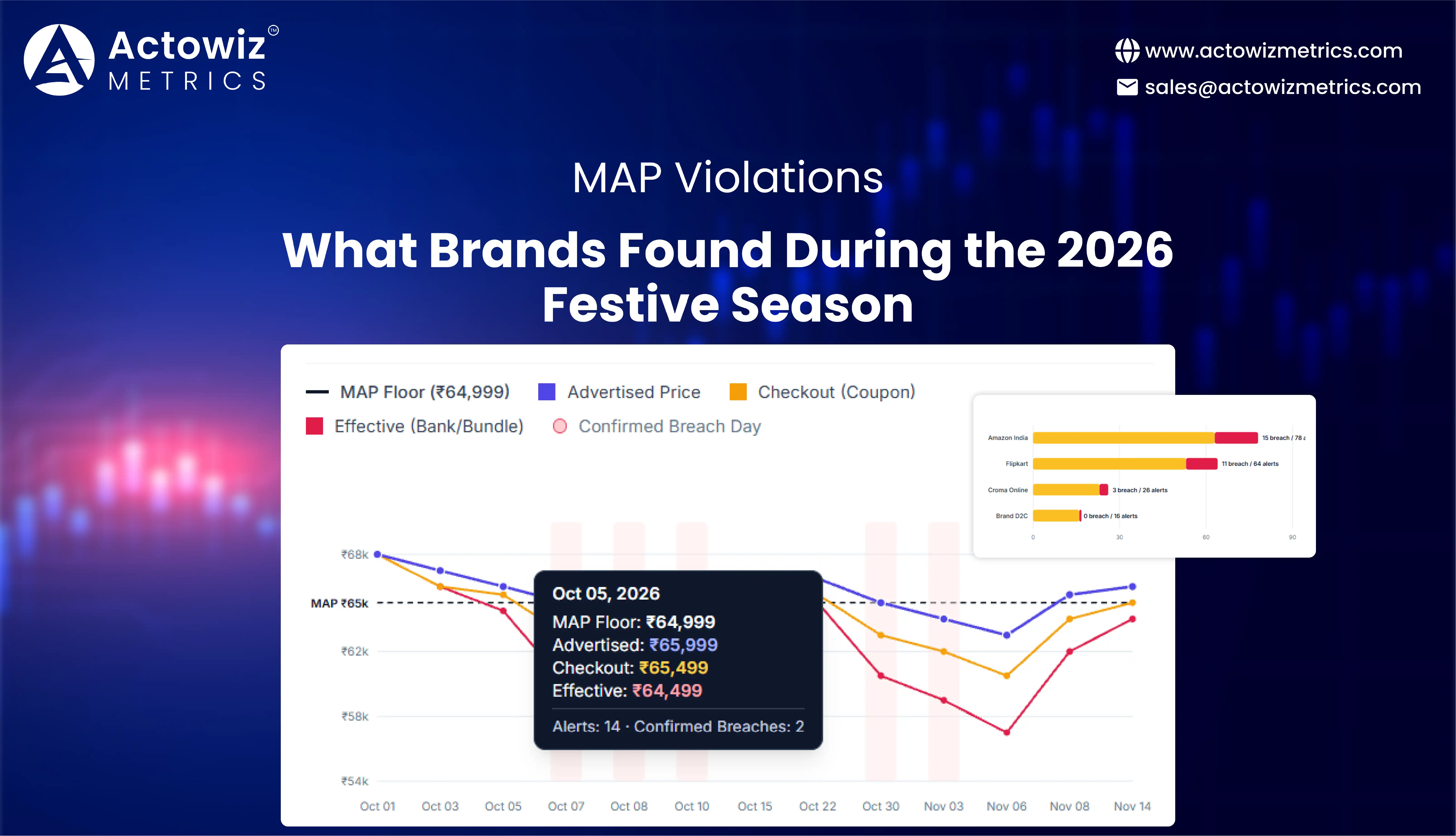
MAP policies add another dimension. MAP Monitoring helps brands identify advertised prices that appear inconsistent with their documented policy, subject to the policy's terms, applicable law, and the quality of the evidence. Monitoring should distinguish the price displayed in an advertisement or listing from the final checkout price and the price at which a retailer actually sells the product.
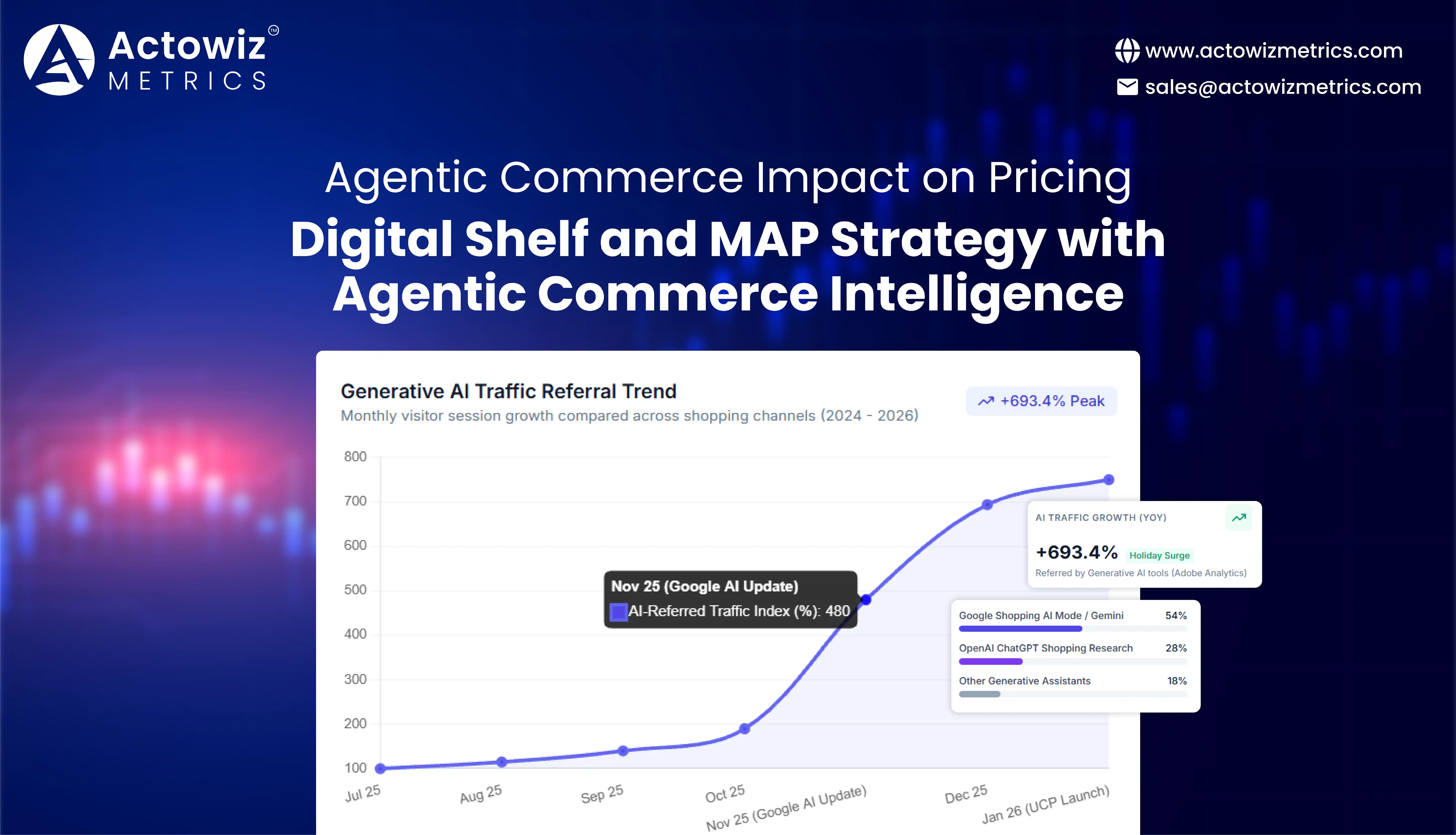
A real-world indicator of the growing role of AI-assisted shopping came from Adobe Analytics. During the US holiday season from November 1 to December 31, 2025, traffic to retail websites from generative AI tools increased by 693.4% compared with the same period in 2024. Adobe measured visits referred by AI tools, not all AI-assisted purchases or autonomous-agent transactions. Source: Adobe's January 2026 holiday shopping report.
| Monitoring area | What brands should record | Why it matters |
|---|---|---|
| Advertised price | Displayed price, currency, seller, timestamp | Detect pricing differences across retailers |
| Promotional offer | Discounted price and visible promotion terms | Separate temporary offers from standard pricing |
| Product identity | GTIN, model, size, variant, or SKU | Avoid comparing non-equivalent products |
| Availability | In stock, out of stock, or unavailable | Add context to price comparisons |
| Shipping and conditions | Shipping costs, bundle details, and eligibility | Compare the actual offer more accurately |
| MAP status | Applicable policy, evidence, and review outcome | Support consistent, documented investigations |
These are recommended monitoring fields, not a claim that every AI shopping platform exposes all of them.
The practical takeaway is to create a dependable price record before drawing conclusions about agent-driven competition. Historical observations can help teams identify unusual changes, but a price change alone does not establish why an AI system selected or recommended a product.
Agentic Commerce Product Discovery refers to product research and selection assisted by AI systems that interpret a shopper's needs and help narrow the available options. Instead of relying only on short search terms, shoppers may describe a use case, budget, preferred features, compatibility requirements, or delivery expectations in natural language.
This changes the questions brands need to ask about their digital presence. Is the product's intended use clear? Are the specifications complete? Does the listing identify compatible models and relevant product variants? Are pricing and availability consistent with what customers encounter after clicking through?
Google's 2025 shopping announcement described conversational discovery in AI Mode and Gemini, including product listings, comparison tables, and price information from across the web. Its 2026 Universal Commerce Protocol announcement extended this direction by establishing a common framework for commerce interactions across discovery, purchase, and post-purchase experiences. Sources: Google Shopping and Google's commerce protocol.
For brands, a useful response is to improve product data at its source rather than attempting to optimize for a single AI interface. Product titles should identify the item accurately. Specifications should use consistent units. Variant relationships should be clear, and availability should reflect the actual offer.
Google's product structured-data documentation explains that product pages can provide information such as price, availability, shipping, returns, and ratings for eligible search experiences. Google also notes that structured data makes pages eligible for enhanced presentations but does not guarantee that a particular enhancement will appear. Source: Google Search Central product structured data.
| Product information | Recommended practice | Common risk |
|---|---|---|
| Product name and model | Use a clear, consistent identity | Similar products become confused |
| Specifications | Provide accurate, structured attributes | Important requirements remain ambiguous |
| Product variants | Distinguish sizes, colors, and configurations | Incorrect offers are compared |
| Price and currency | Keep visible pricing consistent with submitted data | Conflicting price signals |
| Availability | Update stock status promptly | Shoppers encounter unavailable items |
| Shipping and returns | State terms clearly | The offer appears better than it actually is |
Brands should evaluate discovery performance using measurable signals such as qualified product-page visits, referral traffic, product-feed errors, and conversion outcomes where available. AI visibility should not be inferred from ordinary website traffic alone; attribution needs to distinguish AI-referred sessions from other sources when analytics tools permit.
The strategic goal is to make products easier to understand, compare, and purchase accurately, regardless of which shopping interface initiates the journey.
AI Agent Digital Shelf Optimization focuses on making product information, pricing, availability, and offer details clear and consistent across the digital environments where customers and automated systems discover products.
A digital shelf includes product detail pages, retailer listings, marketplace offers, product feeds, images, specifications, reviews, and related shopping information. In agentic commerce, inconsistencies can complicate comparisons. A retailer page may show one variant while a product feed describes another, or an offer may remain visible after inventory changes.
Brands should establish a single source of truth for core product attributes and define processes for validating retailer-specific representations. This does not mean every retailer must use identical content. Different channels can require different formats, but the underlying product identity and factual specifications should remain consistent.
Agentic Commerce Intelligence can bring these checks together with price and competitive monitoring so teams can investigate whether data inconsistencies coincide with weaker product visibility or customer conversion. Such relationships should be tested using actual performance data rather than assumed.
Google's merchant-listing guidance identifies product price, availability, shipping, and returns as attributes that can be represented in structured data. Its Merchant Center specifications also require submitted availability to match the landing page and structured data. These are concrete examples of the data-quality expectations brands must manage across commerce systems. Sources: Google merchant listings and Google Merchant Center product data specifications.
| Digital shelf dimension | What to audit | Business benefit |
|---|---|---|
| Product identity | Model, SKU, GTIN, and variant relationships | More reliable product matching |
| Content completeness | Attributes, dimensions, compatibility, and use cases | Better-informed comparisons |
| Offer accuracy | Price, promotion terms, and seller details | Fewer conflicting offer signals |
| Stock status | Availability across channels | More accurate shopping expectations |
| Visual assets | Product images and variant accuracy | Clearer product identification |
| Data freshness | Update times and feed errors | Faster detection of stale information |
A practical workflow begins with a product master record, followed by scheduled checks of retailer listings and product feeds. Discrepancies should be classified by severity, assigned to an owner, and tracked until corrected. Brands should retain evidence of the original discrepancy and the corrected state so they can assess whether the fix resolved the problem.
Performance measurement should include both operational and commercial metrics. Data completeness, feed error rates, and correction time measure execution. Qualified traffic, conversion, and out-of-stock exposure help assess commercial relevance when the necessary analytics are available.
Digital shelf quality is not simply a content exercise. It is a data-governance process that supports accurate shopping decisions across human-facing and AI-assisted channels.
Minimum Advertised Price (MAP) policies are intended to govern the prices at which participating resellers advertise products under a brand's policy. They should not automatically be treated as a rule governing the final price at which a retailer may sell an item. The distinction matters because applicable competition laws vary by jurisdiction and policy design.
A monitoring program should first document the exact policy: covered products, applicable retailers or channels, relevant advertised-price definitions, permitted exceptions, and the process for reviewing potential discrepancies. The system should then collect evidence that can be checked against those terms.
The US Federal Trade Commission explains that manufacturer-imposed pricing policies and agreements can raise different legal questions depending on whether a manufacturer acts independently or participates in an agreement with other market participants. The UK's Competition and Markets Authority separately warns that restrictions on advertised discounts can constitute resale price maintenance in the UK. Businesses should therefore seek jurisdiction-specific legal advice before designing or enforcing a policy. Sources: FTC guidance and UK CMA guidance.
An effective process should separate automated detection from a final compliance determination.
| Review stage | Required evidence | Control |
|---|---|---|
| Policy definition | Current written policy and covered products | Legal or compliance approval |
| Price collection | URL, timestamp, seller, product identity, and displayed price | Preserve source evidence |
| Exception handling | Coupons, member offers, bundles, or other policy-specific exclusions | Apply documented rules |
| Validation | Confirm that the listing and product match | Human review of ambiguous cases |
| Escalation | Evidence and relevant policy clause | Authorized review before action |
| Resolution | Outcome, rationale, and correction history | Maintain an auditable record |
Automated systems can flag possible discrepancies, but they should not automatically accuse a retailer of misconduct. Price display may vary by location, membership status, promotion, or checkout conditions. Product mismatches and stale pages can also create false alerts.
The FTC's competition guidance notes that a manufacturer's independently adopted policy can be treated differently from arrangements involving agreements among competitors or other parties. In the UK, the CMA explicitly identifies restrictions on online advertised prices as a potential form of resale price maintenance. These differences make a universal, cross-market enforcement rule inappropriate.
Brands should use monitoring to improve visibility and documentation, while leaving legal interpretation and enforcement decisions to appropriately qualified personnel. The objective is a defensible review process, not automatic punishment for every observed price difference.
Competitor Price Analysis for AI Shopping Agents helps brands evaluate the offers that shoppers may encounter when AI systems compare products across retailers. The analysis should consider product equivalence, price, availability, shipping, promotions, and the quality of the information available to the shopping interface.
Competitive monitoring becomes more complicated when the same product appears through multiple sellers or in different configurations. A lower displayed price might refer to a different pack size, refurbished item, membership offer, or delivery condition. Before comparing offers, analysts should normalize the product identity and document the terms associated with each price.
Agentic Commerce Intelligence can help structure this evidence into competitive reports that show where prices differ, where offers are unavailable, and where product information is inconsistent. However, these reports cannot establish an AI agent's internal ranking logic unless the relevant platform explicitly provides that information.
The opportunity is commercially important. In its January 2026 research, the National Retail Federation and IBM reported that 41% of surveyed consumers used AI assistants to research products, 33% used them to look for reviews, and 31% used them to search for deals. These figures come from a global consumer study and describe reported use of AI assistants, not necessarily autonomous purchasing. Sources: NRF and IBM, Own the Agentic Commerce Experience.
| Competitive question | Data to examine | Recommended response |
|---|---|---|
| Is the offer competitively priced? | Comparable product prices and promotion terms | Review pricing against defined competitors |
| Is the product available? | Stock status and retailer offer details | Investigate availability gaps |
| Is the product represented accurately? | Specifications, variants, and identifiers | Correct inconsistent content |
| Is the offer attractive beyond price? | Shipping, returns, warranty, and product features | Evaluate total offer value |
| Is AI-referred traffic changing? | Referral analytics and conversion data | Compare performance across consistent periods |
| Is the competitor gaining visibility? | Available search, referral, and product-performance evidence | Investigate possible contributing factors |
Brands should distinguish three concepts: competitive price position, visibility in AI-assisted discovery, and actual sales performance. These measures can influence one another, but they are not interchangeable. A competitive price does not guarantee an AI recommendation, and a recommendation does not guarantee a completed purchase.
The best operating model is to establish a consistent competitive set, capture observations at regular intervals, and connect price changes to business outcomes wherever reliable data is available. Teams can then test whether a pricing adjustment, content improvement, or availability correction produces a measurable difference.
Competitive analysis should inform independent commercial decisions. Brands should not use monitoring systems to coordinate prices with competitors or exchange competitively sensitive information. Where pricing policies and competition laws are involved, legal review should remain part of the governance process.
AI Search Visibility and Product Discoverability depend on whether shoppers can find, understand, and evaluate a product through the discovery systems they use. As shopping interfaces incorporate conversational answers and agentic capabilities, brands need to monitor not only conventional search performance but also the accuracy and consistency of their product information.
There is no single universal metric that captures visibility across every AI shopping assistant. Different systems use different data sources, interfaces, and product-selection methods. Brands should therefore avoid treating one platform's results as a complete measurement of AI visibility.
A useful measurement framework combines observable signals:
Google's documentation states that structured product information can make pages eligible for richer search presentations, including price and availability details, but appearance is not guaranteed. This is an important distinction: improving product data can support eligibility and interpretation, but it does not guarantee a particular position or recommendation. Sources: Google Search Central.
Adobe's January 2026 report offers another useful market signal. During the 2025 US holiday shopping season, Adobe measured a 693.4% year-over-year increase in traffic to retail websites from generative AI tools. Adobe also reported that AI-referred traffic remained modest relative to more established channels. This suggests that brands should monitor the channel's growth without assuming that it has already replaced traditional search, advertising, or direct traffic. Sources: Adobe Analytics.
| Visibility metric | How to measure it | Important caveat |
|---|---|---|
| AI referral visits | Analytics attribution by source | Some AI-assisted journeys may not be identifiable |
| Product-data completeness | Required attributes populated correctly | Completeness does not guarantee recommendations |
| Search impressions and clicks | Platform-provided reporting | Each platform measures a different environment |
| Product accuracy | Compare displayed details with verified source data | Responses may vary by session or platform |
| Conversion rate | Purchases divided by a defined visit or session measure | Attribution and customer mix affect results |
| Data correction time | Time from issue detection to resolution | Faster correction does not automatically prove higher sales |
A practical program should begin with a representative set of products and priority shopping questions. Brands can check whether product details remain accurate across their own pages, retailer listings, feeds, and selected AI-assisted shopping experiences where testing is permitted. Findings should be logged with the platform, date, query or task, observed response, and supporting evidence.
This approach creates a repeatable measurement process without claiming access to proprietary AI ranking systems. Over time, it can help teams distinguish data-quality problems from changes in demand or platform behavior.
Actowiz Metrics can support brands that need structured marketplace data to understand pricing movements, competitive offers, product availability, and changes across digital retail channels. For manufacturers, retailers, and e-commerce teams, the priority is to turn scattered observations into a consistent evidence base for commercial decisions.
One emerging measurement area is Share of AI. Brands can define this as a specific, measurable indicator—for example, the proportion of a fixed set of monitored product-discovery tasks in which a brand appears in the observed results. This is a proposed measurement definition, not an established universal industry standard. Results should identify the platforms, prompts, products, dates, and inclusion criteria used, because visibility can vary across contexts.
Actowiz Metrics can help businesses organize a monitoring approach around the following activities:
A useful implementation starts with a focused pilot. Select priority products, define the competitive set, document the relevant MAP policy where applicable, and determine which metrics can be verified. Establish a baseline before introducing pricing or content changes, then evaluate outcomes against the original measures.
Data access is an important constraint. Not every shopping assistant exposes its selection logic, and not every platform provides the same pricing, availability, or referral information. Any proposed service scope should therefore confirm source coverage, refresh frequency, historical depth, reporting fields, and permitted data-collection methods.
The goal is a dependable operating process: identify a signal, validate it, assign responsibility, take an appropriate action, and measure the result. This enables brands to respond to changing commerce experiences without treating AI recommendations, competitor behavior, or correlations as proof of causation.
Agentic commerce is creating new considerations for pricing strategy, digital shelf quality, and advertised-price monitoring. AI-assisted shopping is expanding, and major technology companies are introducing tools and standards that support more conversational and automated shopping journeys. Brands need reliable product information and competitive data to understand these changes, while recognizing that no single metric explains every AI-driven shopping outcome.
A structured approach to Price & Promotion Intelligence can help businesses monitor offer changes, evaluate competitive positioning, identify data inconsistencies, and review potential MAP discrepancies responsibly. Combined with Agentic Commerce Intelligence, these capabilities can support better-informed decisions across pricing, product content, marketplace operations, and competitive research.
For 2026, brands should focus on accurate product data, transparent measurement, jurisdiction-specific MAP governance, and evidence-based experimentation. They should measure what is observable, distinguish facts from hypotheses, and validate business outcomes using reliable data.
Ready to strengthen your pricing and digital shelf strategy for AI-driven commerce? Contact Actowiz Metrics to explore marketplace intelligence solutions that help you monitor competitors, improve product-data visibility, and make more informed pricing decisions!
Expert blogs, research reports and infographics — practical, data-driven reading across e-commerce and quick-commerce.
Most fields are optional — the more you share, the better your sample.
.webp "infographics")
.webp "infographics")