BLOG

















The retail data environment has changed significantly between 2020 and 2026. Retailers, brands, marketplaces, and consumer-goods companies increasingly depend on continuously refreshed information covering prices, promotions, product availability, assortment, customer behavior, competitor activity, and digital shelf performance. The shift from periodic reporting toward always-available data has made the delivery layer as important as the analytics layer itself.
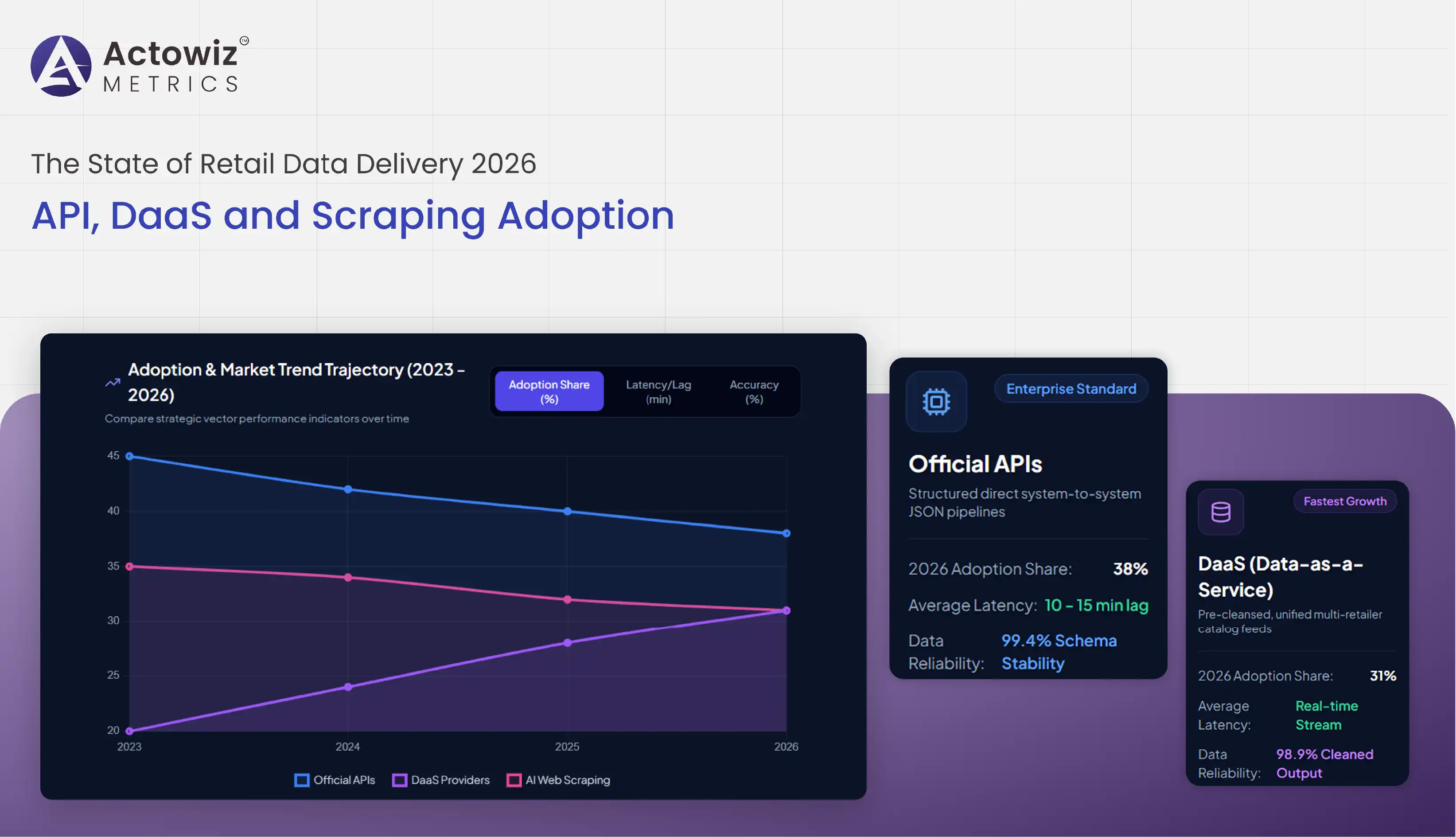
The State of Retail Data Delivery 2026 reflects this transition toward faster, scalable, machine-readable information. APIs, Data as a Service (DaaS), cloud platforms, automated extraction, and web-based monitoring are becoming interconnected components of modern retail intelligence. Rather than depending on manually exported spreadsheets or isolated databases, organizations are building pipelines capable of moving information from external and internal sources into dashboards, analytical models, alerts, and AI systems.
This evolution is also strengthening Digital shelf analytics, which enables brands and retailers to evaluate online product visibility, pricing, availability, content quality, search positioning, reviews, and competitor execution. Gartner describes digital shelf analytics applications as tools that gather information from third-party digital channels selling products, emphasizing channel coverage, insight depth, and integration capabilities.
The broader retail analytics market demonstrates the scale of this transformation. One 2026 market assessment estimates the global retail analytics market at $11.96 billion in 2026, up from $10.20 billion in 2025, with a projected 15.2% CAGR through 2034.
The period from 2020 to 2026 shows a clear progression from basic data collection toward connected delivery architectures. In 2020, many retail organizations still relied heavily on scheduled database exports, CSV files, manually maintained reports, and conventional business-intelligence workflows. The acceleration of e-commerce during 2020–2021 increased the amount and frequency of information that businesses needed to monitor.
By 2022, cloud adoption and automated pipelines were becoming increasingly important for retailers operating across marketplaces, websites, mobile applications, and physical stores. Data no longer represented only internal transactions. Competitive prices, promotions, product listings, availability, reviews, delivery promises, and marketplace seller information also became commercially important.
The 2023–2024 period introduced stronger demand for API-based integration and automated external data acquisition. Organizations increasingly wanted data to move directly into applications rather than requiring analysts to download and prepare files. By 2025 and 2026, AI applications further raised expectations around data freshness, structure, reliability, and accessibility.
| Indicator | Latest Reported Figure |
|---|---|
| Global retail analytics market, 2025 | $10.20B |
| Projected retail analytics market, 2026 | $11.96B |
| Retail analytics projected CAGR, 2025–2034 | 15.20% |
| DaaS market, 2025 | $24.88B |
| DaaS market, 2026 | $29.72B |
| DaaS projected market, 2031 | $61.18B |
Sources: Fortune Business Insights and Mordor Intelligence.
The adoption of Retail API, DaaS and Web Scraping Adoption 2026 therefore represents more than a technology preference. It reflects the need to create a dependable supply of information for pricing intelligence, assortment management, inventory analysis, promotion measurement, competitive benchmarking, and AI-supported decision-making. DaaS is particularly significant because its market is projected to expand from $29.72 billion in 2026 to $61.18 billion by 2031.
Between 2020 and 2026, retailers moved from asking whether data should be collected to asking how quickly, consistently, and economically it can be delivered. This represents an important change in data strategy.
During 2020–2021, retailers primarily focused on digital transformation and maintaining online availability. In 2022, competitive monitoring became more complex as marketplaces and omnichannel retail expanded. By 2023, organizations increasingly required standardized feeds for pricing, assortment, product, and availability intelligence. In 2024–2025, cloud-native architectures, automation, and AI increased the value of structured and continuously refreshed information.
In 2026, the focus is shifting toward data usability. Information that sits inside a warehouse but cannot be accessed by applications, analysts, or AI systems quickly has limited operational value. This is why modern retail organizations are investing in pipelines that connect external sources, APIs, databases, scraping systems, cloud storage, analytics platforms, and decision applications.
| Area | 2026 Indicator |
|---|---|
| DaaS market size | $29.72B |
| Retail analytics market size | $11.96B |
| Retail analytics projected CAGR | 15.20% |
| Cloud deployment share in retail analytics | 51.00% |
| Retail-chain segment share in retail analytics | 59.06% |
The retail analytics market assessment indicates that cloud deployment is expected to represent 51% of the market in 2026, highlighting the continuing movement toward scalable infrastructure.
These Retail data delivery trends 2026 demonstrate why data delivery has become an operational capability rather than a back-office function. Retail teams increasingly need information delivered according to business workflows: price changes can trigger alerts, inventory changes can update dashboards, assortment gaps can enter merchandising systems, and competitor promotions can feed pricing decisions.
For retailers managing thousands or millions of SKUs, delivery speed also affects the usefulness of intelligence. A competitive price discovered days after a promotion begins may be informative but commercially weak. The value increases when the information reaches decision-makers while action is still possible.
The development of APIs between 2020 and 2026 mirrors the broader transformation of retail technology. In the early part of the period, APIs were commonly viewed as technical mechanisms connecting applications. As retail systems became more interconnected, they increasingly became the preferred delivery layer for structured information.
From 2020 to 2022, retailers expanded integrations among commerce platforms, payment systems, inventory applications, customer platforms, and enterprise systems. Between 2023 and 2024, API-first development became more prominent as organizations sought reusable and scalable connections. In 2025, the emergence of AI agents created another reason to make business information accessible through well-designed interfaces.
Postman's 2025 State of the API report surveyed more than 5,700 developers, architects, and executives. It found that 82% of organizations had adopted some level of an API-first approach, while 25% described themselves as fully API-first. The report also found that 65% of organizations generate revenue from APIs.
| Metric | 2025 Finding |
|---|---|
| Organizations adopting some API-first approach | 82% |
| Fully API-first organizations | 25% |
| Organizations generating API revenue | 65% |
| Organizations planning increased API investment | 46% |
| Developers using AI | 89% |
| APIs designed for AI agents | 24% |
Source: Postman State of the API Report 2025.
The Retail API adoption 2026 environment is consequently moving beyond simple system integration. Retail APIs increasingly support pricing applications, product feeds, inventory services, personalization engines, recommendation systems, marketplace integrations, analytics platforms, and AI workflows.
The State of Retail Data Delivery 2026 also indicates a growing requirement for APIs to be reliable, documented, governed, monitored, and designed for machine consumption. For retailers, this means the API layer can become the bridge between raw information and operational decision-making.
Retail organizations cannot rely exclusively on internal databases. Important competitive information often exists outside their own technology environments, including marketplace listings, retailer websites, search results, promotional pages, product-detail pages, seller information, delivery promises, reviews, and publicly visible assortment data.
From 2020 to 2021, the rapid expansion of online shopping increased the volume of external retail information. In 2022–2023, marketplaces became increasingly important sources of competitive intelligence. During 2024–2025, businesses increasingly combined structured integrations with automated web-based collection to build broader datasets.
By 2026, Web scraping adoption in retail is increasingly positioned as one component of a wider data-delivery architecture rather than an isolated extraction activity. Automated collection can complement APIs when information is publicly visible but not exposed through a suitable structured interface.
| Year | Digital Shelf Analytics Market Indicator |
|---|---|
| 2020 | $310.45M* |
| 2021 | $407.61M* |
| 2022 | $453.21M* |
| 2023 | $538.31M* |
| 2024 | $691.38M* |
| 2025 | $845.50M* |
| 2026 | $1.04B* |
*MarketResearch/PW Consulting estimates; figures represent a third-party market forecast series rather than a universal industry measurement.
The growth of digital shelf intelligence illustrates why external data collection is increasingly valuable. Brands can use automated data acquisition to monitor competitor pricing, product availability, content completeness, promotional activity, search positioning, and assortment changes.
The objective is not simply to collect more information. The commercial objective is to transform external signals into structured datasets that can enter dashboards, alerting systems, pricing workflows, assortment models, and competitive intelligence processes.
The infrastructure supporting retail data has undergone a major transition since 2020. Earlier environments commonly separated transactional systems, analytics databases, reporting tools, and external datasets. As data volumes increased, retailers began adopting cloud storage, distributed processing, centralized data platforms, and automated pipelines.
The 2020–2021 period accelerated cloud migration because retailers needed scalable digital infrastructure. During 2022–2023, data lakes, warehouses, APIs, and integration platforms became increasingly interconnected. By 2024–2025, AI workloads increased pressure on organizations to improve data quality, governance, metadata, and accessibility.
The 2026 environment is increasingly characterized by architectures designed around continuous ingestion and flexible consumption.
| Metric | Current Indication |
|---|---|
| Retail analytics market, 2026 | $11.96B |
| Cloud segment share, 2026 | 51% |
| DaaS market, 2026 | $29.72B |
| DaaS projected CAGR, 2026–2031 | 15.53% |
| Retail analytics projected CAGR, 2025–2034 | 15.20% |
Sources: Fortune Business Insights and Mordor Intelligence.
The most important Retail data infrastructure trends include cloud-first deployment, API-led integration, automated ingestion, scalable storage, data quality controls, centralized governance, event-driven workflows, and AI-ready data models.
This architecture enables retailers to combine multiple sources without forcing every team to create separate collection and transformation processes. Product, price, promotion, inventory, seller, review, and customer datasets can be standardized and delivered to the applications that need them.
The infrastructure challenge is increasingly about consistency as much as volume. Data that arrives quickly but contains duplicate SKUs, inconsistent product identifiers, outdated prices, or incomplete attributes can create misleading conclusions. Consequently, modern retail infrastructure must combine speed with validation, normalization, monitoring, and governance.
Real-time and near-real-time delivery is becoming increasingly important because retail conditions can change within minutes or hours. Prices can move, promotions can launch, products can go out of stock, sellers can change offers, and delivery promises can shift rapidly.
In 2020, many organizations still depended on daily or weekly reporting cycles. During 2021–2022, faster e-commerce activity increased pressure for more frequent updates. By 2023–2024, automated alerts and continuously refreshed dashboards became more practical. In 2025–2026, AI and automated decision systems further increased the need for current, structured information.
Research on digital shelf analytics highlights the importance of processing high-velocity information and generating actionable alerts around issues such as pricing, search ranking, and availability.
| Period | Dominant Delivery Model | Typical Business Use |
|---|---|---|
| 2020 | Scheduled files and reports | Historical reporting |
| 2021 | Cloud-connected datasets | Omnichannel visibility |
| 2022 | Automated pipelines | Competitive monitoring |
| 2023 | API and platform integration | Operational analytics |
| 2024 | Near-real-time dashboards | Pricing and assortment |
| 2025 | AI-ready data delivery | Automated insights |
| 2026 | Continuous intelligence | Real-time decision support |
The emergence of Real-time retail data delivery changes the role of data from a retrospective reporting asset into an operational trigger. A price movement can initiate a pricing review. A stockout signal can trigger an availability investigation. A competitor promotion can generate a merchandising alert. A product-content change can initiate a catalog-quality workflow.
The most mature retail data environments therefore connect collection, validation, transformation, delivery, analytics, and action into a continuous loop.
Actowiz Metrics can support organizations seeking to turn fragmented retail information into structured, decision-ready intelligence. A modern data strategy requires more than extraction alone. It requires consistent collection, normalization, validation, monitoring, and delivery across multiple sources.
For pricing teams, Price & promotion intelligence can help identify competitor movements, promotional patterns, assortment changes, and market positioning opportunities. Automated datasets can support recurring monitoring rather than one-time research exercises.
The broader State of Retail Data Delivery 2026 landscape also shows why businesses need flexible data pipelines that can accommodate APIs, cloud systems, automated collection, structured feeds, and analytical applications. DaaS market growth and the expansion of retail analytics demonstrate the increasing commercial value of accessible, continuously updated information.
Actowiz Metrics can help businesses transform retail data into structured intelligence for competitive benchmarking, product monitoring, pricing analysis, assortment intelligence, marketplace research, and digital commerce decision-making.
The retail data ecosystem has moved decisively from periodic reporting toward connected, automated, and increasingly continuous intelligence. From 2020 to 2026, retailers progressed through cloud migration, API integration, automated collection, DaaS adoption, digital shelf monitoring, and AI-ready infrastructure.
The key lesson is that data value depends not only on what organizations collect but also on how reliably and quickly that information reaches the people and systems that can act on it. APIs provide scalable connectivity, DaaS creates accessible information products, automated web collection expands external market visibility, and cloud infrastructure enables large-scale processing.
The State of Retail Data Delivery 2026 therefore points toward an operating model in which data is continuously collected, standardized, validated, delivered, analyzed, and converted into action. Retail organizations that establish this connected foundation can respond faster to pricing changes, assortment movements, availability problems, promotions, and competitive shifts.
Ready to build a faster, smarter retail intelligence pipeline? Partner with Actowiz Metrics to transform retail data into actionable insights for pricing, assortment, availability, and competitive decision-making!
Expert blogs, research reports and infographics — practical, data-driven reading across e-commerce and quick-commerce.
Most fields are optional — the more you share, the better your sample.
.webp "infographics")
.webp "infographics")