BLOG






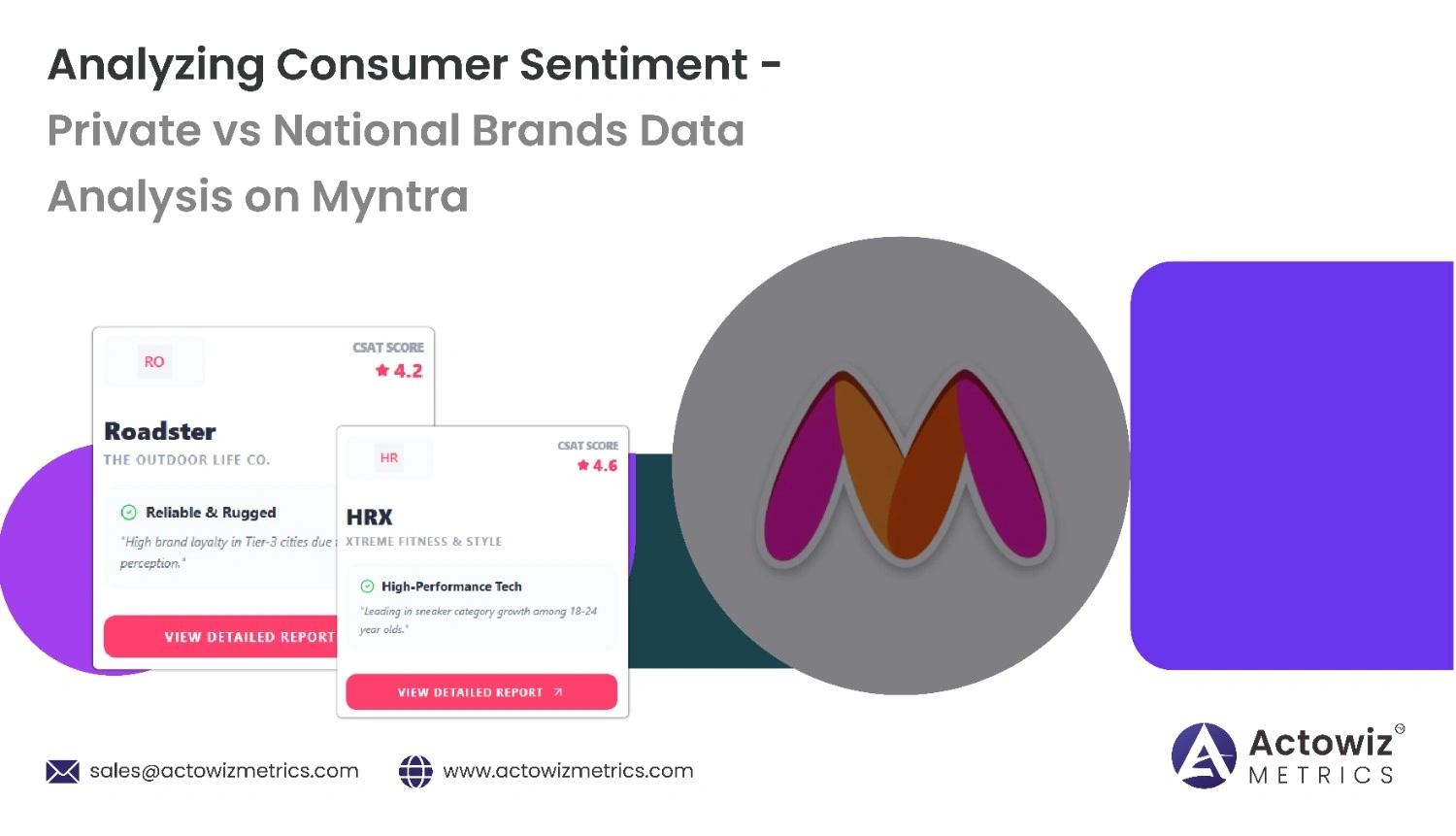
India’s online fashion market has grown rapidly over the last decade, with platforms like Myntra leading the way in shaping consumer shopping behavior. One of the most significant competitive dynamics on such platforms is the rise of private labels competing directly with established national brands. Understanding how these two categories perform requires deep marketplace intelligence, consumer feedback tracking, and pricing analysis. This is where Private vs National Brands Data Analysis on Myntra becomes essential for retailers, manufacturers, and marketplace strategists.
Private labels are often designed to offer competitive pricing and trendy styles, while national brands rely on established trust, brand recognition, and quality perception. However, the real competitive insights emerge when businesses analyze sales trends, customer reviews, pricing strategies, and assortment strategies at scale. This is why Product Data Tracking across product listings, ratings, reviews, and price movements has become a critical component of modern retail analytics.
Through systematic data collection and analysis, brands can identify which categories favor private labels, where national brands dominate, and how consumer sentiment evolves over time. This blog explores key insights derived from marketplace data, examining the evolving battle between private and national brands and the analytics approaches used to measure their performance on Myntra.
Consumer sentiment plays a major role in determining brand success on eCommerce platforms. Businesses increasingly Scrape Myntra Reviews for Brand Sentiment Analysis to understand how customers perceive different brands, product quality, pricing value, and service experience. By analyzing review content, ratings distribution, and recurring feedback patterns, companies can detect strengths and weaknesses across product categories.
Another important aspect of brand sentiment is MAP Monitoring (Minimum Advertised Price Monitoring). Brands track pricing behavior across sellers to ensure consistent price positioning, which significantly influences customer perception and brand credibility.
Below is a trend snapshot of review sentiment distribution across private and national brands on Myntra.
| Year | Avg Rating Private Brands | Avg Rating National Brands | Positive Review % |
|---|---|---|---|
| 2020 | 3.9 | 4.2 | 71% |
| 2021 | 4.0 | 4.2 | 73% |
| 2022 | 4.1 | 4.3 | 75% |
| 2023 | 4.2 | 4.3 | 77% |
| 2024 | 4.2 | 4.4 | 78% |
| 2025 | 4.3 | 4.4 | 79% |
| 2026 | 4.3 | 4.5 | 80% |
Data indicates that national brands still hold slightly higher ratings, but private labels are steadily closing the gap. Fashion retailers leverage review analytics to identify design improvements, quality issues, and product sizing concerns.
By combining review scraping with price monitoring and sentiment classification models, companies gain actionable insights into consumer perception shifts and competitive brand positioning across categories.
Competition between private labels and national brands varies significantly depending on fashion category, pricing range, and customer segment. Using Myntra Private Brand vs Branded Products Analytics, retailers can evaluate category-level performance differences across apparel, footwear, and accessories.
Private labels often dominate fast-fashion segments such as casual wear and everyday apparel, where price sensitivity and trend speed matter most. In contrast, premium categories such as sportswear and formalwear continue to be dominated by established national brands.
The following category-level comparison highlights this difference.
| Category | Private Brand Share (2020) | Private Brand Share (2026) |
|---|---|---|
| Casual Wear | 32% | 46% |
| Sportswear | 12% | 18% |
| Footwear | 19% | 28% |
| Ethnic Wear | 26% | 35% |
| Accessories | 21% | 33% |
These analytics reveal that private labels have gained significant traction in categories driven by affordability and fast-changing trends. Meanwhile, national brands continue to maintain leadership in performance-focused and premium segments.
Retailers utilize such insights to adjust merchandising strategies, product assortment planning, and marketing campaigns. Category-level analytics also help brands identify underperforming segments where strategic investments can improve competitiveness.
Comprehensive marketplace intelligence depends on structured product data extraction and benchmarking. Businesses frequently Extract Private vs National Brands Data on Myntra to evaluate product assortment depth, price tiers, discount strategies, and rating performance.
Large-scale product dataset analysis enables companies to answer questions such as:
The following dataset snapshot illustrates SKU distribution trends.
| Year | Private Brand SKUs | National Brand SKUs |
|---|---|---|
| 2020 | 48,000 | 110,000 |
| 2021 | 56,000 | 118,000 |
| 2022 | 65,000 | 126,000 |
| 2023 | 78,000 | 132,000 |
| 2024 | 92,000 | 139,000 |
| 2025 | 105,000 | 144,000 |
| 2026 | 118,000 | 150,000 |
Although national brands still lead in total product count, private labels are expanding rapidly. This growth reflects Myntra’s strategic focus on developing in-house labels to increase margins and platform exclusivity.
Companies using structured data pipelines gain a clearer view of brand competition, enabling more informed pricing and assortment decisions.
Sales performance data offers another perspective on the competitive landscape. With Myntra BestSelling Brands Analytics, retailers can identify brands that consistently rank in top-selling lists across categories and seasons.
Top-selling brand rankings often fluctuate during festive seasons, sale events, and fashion cycles. However, some brands consistently maintain strong positions due to product quality, brand loyalty, and aggressive marketing strategies.
Below is an example of bestselling brand share trends.
| Year | Private Label Sales Share | National Brand Sales Share |
|---|---|---|
| 2020 | 24% | 76% |
| 2021 | 27% | 73% |
| 2022 | 30% | 70% |
| 2023 | 33% | 67% |
| 2024 | 36% | 64% |
| 2025 | 38% | 62% |
| 2026 | 41% | 59% |
The steady growth of private label sales demonstrates increasing consumer acceptance of platform-owned brands.
Brands leverage bestseller analytics to optimize inventory planning, product promotions, and marketing investments. Understanding bestseller trends also helps retailers anticipate demand patterns and improve supply chain responsiveness.
Modern retail strategies depend heavily on data-driven insights derived from E-commerce Analytics. These analytics combine product performance data, pricing patterns, consumer reviews, and search rankings to generate actionable intelligence.
E-commerce analytics enables businesses to track key performance indicators such as:
Below is a pricing trend comparison between private and national brands.
| Year | Avg Price Private Brands | Avg Price National Brands |
|---|---|---|
| 2020 | ₹899 | ₹1,850 |
| 2021 | ₹925 | ₹1,920 |
| 2022 | ₹950 | ₹1,980 |
| 2023 | ₹980 | ₹2,050 |
| 2024 | ₹1,020 | ₹2,120 |
| 2025 | ₹1,060 | ₹2,200 |
| 2026 | ₹1,100 | ₹2,280 |
This price gap highlights the value positioning of private labels, which continues to attract cost-conscious shoppers.
Brands using advanced analytics dashboards can monitor these trends in real time, enabling faster responses to competitor pricing, customer demand shifts, and promotional opportunities.
In online marketplaces, digital shelf positioning plays a crucial role in influencing purchase decisions. Through Digital Shelf Analytics, brands can measure their visibility across search rankings, category placements, and recommendation engines.
Digital shelf metrics include:
The following table illustrates visibility growth trends for private labels.
| Year | Avg Search Rank Private Labels | Avg Search Rank National Brands |
|---|---|---|
| 2020 | 18 | 9 |
| 2021 | 16 | 9 |
| 2022 | 14 | 8 |
| 2023 | 13 | 8 |
| 2024 | 12 | 7 |
| 2025 | 11 | 7 |
| 2026 | 10 | 6 |
Private labels are gradually improving their visibility due to platform promotion and better optimization strategies. Digital shelf analytics allows brands to monitor these metrics continuously and improve discoverability.
Companies that track digital shelf data gain a competitive advantage by identifying ranking opportunities, optimizing product listings, and improving conversion rates.
Actowiz Metrics provides advanced data intelligence solutions that help brands decode marketplace competition through comprehensive analytics and automation tools. With deep expertise in large-scale eCommerce data extraction, the company enables brands to gain powerful insights into marketplace trends and performance metrics.
Through advanced Price Benchmarking, businesses can track competitor pricing movements, monitor discount patterns, and identify profitable price positioning strategies across product categories. This allows companies to maintain competitive pricing while protecting margins.
Actowiz Metrics also specializes in Private vs National Brands Data Analysis on Myntra, delivering structured datasets and analytical dashboards that highlight brand performance differences, consumer sentiment trends, and product assortment insights.
By combining pricing intelligence, review analytics, product performance tracking, and competitive monitoring, Actowiz helps businesses optimize their marketplace strategies, improve product visibility, and strengthen brand competitiveness in fast-evolving digital retail environments.
The competition between private labels and national brands is reshaping the fashion marketplace landscape. As consumer preferences shift toward value-driven purchasing and fast fashion trends, private labels continue gaining ground in several product categories. However, national brands still maintain strong positions due to brand equity, perceived quality, and loyal customer bases.
Through advanced data intelligence methods such as Brand Competition Analysis, companies can better understand how brand perception, pricing strategies, product assortment, and digital shelf positioning influence consumer behavior.
Businesses leveraging Private vs National Brands Data Analysis on Myntra gain the ability to identify market gaps, optimize product strategies, and respond quickly to emerging trends.
Ready to gain deeper marketplace insights? Partner with Actowiz Metrics to unlock powerful data-driven strategies that help your brand outperform competitors and dominate the digital shelf!
Expert blogs, research reports and infographics — practical, data-driven reading across e-commerce and quick-commerce.
Most fields are optional — the more you share, the better your sample.
.webp "infographics")
.webp "infographics")