BLOG
















India's skincare industry is evolving rapidly as consumers explore ingredient-focused formulations, premium beauty products, affordable alternatives, and specialised skincare routines. Nykaa and Amazon have become important digital channels for discovering skincare brands, comparing product prices, and understanding changing consumer preferences. A structured India Skincare Market Analysis helps beauty brands, retailers, distributors, and market research companies understand these developments through measurable product-level insights.
This research focuses on comparing 1,200 skincare products across 90 brands listed on Nykaa and Amazon. The objective is to understand product availability, pricing differences, brand positioning, assortment diversity, and competitive activity across both marketplaces. The comparison framework covers categories such as cleansers, moisturisers, serums, sunscreens, toners, face masks, and specialised skincare treatments.
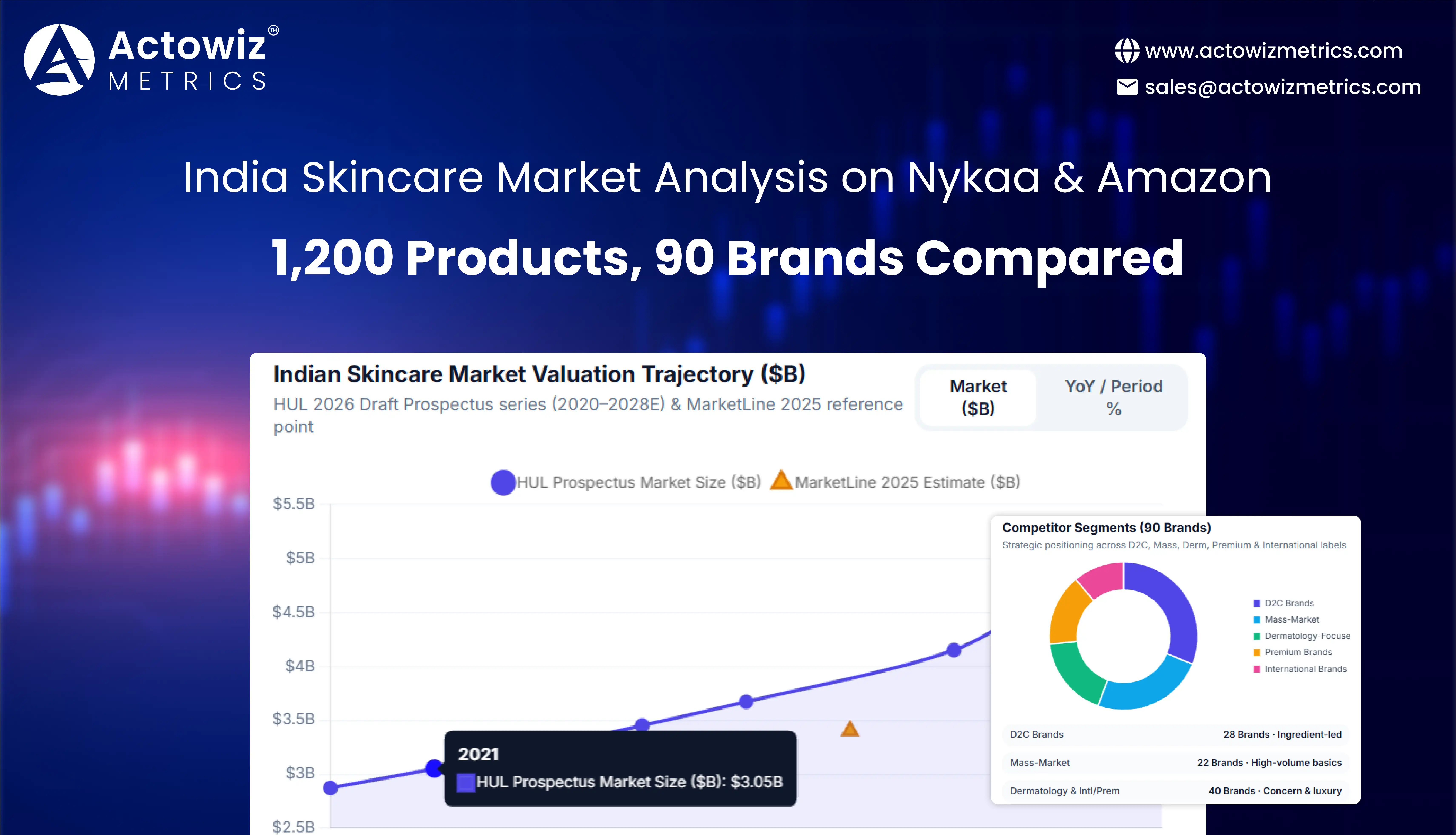
The Indian skincare market was valued at approximately $2.87 billion in 2020 and $3.67 billion in 2024, according to market information included in Hindustan Unilever's 2026 draft red herring prospectus. This growth highlights the commercial importance of understanding digital retail performance.
By applying Beauty & personal care analytics, businesses can convert marketplace product information into structured intelligence. This enables brands to identify pricing opportunities, monitor competitors, evaluate assortment gaps, and make informed decisions about their online retail strategies.
Nykaa and Amazon Skincare Product Data Collection provides the foundation for understanding how skincare products are positioned across India's major online marketplaces. A structured comparison of 1,200 products from 90 brands can help businesses evaluate product listings, category distribution, price points, brand visibility, and availability.
The collection process should capture essential attributes, including product names, brand names, product categories, descriptions, ingredients, pack sizes, listed prices, discounted prices, ratings, review counts, and availability status. These attributes allow businesses to compare equivalent products instead of relying on general marketplace observations.
The broader market demonstrates why this information matters. The skincare market increased from $2.87 billion in 2020 to $3.67 billion in 2024. The same industry source projects a market value of $5.32 billion by 2028. These are market estimates and projections, not audited marketplace sales figures.
India Skincare Market Analysis also requires consistent product classification. For example, a vitamin C serum should be compared with similar serum products rather than grouped with moisturisers simply because both address facial skincare needs.
| Research indicator | Data collected | Business application |
|---|---|---|
| Product identification | Product name and SKU | Catalogue matching |
| Brand information | Brand and manufacturer | Brand benchmarking |
| Product category | Serum, cleanser, sunscreen | Category analysis |
| Pricing | MRP and selling price | Price positioning |
| Customer engagement | Ratings and reviews | Customer feedback analysis |
| Availability | In-stock status | Assortment monitoring |
For brands, distributors, and online retailers, this approach creates a consistent foundation for marketplace intelligence. It also makes it easier to identify missing product information, duplicate listings, and differences in how individual marketplaces present the same skincare product.
Pricing is one of the most important factors influencing online skincare purchases. The same brand may offer multiple product sizes, formulations, bundles, and promotional combinations across Nykaa and Amazon. Therefore, comparing listed prices without checking pack sizes and product specifications can produce misleading conclusions.
Skincare Product Price Comparison India helps businesses identify differences in maximum retail price (MRP), selling price, promotional discounts, and effective unit costs. For example, a 30 ml serum should be compared with the same formulation and pack size wherever possible. If a 30 ml product is compared with a 50 ml alternative, the price difference alone does not establish which marketplace offers better value.
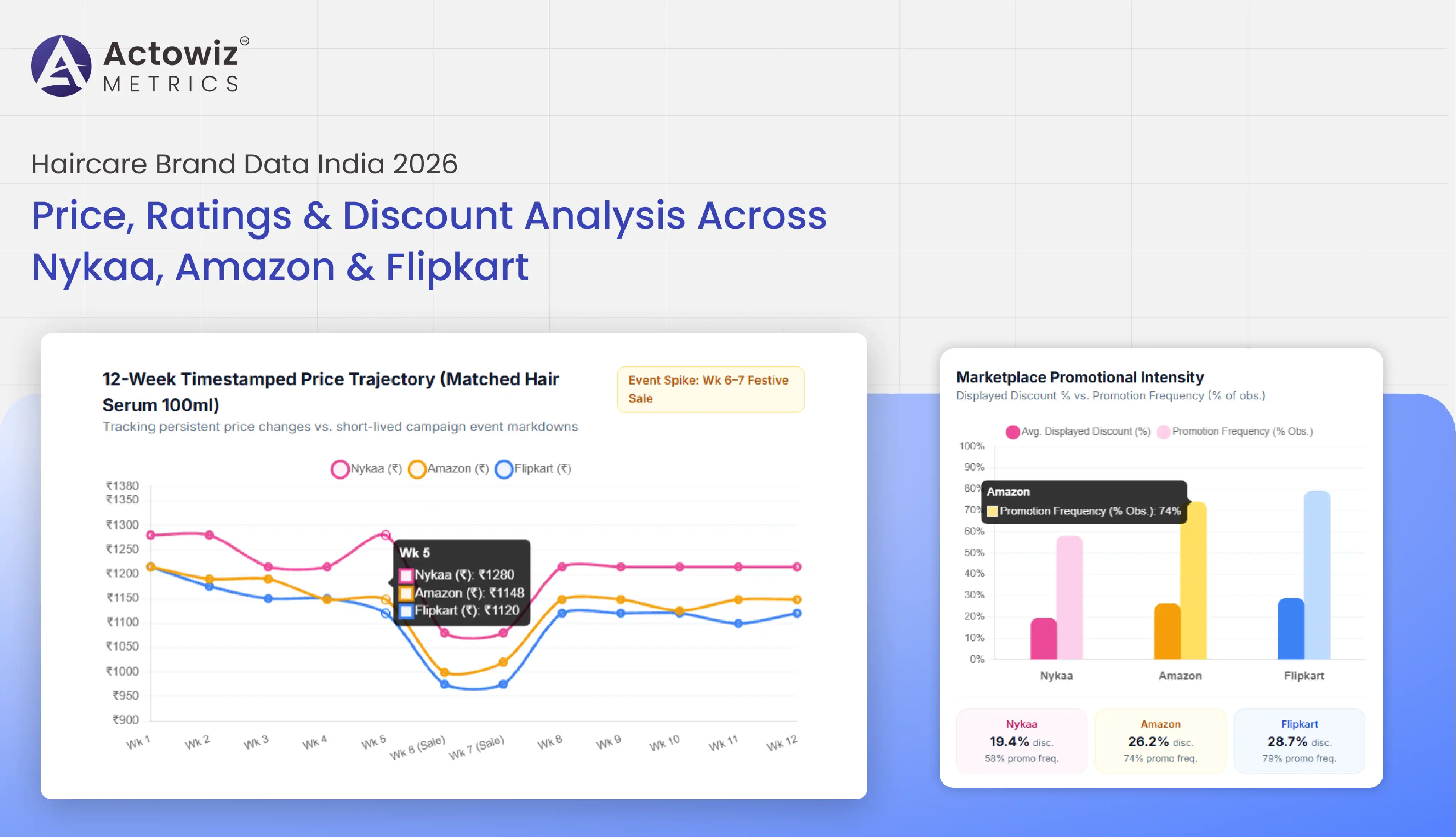
Price monitoring should also distinguish temporary promotions from regular pricing. Festival campaigns, seasonal sales, and marketplace-specific offers can influence observed prices. Businesses should retain historical snapshots to identify whether a discount represents a recurring pricing strategy or a short-term campaign.
| Pricing metric | Calculation or comparison | Business value |
|---|---|---|
| Discount percentage | (MRP − selling price) / MRP × 100 | Promotion tracking |
| Unit price | Selling price / product quantity | Value comparison |
| Price gap | Amazon price − Nykaa price | Marketplace benchmarking |
| Price volatility | Change across collection dates | Pricing stability |
| Offer frequency | Number of promotional observations | Campaign monitoring |
A useful reporting timeline covers 2020–2026, but historical marketplace prices should only be included when archived listing records or reliable historical datasets exist. Current prices must not be presented as historical prices.
For skincare manufacturers and online sellers, this analysis supports better promotional planning, price consistency checks, and competitive positioning without relying on isolated product observations.
India's skincare competition includes established beauty companies, specialised skincare brands, premium international labels, and digitally native businesses. These brands compete through product formulations, ingredient positioning, pricing, packaging, customer reviews, and marketplace visibility.
Skincare Competitor Analysis India enables businesses to evaluate how competing brands perform across comparable product categories. Instead of examining brand popularity alone, companies can analyse the breadth of each competitor's assortment, price distribution, product availability, and customer engagement indicators.
Nykaa's FY2025 annual reporting provides useful context about the scale of the beauty retail ecosystem. The company reported more than 4,200 beauty and personal care brands as of March 31, 2025. Its beauty vertical recorded ₹11,775 crore in GMV during FY2025, compared with ₹9,055 crore in FY2024, representing 30% growth. These figures describe Nykaa's beauty business, not skincare alone.
India Skincare Market Analysis becomes more actionable when competitors are grouped by their market positioning.
| Competitive segment | Examples of research dimensions | Strategic purpose |
|---|---|---|
| Mass-market brands | Affordable cleansers and moisturisers | Value positioning |
| Premium brands | Specialised treatments and premium formulations | Premium pricing |
| D2C brands | Ingredient-led product portfolios | Digital competition |
| International brands | Global formulations and positioning | Imported-brand benchmarking |
| Dermatology-focused brands | Concern-specific skincare products | Functional differentiation |
The research should compare brands using consistent indicators rather than treating review counts as actual sales. Ratings and reviews provide customer feedback signals, but they do not independently establish revenue, conversion rates, or market share.
For brand managers, the resulting intelligence can reveal underrepresented categories, crowded price brackets, and competitor products that deserve closer monitoring. It also supports more informed product development and marketplace positioning decisions.
Brand performance should be evaluated through multiple indicators rather than a single ranking. A skincare brand with a large catalogue may have broad marketplace coverage, while a smaller competitor may focus on a narrow assortment of specialised products. Both strategies require different performance measurements.
Nykaa and Amazon Skincare Brand Performance Analysis examines how brands position their products through pricing, assortment breadth, availability, ratings, and promotional activity.
Nykaa's FY2025 results offer an example of how beauty businesses report their operating scale. Its beauty vertical recorded 54.5 million orders in FY2025, compared with 43.7 million in FY2024. Annual unique transacting customers increased from 12.4 million to 15.8 million over the same period. These are company-wide beauty vertical figures, not skincare-specific order counts.
| Performance metric | Nykaa | Amazon | Comparison objective |
|---|---|---|---|
| Listed product count | To be measured | To be measured | Catalogue coverage |
| Average selling price | To be calculated | To be calculated | Price positioning |
| Average rating | To be calculated | To be calculated | Customer feedback |
| Review count | To be collected | To be collected | Engagement visibility |
| In-stock percentage | To be calculated | To be calculated | Availability |
| Discount frequency | To be calculated | To be calculated | Promotion strategy |
These fields should be calculated from the collected product records, not assumed from industry reports. Matching brand names, product variants, and pack sizes is essential before making comparisons.
For skincare companies, this framework helps identify where a brand has stronger product visibility, where competitors offer broader selections, and which marketplace requires additional commercial attention.
Product assortment determines the variety of skincare solutions available to online shoppers. Nykaa and Amazon serve overlapping beauty audiences, but their product catalogues, brand partnerships, seller structures, and product discovery experiences can differ.
Nykaa and Amazon Skincare Product Assortment Comparison helps retailers understand which brands and product categories are available on both platforms and which appear in only one marketplace.
Nykaa's FY2025 annual report identifies more than 4,200 beauty and personal care brands on its platform. This provides an indication of its broad brand ecosystem, although the figure includes categories beyond skincare.
Amazon also continues expanding its beauty assortment. In May 2026, Amazon India announced plans to introduce more than 100 premium beauty brands during the year, including skincare names such as La Roche-Posay, CeraVe, Avène, Biodance, Eucerin, and Paula's Choice. Amazon also reported that premium beauty was growing 50% year over year on its platform. These are Amazon-reported figures and announcements.
India Skincare Market Analysis should distinguish between shared listings, exclusive listings, and different variants of the same product.
| Assortment indicator | What should be compared? | Business application |
|---|---|---|
| Shared products | Identical products on both platforms | Marketplace overlap |
| Exclusive products | Products listed on one platform | Assortment opportunities |
| Brand coverage | Number of brands represented | Distribution analysis |
| Category coverage | Serums, cleansers, sunscreens | Category expansion |
| Product variants | Sizes, formulations, and packs | Catalogue completeness |
| New launches | Newly appearing products | Innovation monitoring |
A product matching system should use brand, product name, formulation, size, and relevant identifiers. This prevents different variants from being incorrectly counted as identical products.
The comparison can also identify category-level gaps. For instance, if a particular skincare concern has a wider assortment on one platform, competing brands can investigate whether their product range adequately addresses that customer need.
For distributors and manufacturers, assortment intelligence supports channel selection, new product launches, catalogue optimisation, and competitive distribution planning.
Direct-to-consumer skincare brands have changed how products reach customers. Their digital-first strategies allow businesses to build brand awareness, communicate product benefits, and develop specialised product portfolios through online channels.
D2C Skincare Price Data India helps brands understand how their products compete with established beauty labels and other emerging skincare businesses. Price intelligence is particularly important when similar products target the same skin concerns but differ in ingredients, quantities, packaging, and positioning.
The growing importance of digital beauty distribution is supported by industry research. Ipsos India's July 2024 report identifies e-commerce expansion, social media influencers, premiumisation, homegrown brands, and consumer experimentation as important developments in India's beauty and personal care sector.
| Period | Verified industry development | Pricing research opportunity |
|---|---|---|
| 2020 | Indian skincare market valued at $2.87 billion | Establish historical market context |
| 2021–2023 | Consumer and digital beauty trends require year-specific evidence | Compare archived product prices |
| 2024 | Skincare market estimated at $3.67 billion | Evaluate category-level positioning |
| 2025 | Indian skincare market estimated at $3.4 billion by MarketLine | Compare market estimates using their respective methodologies |
| 2026 | Amazon announced expansion of over 100 premium beauty brands | Monitor premium assortment and positioning |
Sources: HUL draft prospectus and MarketLine industry profile. The 2025 MarketLine figure uses a different published research series and should not be treated as a directly comparable continuation of the HUL prospectus estimates.
For D2C businesses, the biggest benefit of structured price intelligence is the ability to distinguish genuine competitive advantages from temporary discounts. It helps teams understand whether their products are competitively positioned and whether pricing adjustments are justified by category conditions.
Actowiz Metrics helps businesses transform marketplace information into structured, decision-ready intelligence. For skincare manufacturers, beauty retailers, distributors, and D2C companies, collecting and analysing product information across Nykaa and Amazon can provide a clearer picture of the competitive environment.
Our marketplace data solutions can support a structured comparison of 1,200 skincare products across 90 brands, based on the research scope and product records available for collection.
Through Nykaa analytics, businesses can evaluate marketplace assortment and brand positioning while identifying potential catalogue gaps. Combined with regular monitoring, these insights can support more informed pricing and distribution strategies.
Actowiz Metrics focuses on transforming complex e-commerce information into practical intelligence that businesses can use to improve their understanding of India's competitive beauty retail environment.
The Indian skincare industry offers significant opportunities for established beauty companies, emerging D2C brands, and online retailers. However, understanding this competitive environment requires more than tracking market growth. Businesses need reliable product-level intelligence to evaluate pricing, brand performance, catalogue coverage, promotional activity, and marketplace availability.
Comparing 1,200 skincare products across 90 brands on Nykaa and Amazon provides a structured approach to understanding these competitive factors. The findings can help businesses identify product assortment gaps, benchmark competitors, evaluate pricing differences, and improve online retail strategies.
A data-driven India Skincare Market Analysis also enables companies to make informed decisions about product launches, promotional campaigns, and distribution opportunities.
With Amazon analytics, businesses can strengthen their understanding of marketplace competition and combine these insights with Nykaa data to develop a more comprehensive beauty retail strategy.
Want to understand how your skincare brand compares with competitors on Nykaa and Amazon?
Partner with Actowiz Metrics for reliable e-commerce data extraction, product intelligence, competitor monitoring, and actionable market research. Contact Actowiz Metrics today to transform marketplace data into smarter business decisions!
It compares product assortments, selling prices, discounts, unit costs, ratings, reviews, and availability across cleansers, moisturisers, serums, sunscreens, toners, face masks, and treatments.
Comparing listings with different millilitre or gram weights or different formulations without adjusting for unit size and product type can distort value and discount comparisons.
Teams should evaluate multiple signals together—such as listed product counts, price brackets, stock availability, ratings, review volume, and discount frequency—rather than relying on a single metric.
Businesses should track shared versus exclusive listings, brand and category coverage, variant availability across sizes and formulations, and newly introduced products.
Actowiz Metrics helps extract and standardize product, pricing, promotional, rating, and availability data across Nykaa and Amazon into structured datasets and reports for competitive analysis.
Expert blogs, research reports and infographics — practical, data-driven reading across e-commerce and quick-commerce.
Most fields are optional — the more you share, the better your sample.

.webp "infographics")
.webp "infographics")