BLOG













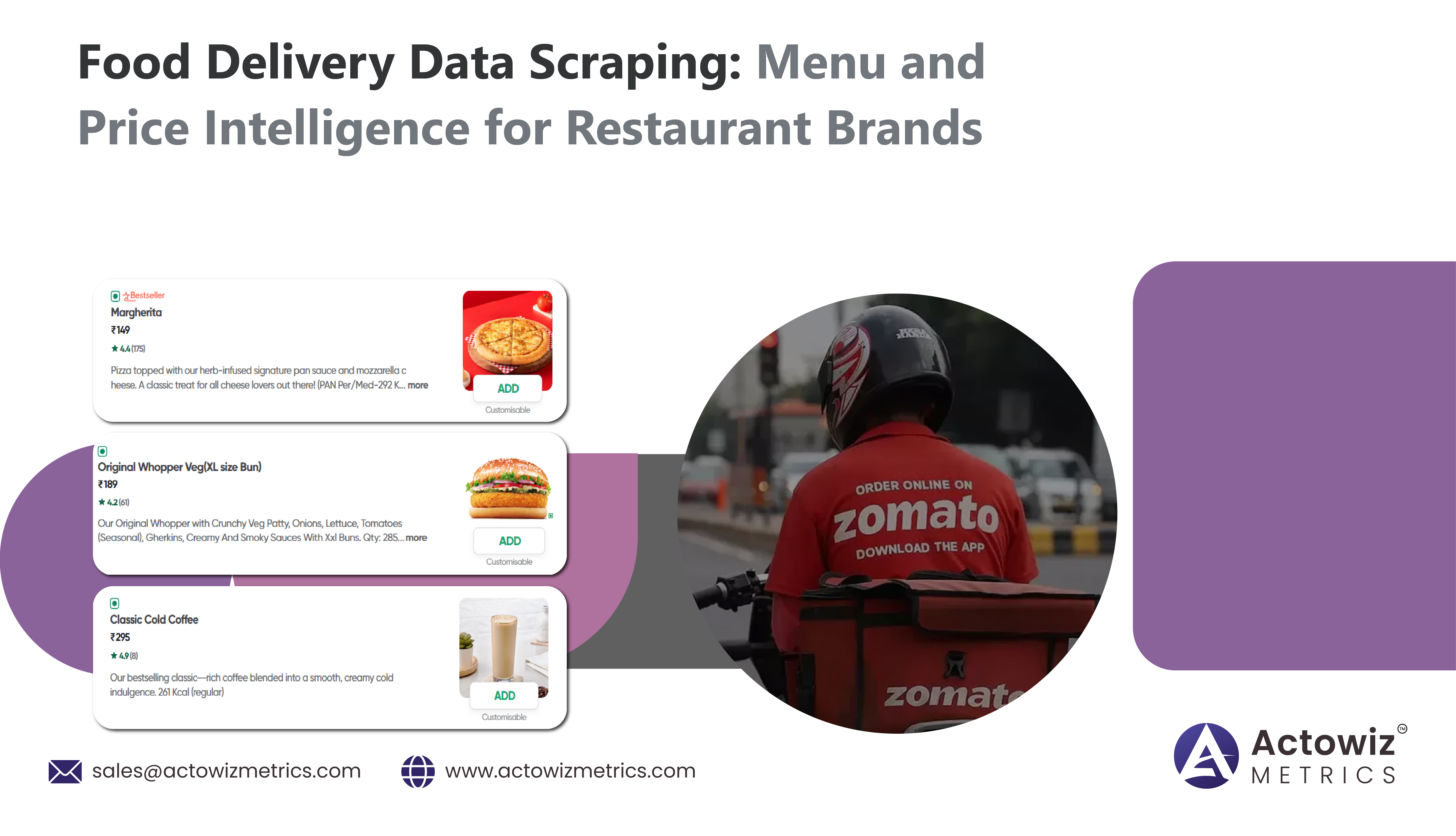
Food delivery has become a marketplace in its own right. For a growing share of restaurants and food brands, more revenue now arrives through Swiggy, Zomato, UberEats, DoorDash, Keeta, Glovo, and iFood than through the front door, and the decisions that determine performance on those apps look far more like retail merchandising than hospitality. Menu composition, item pricing, promotional depth, delivery time, and visibility in search now decide whether an order is placed — and all of them are set inside apps a brand cannot see from the outside. Food delivery data scraping closes that gap by turning what is displayed to millions of diners into a structured dataset a brand can analyse and act on.
The competitive pressure is intense. In any given locality, dozens of restaurants offer overlapping cuisines at overlapping price points, and a diner scrolling an app makes a decision in seconds based on price, rating, delivery estimate, and how appealing the listing looks. A restaurant brand that does not know how its menu is priced against nearby competitors, or how its delivery promise compares, is competing without seeing the scoreboard.
This article explains what food delivery data contains, why it is unusually difficult to collect, how restaurant brands and analysts use it, and what a well-designed monitoring programme looks like. The throughline is that food delivery has quietly become a data-driven channel, and the brands treating it as one are pulling ahead of those still relying on instinct and occasional manual checks.
A restaurant listing on a delivery app behaves far more like a product page than a table booking. It has a headline image, a rating, a price point, a delivery promise, and a position in a ranked list of alternatives. Diners compare these attributes across several options in seconds and choose, much as an online shopper compares products. The skills that win in this environment — pricing, merchandising, and visibility management — come from retail rather than hospitality, and many restaurant operators are still adapting to that.
The economics reinforce the point. Platform commissions compress margins, which makes pricing decisions unusually consequential: a dish priced slightly too high loses orders, while one priced slightly too low erodes what little margin remains after commission. Getting that balance right for every item, in every locality, against competitors who are constantly adjusting, is not something intuition can manage reliably. It requires knowing what the alternatives actually cost.
The food delivery market is regional in a way that few digital channels are. In India, Swiggy and Zomato dominate the everyday order. In the United States, UberEats, DoorDash, and Postmates compete for the same diner. Across the Middle East, platforms including Keeta, HungerStation, and Talabat lead in their respective markets, while Glovo is significant across parts of Europe and iFood dominates in Brazil. A brand operating in several countries is therefore competing on entirely different platforms in each, with different conventions, different competitors, and different pricing norms.
This fragmentation has a practical consequence: there is no single dashboard that shows a multi-market food brand how it is performing. Each platform must be understood on its own terms, and comparisons across markets require data that has been normalised into a common structure. For brands expanding internationally, or for analysts studying the sector, that normalisation is often the hardest and most valuable part of the exercise.
The channel is also still growing and consolidating, with platforms competing aggressively on commission structures, promotional programmes, and delivery speed. That volatility means the competitive picture a brand formed six months ago is likely already out of date, which further raises the value of continuous rather than occasional visibility.
Cloud kitchens have added another layer of competitive intensity. Because a delivery-only brand can launch without a storefront and operate several concepts from one kitchen, the number of competitors in any given cuisine and locality can grow quickly and without the visible signals a physical opening would provide. A restaurant can find itself competing against half a dozen new entrants it never saw arrive, which makes systematic monitoring the only practical way to know who is actually competing for the same order.
A useful food delivery dataset goes well beyond a restaurant's name and address. The richest and most commercially relevant information sits inside the menu, where each item carries a price that can be compared, tracked, and benchmarked. Around that sit the signals that shape whether a diner clicks at all.
Together these describe the listing exactly as a diner experiences it, which is the only view that matters commercially. The sample below shows how that looks once structured.
| Restaurant | Platform | City | Item | Price | Delivery ETA | Rating |
|---|---|---|---|---|---|---|
| Your Brand | Swiggy | Mumbai | Paneer Butter Masala | ₹329 | 28 min | 4.3 |
| Competitor A | Swiggy | Mumbai | Paneer Butter Masala | ₹299 | 24 min | 4.5 |
| Competitor B | Zomato | Mumbai | Paneer Butter Masala | ₹315 | 31 min | 4.1 |
| Your Brand | Zomato | Mumbai | Paneer Butter Masala | ₹329 | 30 min | 4.2 |
Illustrative sample — the same dish benchmarked across platforms and competitors, with delivery time and rating shown alongside price.
Food delivery data presents challenges that most retail data does not. The first is hyperlocality: what a diner sees depends entirely on their delivery address, because platforms show only restaurants that serve that location. A single national view is meaningless; the data must be collected against specific locations to reflect any real diner's experience, which multiplies the collection effort by the number of localities a brand cares about.
The second challenge is that much of this information lives primarily inside mobile applications rather than on websites. Several platforms, particularly in Asia and the Middle East, are effectively mobile-only, so conventional web collection reaches very little of the catalogue. Extracting menu and pricing data from these platforms requires working with the application layer directly, which is a materially more specialised undertaking than reading a web page.
The third is volume and volatility combined. A single restaurant may list dozens of items, a city contains thousands of restaurants, and prices, promotions, and delivery estimates change frequently — often several times a day as demand and rider availability shift. Capturing a meaningful picture therefore means collecting a great deal of data repeatedly, which only a properly engineered pipeline can sustain.
For restaurant and food brands, the most direct application is menu price benchmarking. Knowing how comparable dishes are priced at nearby competitors, locality by locality, lets a brand position its menu deliberately rather than by guesswork. This is particularly valuable for signature and high-volume items, where a small pricing difference against a close competitor can measurably shift order share.
Promotion intelligence is a close second. Discounting is heavy in this channel, and a brand that cannot see competitor promotions ends up either over-discounting to be safe or being quietly outbid during peak periods. Tracking offers over time also reveals promotional rhythms — which competitors discount on which days, and how deeply — allowing a brand to time its own activity rather than react to it.
Delivery performance is a third area that brands often underestimate. Because the promised delivery time appears prominently and influences the click, a restaurant that is consistently slower than nearby alternatives loses orders it might otherwise win on food and price alone. Benchmarking delivery estimates by locality highlights where operational improvement would pay off commercially.
Beyond individual brands, this data supports market research, franchise expansion analysis, and category studies. Cuisine mix, price distribution, and restaurant density by locality all become measurable, which helps operators decide where to open, what to charge, and which segments are underserved in a given city.
Ratings deserve attention alongside price because they function as a conversion multiplier on these platforms. A restaurant priced competitively but rated meaningfully below nearby alternatives will still lose orders, and the gap is often wide enough to outweigh a sensible price advantage. Tracking rating and review volume across competitors shows where a brand stands on the dimension diners weigh most heavily after price.
Review content is more actionable still. Recurring themes — packaging that fails in transit, portions that disappoint, items that arrive cold — point to operational fixes that improve both rating and repeat ordering. Because these complaints are visible publicly for competitors as well, they also reveal where rivals are weak, which can inform how a brand positions its own listing and what it emphasises in its menu descriptions.
A practical programme begins with scoping the localities, platforms, competitors, and menu items that genuinely matter. Because collection is location-specific, this scoping does more to determine cost and value than any other decision — a focused set of high-priority localities produces far more usable insight than a thin national sweep.
Collection then runs at a frequency matched to how quickly the data changes, with prices and promotions typically warranting more regular capture than static restaurant details. The output is cleaned and normalised so that items can be compared across platforms and competitors, which requires careful matching given how differently the same dish may be named. Finally, the structured data flows into whatever dashboard or analysis environment the team already uses, with alerts on the changes that warrant a response.
Scoping deserves more care in this channel than in most because the cost of collection scales with the number of localities rather than the number of brands. A national sweep across every district is expensive and produces more data than most teams can use, whereas a well-chosen set of localities — those where a brand actually operates, plus the areas it is considering — delivers nearly all the useful insight at a fraction of the effort. Being deliberate at this stage is the single biggest determinant of whether a programme is worth its cost.
Food delivery intelligence should work with publicly displayed information — the menus, prices, ratings, and delivery estimates any diner can see in the app. Collecting only this public commercial data, transparently and without touching personal information about diners or delivery workers, keeps the practice on sound footing. It is a point worth confirming with any data partner, since the credibility of the insight depends on how the data was obtained.
Expert blogs, research reports and infographics — practical, data-driven reading across e-commerce and quick-commerce.
Most fields are optional — the more you share, the better your sample.


.webp "infographics")
.webp "infographics")