BLOG
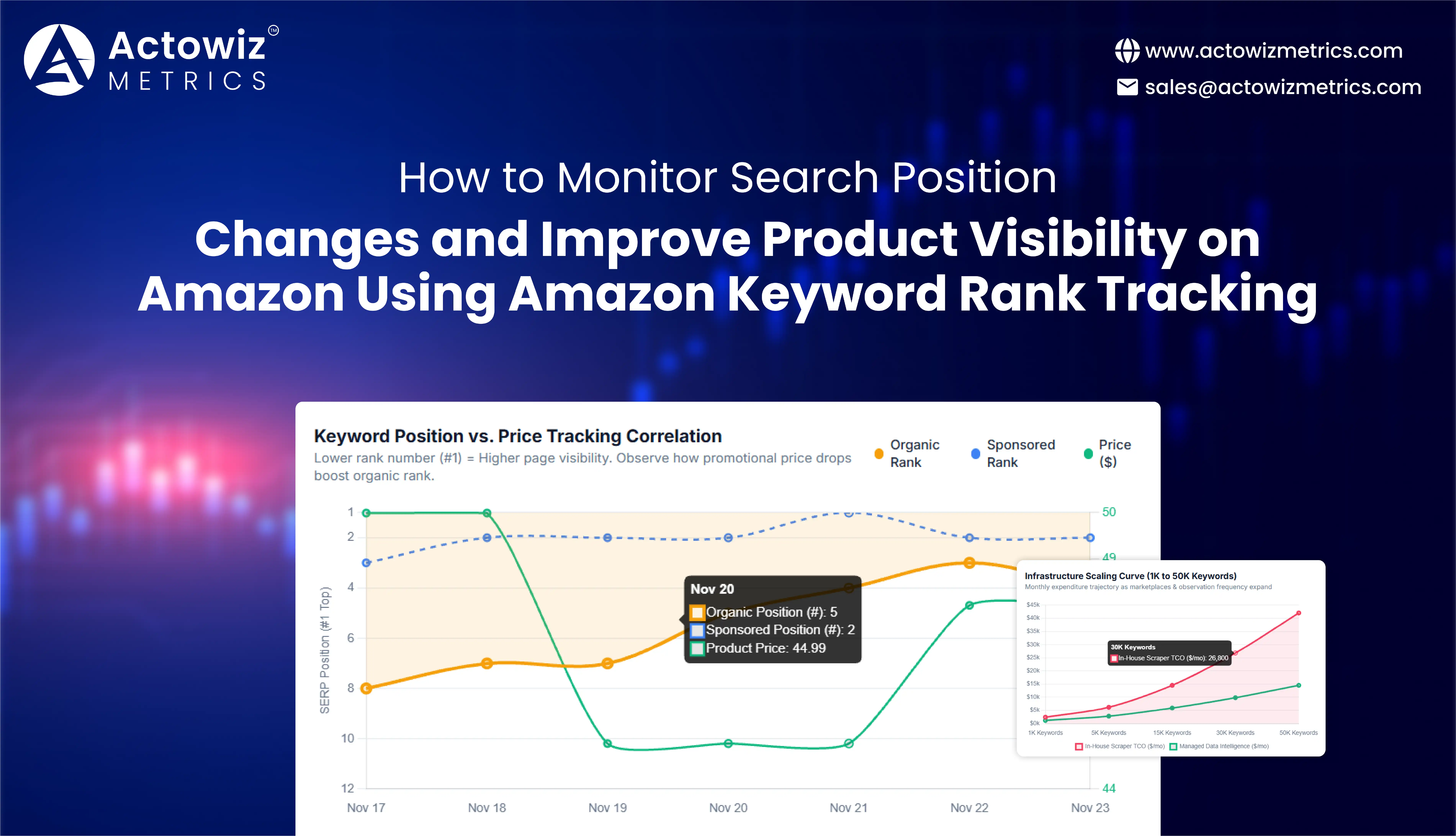










Monitoring product search positions is essential for Amazon sellers and brands that want to improve organic visibility, attract relevant shoppers, and compete effectively in crowded product categories. Amazon Keyword Rank Tracking helps businesses measure where their products appear for targeted search terms, identify ranking fluctuations, evaluate competitor visibility, and understand the impact of listing optimization.
Amazon search visibility is influenced by several factors, including product relevance, pricing, availability, customer experience, and shopping behavior. Sellers therefore need more than occasional keyword checks. They need consistent marketplace intelligence that connects search performance with product-level information.
Combining keyword monitoring with Amazon Price Tracking gives businesses a broader understanding of competitive performance. For example, sellers can examine whether changes in a product’s search position coincide with price adjustments, promotional activity, or changes in competitor offerings.
For e-commerce brands, marketplace intelligence teams, agencies, and Amazon retailers, the objective is to turn fragmented search observations into structured information that supports measurable optimization decisions.
This report explores search-position monitoring, data collection, operational costs, infrastructure requirements, outsourcing considerations, and the role of structured analytics in improving Amazon product discoverability.
Search position monitoring helps sellers understand whether their products are becoming more or less visible for relevant customer searches. A product can perform well for one keyword while losing visibility for another, making keyword-level analysis essential.
Amazon Keyword Rank Tracking Data should connect the search term with the product ASIN, marketplace, observation date, organic position, sponsored placement, and competitor information. This allows businesses to compare search performance over time instead of relying on isolated search-result screenshots.
| Data point | What it measures | Business application |
|---|---|---|
| Keyword | Customer search phrase | Identify target searches |
| ASIN | Product identifier | Match ranking to product |
| Organic position | Natural search placement | Evaluate organic visibility |
| Sponsored position | Paid search placement | Separate advertising visibility |
| Competitor position | Rival product placement | Benchmark competitors |
| Search volume | Search demand | Prioritize relevant terms |
| Collection timestamp | Observation date and time | Identify ranking changes |
| Marketplace | Amazon country store | Compare regional performance |
Amazon’s own Brand Analytics tools provide useful supporting information. Search Query Performance reports search terms associated with a brand’s products and provides metrics such as impressions, clicks, add-to-cart actions, and purchases. Access requires a Professional selling account and brand-representative status for a brand enrolled in Brand Registry.
The following timeline identifies documented developments in Amazon’s search and advertising measurement capabilities.
| Year | Verified development | Research significance |
|---|---|---|
| 2020 | Amazon introduced a downloadable search-term impression rank and share report for Sponsored Brands. | Advertisers could compare impression performance. |
| 2021 | Search-term impression share reporting expanded for Sponsored Products. | Improved paid-search benchmarking. |
| 2022 | Amazon announced Search Catalog Performance and Search Query Performance dashboards. | Added product- and query-level shopping funnel insights. |
| 2023 | Amazon’s search analytics tools continued to support brand performance analysis. | Businesses could use existing query-level measurements. |
| 2024 | Amazon’s advertising performance reporting provided additional campaign measurement capabilities. | Improved paid-search analysis. |
| 2025 | Amazon published its DMA compliance report describing search-result matching and ranking models. | Provided additional transparency about ranking inputs. |
| 2026 | Amazon published updated search-term reporting and keyword-targeting guidance. | Reinforced the importance of ongoing keyword measurement. |
These developments demonstrate how marketplace measurement has evolved from advertising impression comparisons toward broader product and customer-search analysis. Sellers should use official performance reports alongside independently collected ranking observations because advertising metrics and organic positions measure different things.
Building an internal data collection system gives businesses control over their monitoring schedules, data structures, and reporting processes. However, maintaining such a system requires ongoing technical resources.
In-House Amazon Scraper Maintenance Costs depend on the number of products, keywords, marketplaces, observation frequency, infrastructure requirements, and engineering resources involved.
For example, a business tracking a limited product catalog has different operational requirements from a retailer monitoring thousands of ASINs across several Amazon marketplaces.
| Cost component | Description | Operational impact |
|---|---|---|
| Development | Initial scraper and workflow development | Engineering investment |
| Maintenance | Fixing collection failures and changes | Recurring technical work |
| Infrastructure | Servers, storage, and processing | Operating expenditure |
| Data validation | Duplicate and missing-record checks | Data quality investment |
| Monitoring | Error detection and alerts | Operational reliability |
| Security | Access management and protection | Governance requirements |
| Reporting | Dashboards and analytics | Business intelligence expenditure |
The biggest challenge is often not initial development but ongoing maintenance. Changes in page structures, access controls, product presentation, and collection requirements can require technical adjustments.
Businesses must also distinguish between permitted data access and unauthorized collection methods. Amazon’s Selling Partner API has defined usage plans and rate limits for its operations. Its pricing operation, for example, provides seller-offer pricing information using SKU or ASIN identifiers; it is not an unrestricted organic keyword-ranking endpoint.
Companies should calculate the complete monthly cost of engineering time, hosting, storage, monitoring, quality assurance, and reporting. They should also measure the time employees spend investigating incomplete or inconsistent records.
A useful approach is to compare total operating expenditure with the number of validated product-keyword observations delivered.
This makes it easier to determine whether internal development remains economical as tracking requirements expand.
Accurate search analysis depends on consistent collection methods. Businesses need to observe product positions under comparable conditions and preserve the information required to explain changes.
Amazon Search Rank Data Extraction involves collecting relevant search-result information and organizing it into structured records. Depending on the permitted collection method and available information, these records may include search terms, ASINs, product titles, organic positions, sponsored placements, competitor listings, and collection timestamps.
| Processing stage | Activity | Expected output |
|---|---|---|
| Keyword selection | Identify relevant customer search terms | Target keyword list |
| Product mapping | Associate keywords with ASINs | Product-keyword mapping |
| Search observation | Collect permitted search-result information | Position observations |
| Classification | Separate organic and sponsored results | Search placement categories |
| Validation | Check missing and duplicate records | Validated dataset |
| Historical storage | Preserve dated observations | Ranking history |
| Analysis | Compare positions across periods | Ranking movement insights |
Amazon’s March 2025 compliance report explains that its product search system uses matching algorithms to identify relevant products and ranking models to order results. The report identifies signals such as past customer actions and product information, including titles, prices, and descriptions. It also explains that different ranking models may be used for different product categories.
This is important because keyword monitoring should not assume that search placement is determined by keyword frequency alone.
Businesses should compare keyword observations with relevant commercial and customer-engagement indicators.
| Indicator | Analytical purpose |
|---|---|
| Organic search position | Measures natural placement |
| Search impressions | Measures search-result exposure |
| Clicks | Indicates customer engagement |
| Add-to-cart actions | Indicates shopping consideration |
| Purchases | Measures downstream conversion |
| Price changes | Identifies potential commercial influences |
| Competitor visibility | Measures competitive positioning |
Amazon’s Search Catalog Performance dashboard provides impressions, clicks, add-to-cart actions, and purchases at the ASIN level. Amazon clarifies that its search dashboard includes organic and Sponsored Products activity originating from search results. These measurements should not be treated as identical to an independently observed organic ranking position.
For stronger analysis, businesses should preserve the marketplace, delivery location where relevant, device context where available, and observation timestamp. They should also document whether the observed position includes sponsored placements.
Actionable recommendation: Establish a consistent keyword observation schedule, compare like-for-like search conditions, and investigate ranking movements alongside pricing, availability, and listing changes. This helps distinguish actual performance changes from differences in measurement conditions.
The cost of a search-monitoring program extends beyond software subscriptions or data collection. Businesses must consider the complete expenditure involved in gathering, processing, validating, storing, and analyzing marketplace information.
Amazon Rank Tracking Total Cost of Ownership provides a broader financial perspective by combining initial implementation costs with recurring operating expenses.
| Cost category | Included expenses | Measurement approach |
|---|---|---|
| Technology | Software and licenses | Monthly or annual expenditure |
| Development | Initial integration | Project expenditure |
| Data collection | Authorized collection services | Cost per observation |
| Infrastructure | Compute, storage, and networking | Monthly usage |
| Maintenance | Technical support and updates | Engineering hours |
| Quality assurance | Validation and reconciliation | Cost per validated record |
| Analytics | Dashboards and reporting | Development and licensing |
| Management | Internal coordination | Employee time |
There is no universally applicable published cost benchmark for Amazon organic keyword-rank tracking across all sellers. Costs vary significantly according to scope, access methods, data volume, and service requirements. Therefore, businesses should avoid relying on generic per-keyword cost estimates without a defined project specification.
| Year | Documented development | Cost-planning implication |
|---|---|---|
| 2020 | Sponsored Brands impression reporting launched | Paid-search reporting became more measurable |
| 2021 | Sponsored Products impression-share reporting introduced | Additional reporting requirements emerged |
| 2022 | Brand Analytics search dashboards announced | Product and query analytics gained importance |
| 2023 | Existing search analytics capabilities remained relevant | Integration and reporting continued |
| 2024 | Amazon advertising measurement capabilities continued | More comprehensive campaign analysis |
| 2025 | Amazon published search-ranking transparency information | Greater need to interpret ranking signals |
| 2026 | Updated search-term and keyword-targeting guidance | Continued investment in search intelligence |
Sources: Amazon’s official announcements and documentation cited in the preceding sections.
Businesses should first define the exact number of products, keywords, marketplaces, and observation intervals they need. They can then estimate collection volume and calculate the resources needed for processing and historical storage.
A practical evaluation should compare:
These indicators make the financial performance of an internal system easier to assess. They also help management identify when additional engineering investment may no longer be justified by the business value generated.
Managing search intelligence internally is not always the most efficient option. Businesses monitoring several product categories or marketplaces may face increasing maintenance, data-quality, and infrastructure requirements.
Outsourced Amazon Rank Tracking Solutions can help brands access specialized data collection and processing capabilities without building every technical component internally.
For established retailers, the decision should depend on the cost of internal operations, required data coverage, technical expertise, and the importance of timely reporting.
| Evaluation criterion | Internal solution | External solution |
|---|---|---|
| Initial development | Internal engineering effort | Depends on provider onboarding |
| Maintenance | Managed internally | Defined by service agreement |
| Infrastructure | Business-managed | Provider-managed or shared |
| Data validation | Internal processes | Provider’s validation workflow |
| Customization | Direct engineering control | Depends on service capabilities |
| Scalability | Requires internal capacity planning | Depends on provider capacity |
| Reporting | Internal dashboard development | Available reporting and integrations |
Outsourcing does not automatically eliminate operational risk. Businesses must evaluate collection permissions, data accuracy, service-level commitments, security controls, and data ownership.
A suitable provider should offer clearly documented data fields, collection timestamps, validation processes, structured delivery formats, and support for historical comparisons.
Businesses should also ask how organic and sponsored placements are separated, how product identifiers are matched, and how missing observations are handled.
A strong external solution should provide more than ranking numbers. It should deliver traceable information that helps analysts understand what changed, when it changed, and which additional business indicators may explain the movement.
Looking to reduce manual marketplace research and improve search-performance visibility? Explore Actowiz Metrics’ structured data intelligence capabilities for scalable e-commerce research!
As product catalogs and keyword lists expand, data infrastructure becomes increasingly important. A monitoring system must handle collection requests, data processing, historical storage, validation, and reporting without compromising consistency.
Amazon Scraper Infrastructure and Scaling Costs are influenced by collection frequency, concurrent workloads, storage requirements, data-retention policies, and the number of marketplaces being monitored.
| Component | Technical responsibility | Scaling consideration |
|---|---|---|
| Collection layer | Gather permitted marketplace observations | Request volume |
| Processing layer | Normalize collected records | Processing capacity |
| Storage system | Maintain historical snapshots | Data retention |
| Validation layer | Identify missing and duplicate records | Quality-check volume |
| Monitoring system | Detect failures | Alerting and reliability |
| Analytics layer | Generate ranking reports | Query performance |
| Integration layer | Deliver structured datasets | Downstream demand |
Amazon’s Selling Partner API documentation explains that API operations have usage plans and rate limits. These limits can depend on factors including the selling-partner account, application, and Amazon store. The documentation also describes rate and burst limits, emphasizing the need for capacity planning when developing integrations.
This is particularly relevant when businesses combine official seller data with separately collected search observations. Different sources may have different access conditions, update frequencies, and technical constraints.
| Period | Industry measurement development | Infrastructure priority |
|---|---|---|
| 2020 | Search-term impression reporting | Historical campaign records |
| 2021 | Search impression-share measurement | Comparative reporting |
| 2022 | Product and query analytics dashboards | Structured data storage |
| 2023 | Continued use of search analytics | Consistent data integration |
| 2024 | Expanded advertising measurement | Multi-source reporting |
| 2025 | Published ranking-model transparency | Better analytical classification |
| 2026 | Updated keyword-targeting guidance | Scalable search intelligence |
For organizations planning larger monitoring operations, infrastructure should support incremental scaling rather than requiring a complete redesign whenever the keyword list grows.
The most important practices include maintaining unique product identifiers, retaining original observation timestamps, recording source information, implementing validation checks, and separating raw observations from processed analytics.
Businesses should also monitor infrastructure performance through collection success rates, processing delays, missing-record percentages, and historical data availability.
A well-designed architecture helps brands maintain consistent reporting while supporting additional products, categories, and marketplace requirements.
Actowiz Metrics helps businesses transform fragmented e-commerce information into structured datasets that support competitive research, product intelligence, and marketplace performance analysis.
For Amazon sellers, manufacturers, retailers, and market research agencies, reliable product and search information can help identify visibility gaps and improve commercial decision-making.
By combining Amazon Keyword Rank Tracking with product-level intelligence, businesses can develop a broader understanding of marketplace competition.
Actowiz Metrics focuses on helping businesses convert complex marketplace information into actionable insights through customized data collection, data validation, and analytics support.
Monitoring Amazon product positions requires consistent observations, accurate product identification, and an understanding of the commercial factors influencing search performance.
Brands that analyze keyword positions alongside product pricing, competitor activity, availability, and customer engagement can make more informed optimization decisions.
An effective Share of Search analysis can also help businesses understand their relative search visibility within a selected competitive category, provided the measurement methodology and data coverage are clearly defined.
Combining structured search observations with Amazon Keyword Rank Tracking enables businesses to identify ranking fluctuations, evaluate competitive positioning, and develop more informed product visibility strategies.
For sellers, manufacturers, and marketplace research teams, the next step is building a dependable data foundation that supports continuous analysis rather than relying on occasional manual checks.
Ready to strengthen your Amazon marketplace intelligence? Partner with Actowiz Metrics for customized data collection, product intelligence, competitor benchmarking, and structured e-commerce analytics that help your business make smarter decisions!
It helps sellers monitor product search positions, identify ranking fluctuations, evaluate competitors, and discover optimization opportunities to improve organic product visibility across relevant Amazon searches.
Amazon Price Tracking helps businesses compare selling prices, identify promotional changes, and evaluate whether pricing movements coincide with changes in product search visibility.
Amazon Keyword Rank Tracking Data can include keywords, ASINs, organic positions, sponsored placements, competitor listings, marketplace details, and collection timestamps for historical analysis.
In-House Amazon Scraper Maintenance Costs depend on engineering resources, infrastructure, collection frequency, technical updates, data validation, storage requirements, and ongoing operational support.
Actowiz Metrics supports structured marketplace data collection, product identification, validation, and customized reporting to help businesses analyze search visibility and competitive performance.
Expert blogs, research reports and infographics — practical, data-driven reading across e-commerce and quick-commerce.
Most fields are optional — the more you share, the better your sample.

.webp "infographics")
.webp "infographics")