BLOG













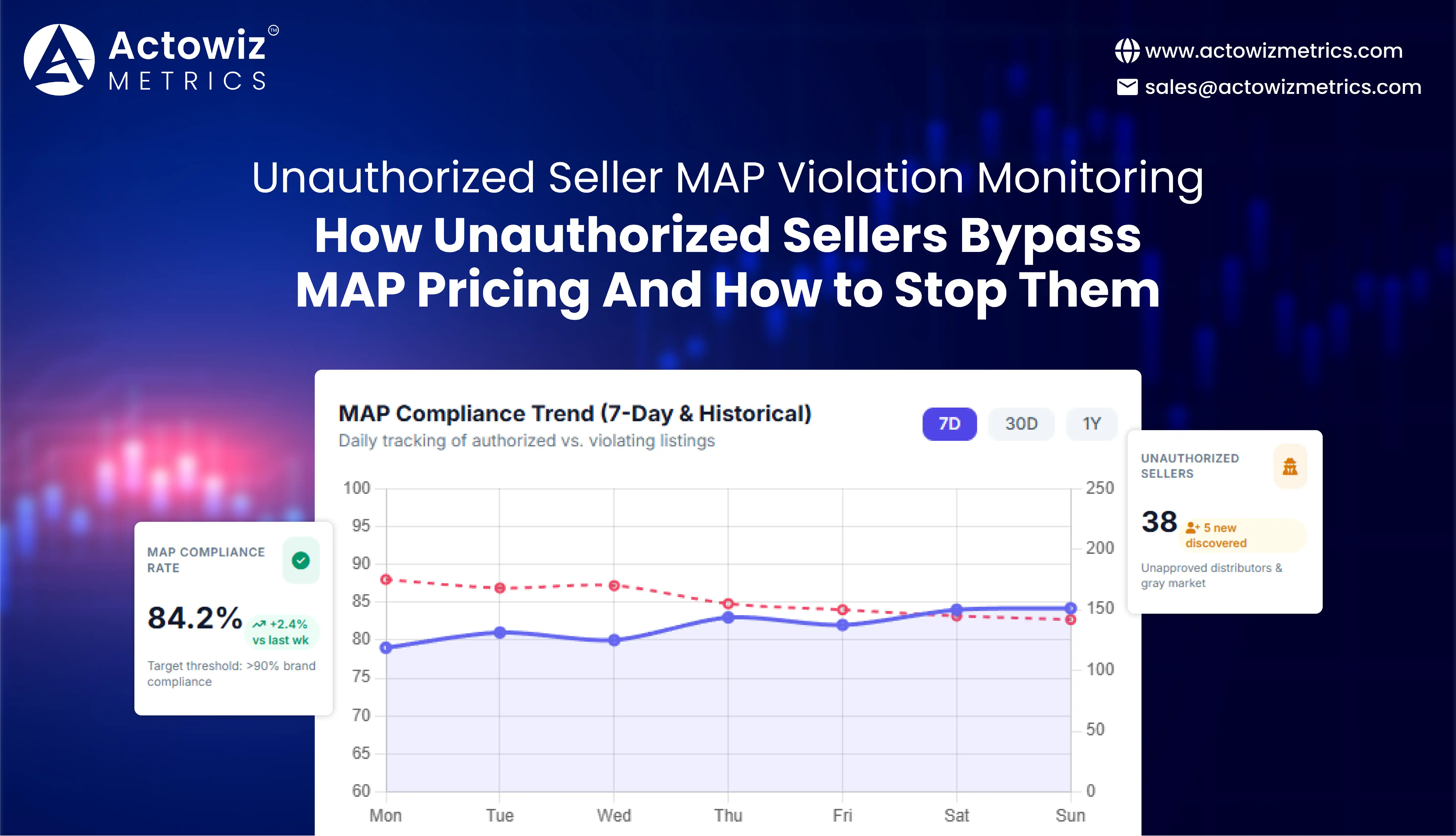
Unauthorized sellers can bypass a brand's MAP policy by sourcing products through indirect channels, changing seller identities, exploiting marketplace listings, or repeatedly undercutting advertised price thresholds. Unauthorized Seller MAP Violation Monitoring helps brands identify these sellers, document pricing breaches, connect seller activity across marketplaces, and take faster enforcement action.
The challenge has become more complex as e-commerce marketplaces expand their third-party seller ecosystems. Amazon, for example, reported that independent sellers accounted for more than 60% of sales in its store in 2024. This scale creates a larger monitoring surface for manufacturers, distributors, and authorized retailers.
For brands, the objective is not simply to find a low price. The real task is to determine who is selling the product, whether the seller is authorized, where the product may have originated, how frequently the price changes, and whether the advertised price violates the brand's documented policy.
A structured monitoring program combines seller discovery, product matching, price collection, historical tracking, evidence capture, and alerting. This gives pricing, sales, marketplace, and compliance teams a shared view of potential violations.
MAP violations can move quickly across marketplaces. A single seller may list hundreds or thousands of SKUs, while another seller can copy the same product listing and change its advertised price within minutes.
The first step is separating legitimate competitive pricing from policy violations.
Seller Intelligence provides the context needed to evaluate seller behavior. Instead of looking at price alone, brands can combine seller name, marketplace, SKU, product identifier, seller rating, availability, fulfillment information, price, discount, promotion, and historical activity.
A practical monitoring workflow includes:
The FTC notes that manufacturers may establish certain unilateral pricing policies and may choose not to deal with retailers that do not follow their policies, while competition-law treatment can vary by jurisdiction and circumstances. Brands should therefore have their legal teams review the design and enforcement of MAP programs in every applicable market.
Unauthorized Seller Price Monitoring enables brands to continuously compare advertised prices against defined thresholds instead of depending on occasional manual checks.
Traditional monitoring often starts with a spreadsheet. Teams search selected marketplaces, record prices, identify sellers, and send reports to sales or channel-management teams. This approach becomes difficult when thousands of SKUs appear across multiple marketplaces.
A scalable process can monitor:
| Data Point | Business Use |
|---|---|
| SKU / Product ID | Connect listing to the correct product |
| Seller Name | Identify the selling party |
| Seller URL | Create a traceable seller record |
| Advertised Price | Compare against MAP |
| Discount | Detect visible price reductions |
| Stock Status | Determine active selling activity |
| Marketplace | Understand channel exposure |
| Timestamp | Establish when the violation occurred |
| Product URL | Preserve evidence |
| Seller Rating | Support seller profiling |
The value comes from historical data. If a product is observed at $99 on Monday, $89 on Tuesday, and $79 on Wednesday against a $100 advertised-price threshold, the pattern is more informative than a single snapshot.
Automation can also prioritize violations by severity. A brand could classify observations into categories such as:
This creates a risk-based workflow rather than forcing teams to investigate every observation manually.
MAP Violation Detection & Seller Tracking connects price monitoring with seller-level history.
A seller should not be treated as a completely new entity every time the marketplace listing changes. Seller names, storefront URLs, product assortments, and other identifiers can be normalized to create a persistent seller profile.
For example, a monitoring system can build a seller record containing:
| Seller Attribute | Tracking Purpose |
|---|---|
| Seller ID | Persistent identification |
| Seller Name | Entity matching |
| Marketplace | Channel segmentation |
| Product Count | Seller scale |
| Violated SKUs | Exposure measurement |
| Average Price Gap | Violation severity |
| Violation Frequency | Recurrence measurement |
| First Seen Date | Seller discovery |
| Last Seen Date | Activity monitoring |
| Historical Prices | Trend analysis |
This approach helps answer practical questions: Is the seller new? Which products are affected? Is the seller repeatedly undercutting MAP? Are violations limited to one marketplace? Did the seller disappear after an enforcement action and later return under another storefront?
The historical layer is especially important because marketplace pricing is dynamic. Amazon's reported third-party seller services revenue increased from $117.7 billion in 2022 to $156.1 billion in 2024, illustrating the scale of the broader seller ecosystem.
Unauthorized Seller Detection on Marketplaces requires monitoring beyond a brand's approved reseller list.
A brand may know its distributors and authorized retailers but still have limited visibility into downstream marketplace sellers. Products can move through liquidation, secondary distribution, overstock channels, or other supply routes before appearing under an unfamiliar seller account.
An effective discovery process searches marketplaces using multiple identifiers:
Product matching is critical. A seller may use abbreviated product names, alternate descriptions, bundles, or marketplace-specific titles. Matching only by title can therefore produce false positives or miss relevant listings. A stronger system combines product identifiers with attributes such as brand, model number, pack size, specifications, images, and category.
Once a potential unauthorized seller is discovered, the monitoring system can compare the seller against the authorized channel database.
| Stage | Question |
|---|---|
| Discovery | Where is the product being sold? |
| Identification | Who is selling it? |
| Matching | Is this the same SKU? |
| Authorization | Is the seller approved? |
| Pricing | Is the advertised price compliant? |
| History | Has this seller violated before? |
| Evidence | Can the observation be documented? |
| Action | What response is appropriate? |
This turns seller discovery into a repeatable process instead of a one-time investigation.
Grey Market Seller helps brands investigate sellers operating outside
Grey Market Seller MAP Monitoring helps brands investigate sellers operating outside intended distribution channels and distinguish them from authorized partners.
Grey-market activity can create several visibility problems. A product may be genuine but sold outside the manufacturer's approved distribution network. Alternatively, a listing may raise additional questions about warranty eligibility, product condition, regional packaging, or source of inventory.
Price data alone cannot prove how a seller obtained inventory. It can, however, reveal patterns that deserve investigation.
For example, a monitoring platform can flag a seller when:
Unauthorized Seller MAP Violation Monitoring adds the historical layer needed to identify recurring patterns instead of treating every observation as an isolated event.
Brands can also maintain an evidence trail showing the product URL, seller identity, observed price, timestamp, and relevant policy threshold. This gives internal teams a consistent record for investigation and channel-management discussions.
MAP programs should be designed and enforced with applicable competition laws in mind. The FTC explains that unilateral manufacturer pricing policies can be treated differently from agreements that require retailers to maintain resale prices. International requirements can also differ, so legal review remains important.
MAP Scraping for Unauthorized Seller Monitoring allows brands to collect marketplace information continuously and transform raw listing data into structured compliance signals.
A typical automated pipeline includes:
Marketplace discovery → Data extraction → Product matching → Seller identification → MAP comparison → Historical storage → Alert generation → Reporting
The system can collect product and seller information at scheduled intervals. Instead of relying on one daily manual search, brands can configure monitoring according to product velocity and business risk.
For example:
| Monitoring Frequency | Suitable Use |
|---|---|
| Daily | Stable categories and large catalogs |
| Several times daily | High-volume marketplace products |
| Hourly | Highly competitive or promotional SKUs |
| Event-based | Major sales and promotional periods |
| On-demand | Investigations and enforcement cases |
The output can be delivered as structured datasets, dashboards, alerts, or APIs depending on the organization's workflow.
Historical storage also enables brands to calculate useful indicators such as:
These measurements shift MAP enforcement from reactive investigation to measurable channel intelligence.
MAP Monitoring becomes significantly more valuable when it is integrated into a broader marketplace intelligence process.
A mature program connects product, seller, pricing, and historical datasets. Instead of asking only, "Who is below MAP today?", teams can answer:
Unauthorized Seller MAP Violation Monitoring can support these analyses by maintaining a historical seller-product relationship.
| KPI | What It Shows |
|---|---|
| MAP Compliance Rate | Percentage of monitored listings meeting policy thresholds |
| Violation Count | Total detected incidents |
| Unauthorized Seller Count | Number of unapproved sellers identified |
| Average Price Gap | Typical distance from the defined threshold |
| Repeat Violation Rate | Frequency of recurring violations |
| Correction Time | Time between detection and observed compliance |
| Marketplace Violation Share | Distribution across channels |
| SKU Violation Density | Products with concentrated pricing issues |
The objective is not merely to collect more data. It is to make the data operational. A compliance team can use alerts for urgent cases, dashboards for management reporting, and historical datasets for distributor investigations and channel strategy.
From 2020 through 2026, marketplace selling has continued moving toward larger third-party ecosystems, faster price changes, and more complex seller networks. The resulting monitoring challenge is increasingly data-intensive.
In 2020, many brands still relied heavily on manual marketplace checks and periodic spreadsheet reporting. During the following years, marketplace assortment expanded and sellers became more numerous across major platforms. By 2024, Amazon stated that independent sellers generated more than 60% of sales in its store, highlighting the scale of third-party participation. Amazon also reported that more than 55,000 independent sellers generated over $1 million in sales in its store during 2024. In 2025, Amazon reported third-party seller services revenue of $172.2 billion, up from $156.1 billion in 2024. These figures do not measure MAP violations directly, but they demonstrate why seller-level visibility has become increasingly important for brands. From 2020-2026, monitoring practices have consequently shifted from periodic price checks toward automated collection, product matching, seller profiling, historical databases, alerting, and analytics. The modern approach focuses on connecting price observations with seller identity and product-level history so teams can investigate recurring patterns rather than isolated incidents. At the same time, MAP enforcement remains legally sensitive and jurisdiction-specific, meaning automated monitoring should support—not replace—appropriate legal, commercial, and channel-management review.
Actowiz Metrics can help brands build structured marketplace datasets that connect products, prices, sellers, and historical observations.
The platform can support a data-driven workflow for monitoring product listings and identifying potential pricing exceptions. Depending on the marketplace and project requirements, the data pipeline can be configured around:
For brands managing large catalogs, automated monitoring can reduce dependence on manual marketplace checks. Historical records allow teams to identify recurring seller behavior, compare violation frequency, and prioritize cases based on business impact.
The resulting dataset can feed dashboards, internal compliance systems, pricing workflows, or analytical models. This allows different teams to work from the same structured information rather than disconnected spreadsheets.
Actowiz Metrics can also help businesses design monitoring around specific marketplaces, product categories, SKUs, sellers, geographies, and collection frequencies. The exact fields and monitoring cadence can be tailored to the brand's operating model and marketplace environment.
Unauthorized sellers can create pricing pressure long before a brand notices a recurring pattern. A single low-price listing may be easy to overlook, but repeated violations across multiple sellers, SKUs, and marketplaces can become much harder to manage manually.
The solution is to combine seller discovery, product matching, price monitoring, historical tracking, and evidence-based alerts. This gives brands a clearer view of where violations occur, which sellers repeatedly create them, and which products require immediate attention.
Legal and commercial teams should also distinguish advertised-price monitoring from broader resale-price requirements and ensure enforcement practices comply with the laws applicable to each market. The FTC specifically highlights the importance of distinguishing unilateral manufacturer policies from agreements involving resale prices.
For brands looking to build a scalable monitoring framework, Unauthorized Seller MAP Violation Monitoring can transform fragmented marketplace observations into structured pricing and seller intelligence.
Ready to strengthen marketplace visibility and protect your pricing strategy? Contact Actowiz Metrics to build a scalable MAP monitoring and unauthorized-seller intelligence solution tailored to your products and marketplaces!
Expert blogs, research reports and infographics — practical, data-driven reading across e-commerce and quick-commerce.
Most fields are optional — the more you share, the better your sample.


.webp "infographics")
.webp "infographics")