BLOG





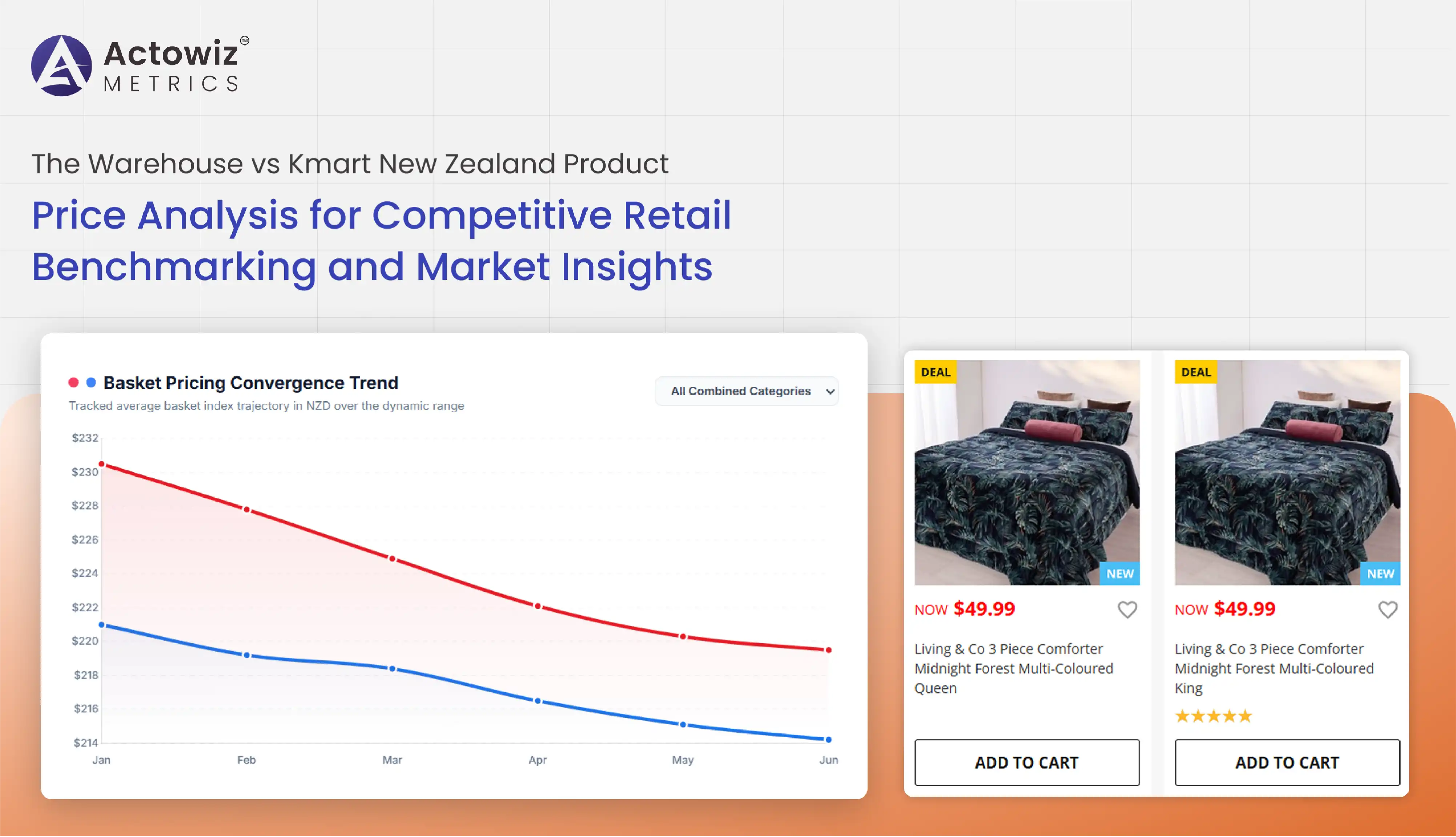
The New Zealand retail market has become increasingly competitive as retailers focus on pricing strategies, product assortment optimization, and customer retention. Understanding competitor pricing behavior is now a critical component of retail success. Businesses that invest in The Warehouse vs Kmart New Zealand Product Price Analysis gain deeper visibility into market trends, pricing movements, and consumer purchasing behavior.
The growing demand for data-driven retail intelligence has accelerated the adoption of The Warehouse Vs Kmart Product Price Scraping solutions. These tools enable brands, manufacturers, distributors, and retailers to monitor product pricing, promotions, and assortment changes across major retail channels. By leveraging competitive pricing intelligence, businesses can improve pricing decisions, optimize margins, and strengthen their market position.
As retail competition intensifies between 2020 and 2026, organizations increasingly rely on automated data collection and analytics platforms to gain real-time insights. This report examines key pricing trends, competitive benchmarking strategies, and brand performance indicators that help businesses make informed decisions in New Zealand's evolving retail landscape.
Monitoring competitor pricing remains one of the most effective ways to improve market positioning. Retailers need consistent visibility into competitor product pricing to identify opportunities and respond quickly to market changes.
Through The Warehouse And Kmart NZ Price Tracking, retailers can monitor thousands of products across categories and identify pricing fluctuations that influence purchasing decisions. Combined with Price Benchmarking, businesses gain measurable insights into how their prices compare with key competitors.
| Year | Retailers Using Competitive Price Monitoring (%) |
|---|---|
| 2020 | 32 |
| 2021 | 38 |
| 2022 | 45 |
| 2023 | 53 |
| 2024 | 61 |
| 2025 | 69 |
| 2026 | 77 |
Key benefits include:
Retailers that implement structured price monitoring frameworks can identify pricing gaps before they affect sales performance. This enables more agile decision-making and stronger competitiveness across product categories. As pricing transparency continues to grow, businesses that actively track competitors gain a substantial advantage in attracting and retaining customers.
Discounting plays a significant role in shaping customer behavior and influencing market share. Consumers frequently compare promotional pricing before making purchases, making discount intelligence essential for retailers.
By leveraging Warehouse Vs Kmart Discount Price Scraping, organizations can evaluate promotional campaigns, identify discount frequency, and analyze pricing strategies across multiple product categories.
| Year | Average Promotional Products (%) |
|---|---|
| 2020 | 21 |
| 2021 | 25 |
| 2022 | 29 |
| 2023 | 33 |
| 2024 | 38 |
| 2025 | 42 |
| 2026 | 47 |
Key observations include:
Understanding discount behavior helps retailers align pricing strategies with market expectations. Businesses can also identify underperforming promotions and optimize future campaigns using historical discount intelligence. As retail competition increases, effective promotion monitoring becomes essential for maximizing revenue opportunities and maintaining customer loyalty.
Product-level intelligence provides valuable insights into assortment performance, pricing competitiveness, and category dynamics. Retailers need accurate product data to understand how competitors position their offerings.
Using Extract The Warehouse vs Kmart New Zealand Product Price, businesses can collect detailed pricing information at the SKU level. This data becomes even more valuable when integrated with Brand Competition Analysis, enabling organizations to compare pricing performance across competing brands.
| Year | Businesses Using SKU-Level Analytics (%) |
|---|---|
| 2020 | 28 |
| 2021 | 35 |
| 2022 | 43 |
| 2023 | 51 |
| 2024 | 60 |
| 2025 | 68 |
| 2026 | 76 |
Benefits include:
Retailers that leverage product-level intelligence can identify pricing opportunities, understand consumer preferences, and optimize inventory allocation. These insights contribute directly to revenue growth and improved customer satisfaction. As product catalogs continue expanding, SKU-level visibility becomes increasingly important for maintaining a competitive edge.
Manual monitoring methods often fail to keep pace with rapidly changing retail environments. Automated data collection enables retailers to gather accurate pricing information at scale.
Through Scrape The Warehouse vs Kmart New Zealand Product Price, businesses can continuously monitor product pricing, availability, and promotional activity without manual intervention.
| Year | Retailers Using Automated Data Collection (%) |
|---|---|
| 2020 | 30 |
| 2021 | 37 |
| 2022 | 45 |
| 2023 | 54 |
| 2024 | 63 |
| 2025 | 72 |
| 2026 | 81 |
Key advantages include:
Automation enables businesses to process large datasets efficiently while maintaining high-quality insights. Retailers gain the ability to track thousands of products across multiple categories, improving responsiveness to market developments. This capability is especially valuable in highly competitive sectors where pricing changes occur frequently.
Understanding which brands perform best within a retail ecosystem helps businesses optimize assortment and promotional strategies. Brand-level analytics reveal customer preferences and category trends that influence purchasing behavior.
Using The Warehouse Best Selling Brands Analytics, organizations can identify top-performing brands, monitor category growth, and evaluate competitive positioning. Combined with Product Data Tracking, retailers gain deeper visibility into brand performance metrics.
| Year | Companies Using Brand Intelligence (%) |
|---|---|
| 2020 | 27 |
| 2021 | 34 |
| 2022 | 42 |
| 2023 | 50 |
| 2024 | 59 |
| 2025 | 68 |
| 2026 | 77 |
Key applications include:
Brand analytics help retailers understand which products drive sales and which categories require strategic adjustments. These insights support better inventory planning and more effective marketing initiatives. As consumer preferences evolve, continuous brand monitoring becomes critical for maintaining market relevance.
Consumer behavior changes rapidly in response to economic conditions, product innovation, and promotional activities. Retailers need reliable analytics to identify emerging trends before competitors.
Through Kmart Best Selling Brands Analytics, businesses can evaluate consumer purchasing patterns, identify fast-growing categories, and understand shifting brand preferences.
| Year | Businesses Leveraging Consumer Trend Analytics (%) |
|---|---|
| 2020 | 29 |
| 2021 | 36 |
| 2022 | 44 |
| 2023 | 53 |
| 2024 | 62 |
| 2025 | 71 |
| 2026 | 80 |
Important insights include:
Retailers that identify trends early can adjust inventory strategies, launch targeted promotions, and optimize product assortments. This proactive approach reduces risk and increases responsiveness to changing consumer demand. Trend intelligence also supports long-term planning and competitive differentiation.
Actowiz Metrics delivers comprehensive retail intelligence solutions that help businesses gain actionable market insights through advanced analytics and automation. The company combines scalable technology, industry expertise, and real-time monitoring capabilities to support competitive decision-making.
Through advanced E-commerce Analytics, businesses gain visibility into pricing strategies, assortment changes, promotional activity, and customer purchasing behavior. Additionally, Map Monitoring enables organizations to track pricing compliance and maintain consistency across distribution channels.
Key advantages include:
Actowiz Metrics empowers retailers, manufacturers, and brands to transform raw data into actionable insights that drive growth, improve efficiency, and strengthen market positioning.
The New Zealand retail landscape continues to evolve rapidly, creating new opportunities and challenges for businesses competing on pricing, assortment, and customer experience. Data-driven intelligence has become essential for understanding market dynamics and responding effectively to competitor actions.
By leveraging Digital Shelf Analytics, organizations can gain comprehensive visibility into pricing performance, product positioning, and consumer behavior. These insights support more accurate forecasting, better promotional planning, and stronger competitive positioning.
As retailers increasingly adopt advanced analytics between 2020 and 2026, competitive intelligence will remain a critical driver of business success. Organizations that invest in automated data collection, benchmarking, and performance analytics will be better equipped to adapt to changing market conditions and maximize growth opportunities.
Ready to unlock real-time retail intelligence and outperform competitors? Partner with Actowiz Metrics today to transform pricing data into actionable business insights and drive measurable retail growth!
Expert blogs, research reports and infographics — practical, data-driven reading across e-commerce and quick-commerce.
Most fields are optional — the more you share, the better your sample.


.webp "infographics")
.webp "infographics")