BLOG
















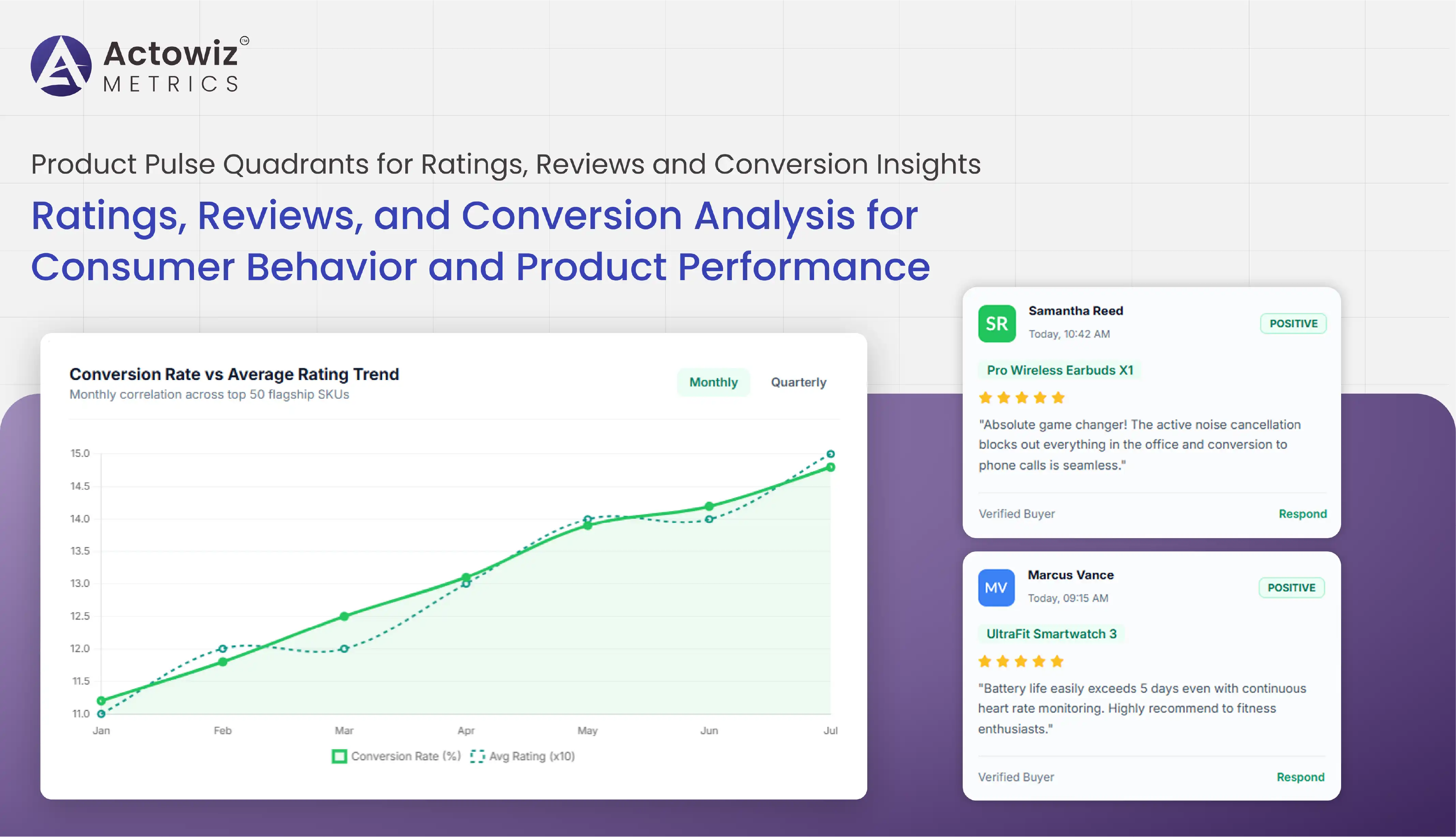
In today's digital commerce landscape, customer ratings and reviews significantly influence purchasing decisions, brand credibility, and product success. Consumers rely on authentic product experiences shared by other buyers before making purchases across eCommerce marketplaces, retail websites, and mobile shopping applications. Product Pulse Quadrants for Ratings, Reviews and Conversion Insights empowers businesses to evaluate product performance, monitor customer sentiment, identify conversion drivers, and optimize digital merchandising strategies through comprehensive data intelligence.
As online competition intensifies, organizations increasingly depend on Ratings and Reviews Analysis to understand customer satisfaction, identify product strengths and weaknesses, benchmark competitors, and improve conversion performance. Advanced analytics powered by artificial intelligence (AI) and machine learning enable businesses to transform large volumes of customer-generated content into actionable insights that support product innovation, pricing optimization, and customer engagement strategies.
This research report explores how ratings, reviews, and conversion intelligence evolved between 2020 and 2026, highlighting their impact on consumer behavior, product visibility, and business performance. It provides data-driven insights for retailers, brands, manufacturers, and marketplace sellers seeking to improve customer experiences, increase conversion rates, and gain a sustainable competitive advantage.
Customer reviews represent one of the richest sources of business intelligence available to modern retailers and brands. Businesses increasingly leverage product review analytics to extract actionable insights from customer feedback, identify recurring product issues, understand buying preferences, and improve product quality. By analyzing reviews across multiple channels, organizations can identify opportunities to enhance customer satisfaction while strengthening product competitiveness.
Between 2020 and 2026, online review volumes grew rapidly as digital shopping continued to expand across global markets. AI-powered analytics platforms now process millions of reviews in near real time, classifying feedback based on sentiment, product attributes, quality concerns, pricing perception, and customer experience. These insights enable businesses to prioritize product improvements and optimize merchandising strategies more effectively.
Review analytics also supports marketing teams by identifying the product features customers appreciate most. Positive feedback can be incorporated into promotional campaigns, while recurring complaints help product development teams address quality concerns before they negatively affect brand reputation.
| Year | Reviews Processed (Million) | Positive Review Rate (%) | Businesses Using Review Analytics (%) |
|---|---|---|---|
| 2020 | 175 | 72 | 43 |
| 2021 | 205 | 74 | 49 |
| 2022 | 242 | 77 | 56 |
| 2023 | 286 | 80 | 63 |
| 2024 | 336 | 82 | 70 |
| 2025* | 392 | 84 | 77 |
| 2026* | 456 | 86 | 84 |
Organizations utilizing comprehensive review analytics gain deeper customer insights, improve product quality, strengthen customer trust, and make faster, evidence-based business decisions that support long-term growth.
Organizations increasingly recognize that product ratings provide a reliable indicator of customer satisfaction, product quality, and purchasing confidence. Businesses rely on product ratings intelligence to monitor star ratings, evaluate product performance across marketplaces, compare competitor offerings, and identify factors influencing customer purchase decisions. Accurate ratings intelligence helps brands improve product positioning while strengthening consumer trust.
From 2020 to 2026, marketplace algorithms placed greater emphasis on customer ratings when determining product rankings and search visibility. Products with consistently higher ratings experienced improved organic visibility, stronger click-through rates, and increased sales conversions. Businesses therefore invested heavily in monitoring customer ratings alongside review sentiment to identify quality improvements and optimize customer experiences.
Advanced product intelligence platforms consolidate ratings across multiple marketplaces, allowing organizations to benchmark product performance by category, geography, and brand. Marketing, quality assurance, and customer experience teams can collaborate using unified performance dashboards to prioritize initiatives that improve ratings and customer satisfaction.
| Year | Average Product Rating | Products Rated 4★+ (%) | Conversion Improvement (%) |
|---|---|---|---|
| 2020 | 4.1 | 58 | 9 |
| 2021 | 4.2 | 61 | 11 |
| 2022 | 4.3 | 65 | 14 |
| 2023 | 4.4 | 69 | 17 |
| 2024 | 4.5 | 73 | 20 |
| 2025* | 4.6 | 77 | 23 |
| 2026* | 4.7 | 81 | 26 |
Businesses leveraging product ratings intelligence improve customer confidence, enhance marketplace visibility, optimize product quality, and drive higher conversion rates through continuous monitoring of customer satisfaction metrics.
Customer reviews have become one of the strongest influences on purchasing decisions in digital commerce. Organizations increasingly focus on conversion rate optimization using reviews to understand how authentic customer feedback affects buying behavior, product credibility, and online sales performance. Reviews reduce purchase uncertainty by providing real-world experiences that help shoppers evaluate product quality, usability, value, and overall satisfaction before completing a purchase.
Between 2020 and 2026, eCommerce platforms increasingly incorporated customer reviews into search rankings, recommendation engines, and product pages. Businesses that actively managed review quality, responded to customer feedback, and encouraged verified reviews consistently achieved higher conversion rates than competitors with limited customer engagement. Positive reviews also reduced product return rates by helping customers make better-informed purchasing decisions.
Advanced analytics platforms correlate review sentiment, average ratings, review volume, and customer engagement with conversion performance. Marketing teams can identify which review characteristics contribute most to sales, while merchandising teams optimize product pages using data-backed insights. These strategies strengthen customer trust and improve digital shopping experiences across multiple channels.
| Year | Products with Verified Reviews (%) | Average Conversion Rate (%) | Customer Trust Score (%) |
|---|---|---|---|
| 2020 | 44 | 3.9 | 74 |
| 2021 | 50 | 4.4 | 77 |
| 2022 | 57 | 5.0 | 80 |
| 2023 | 64 | 5.7 | 83 |
| 2024 | 71 | 6.4 | 86 |
| 2025* | 78 | 7.1 | 89 |
| 2026* | 85 | 7.8 | 91 |
Organizations that optimize conversions using customer reviews experience stronger customer confidence, improved product discoverability, higher purchase completion rates, and sustainable revenue growth through data-driven merchandising strategies.
Product success depends on continuous monitoring of customer engagement, sales performance, pricing, reviews, and operational efficiency. Businesses increasingly utilize product performance analytics to evaluate how products perform throughout their lifecycle while identifying opportunities for optimization. Comprehensive performance measurement enables organizations to make informed decisions regarding product development, pricing, inventory, and marketing investments.
From 2020 to 2026, AI-powered analytics platforms enabled businesses to combine sales metrics with customer feedback, pricing intelligence, inventory availability, and competitor benchmarking into unified performance dashboards. These integrated insights provide decision-makers with a complete understanding of product health across multiple sales channels and geographic markets.
Product performance analytics also helps identify declining products, evaluate promotional effectiveness, forecast future demand, and optimize assortment strategies. Product managers and category teams can prioritize investments based on measurable performance indicators rather than assumptions, improving operational efficiency and customer satisfaction simultaneously.
| Year | Products Monitored (Million) | Product Success Rate (%) | Forecast Accuracy (%) |
|---|---|---|---|
| 2020 | 21 | 67 | 76 |
| 2021 | 26 | 70 | 79 |
| 2022 | 32 | 73 | 82 |
| 2023 | 39 | 77 | 85 |
| 2024 | 47 | 81 | 88 |
| 2025* | 56 | 84 | 91 |
| 2026* | 66 | 87 | 94 |
Businesses implementing comprehensive product performance analytics improve forecasting accuracy, optimize inventory planning, strengthen product portfolios, and accelerate data-driven innovation across increasingly competitive marketplaces.
Modern eCommerce success depends on understanding how customer interactions influence purchasing decisions from product discovery to checkout. Organizations increasingly adopt Product Conversion Optimization Insights to identify friction points within the buying journey, improve product page performance, and maximize conversion opportunities. These insights combine customer behavior, review sentiment, ratings, pricing, and merchandising analytics into a unified decision-making framework.
Between 2020 and 2026, digital retailers significantly expanded the use of AI-powered optimization tools to personalize shopping experiences, improve product recommendations, and enhance website usability. Businesses continuously monitored customer engagement metrics including click-through rates, add-to-cart behavior, checkout completion, and repeat purchases to refine digital merchandising strategies.
Conversion optimization insights also support A/B testing, promotional planning, pricing adjustments, and personalized recommendations. Organizations can evaluate the effectiveness of content, images, customer reviews, and promotional messaging while identifying opportunities to improve user experience and reduce cart abandonment. These data-driven improvements contribute directly to higher sales and stronger customer loyalty.
| Year | Businesses Using Conversion Analytics (%) | Average Cart Completion (%) | Revenue Growth from Optimization (%) |
|---|---|---|---|
| 2020 | 41 | 58 | 8 |
| 2021 | 48 | 61 | 10 |
| 2022 | 56 | 64 | 13 |
| 2023 | 64 | 68 | 16 |
| 2024 | 72 | 72 | 19 |
| 2025* | 79 | 76 | 22 |
| 2026* | 86 | 80 | 25 |
Organizations leveraging advanced conversion optimization insights improve customer experiences, increase purchase completion rates, strengthen digital merchandising strategies, and achieve sustainable business growth through continuous performance enhancement.
In today's competitive digital marketplace, organizations require continuous visibility into product performance, customer engagement, pricing changes, ratings, reviews, and inventory availability. Businesses increasingly rely on Product Data Tracking to consolidate product information from multiple eCommerce platforms into a centralized intelligence system. This comprehensive approach enables brands, retailers, and marketplace sellers to monitor product health, evaluate competitive positioning, and make informed business decisions based on real-time market data.
Between 2020 and 2026, the adoption of AI-powered product tracking solutions accelerated significantly as businesses sought greater transparency across online marketplaces. Automated tracking systems now monitor millions of SKUs, capturing updates related to product listings, pricing, stock availability, customer ratings, reviews, promotional activities, and assortment changes. These insights support proactive merchandising decisions while improving operational efficiency.
Product data tracking also enables organizations to benchmark competitors, forecast demand, optimize product assortments, and identify emerging consumer trends before they impact revenue. Marketing teams use these insights to improve product visibility, while category managers optimize inventory allocation and pricing strategies based on continuously updated market intelligence.
| Year | Products Tracked (Million) | Data Accuracy (%) | Businesses Using Automated Tracking (%) |
|---|---|---|---|
| 2020 | 28 | 90 | 39 |
| 2021 | 34 | 92 | 46 |
| 2022 | 41 | 94 | 54 |
| 2023 | 50 | 95 | 62 |
| 2024 | 60 | 96 | 70 |
| 2025* | 72 | 97 | 78 |
| 2026* | 86 | 98 | 85 |
Organizations implementing advanced product tracking gain greater market visibility, improve decision-making, optimize digital merchandising, and strengthen long-term competitiveness through accurate, real-time product intelligence.
Actowiz Metrics is a trusted provider of AI-powered retail intelligence, marketplace analytics, and web scraping solutions that help businesses transform product data into actionable business insights. Our expertise in Product Pulse Quadrants for Ratings, Reviews and Conversion Insights enables organizations to monitor ratings, reviews, conversion performance, pricing, assortment changes, and customer behavior across leading global marketplaces and eCommerce platforms.
Using advanced artificial intelligence, machine learning, and automated data extraction technologies, Actowiz Metrics delivers accurate, scalable, and near real-time product intelligence. Our customized solutions empower brands, retailers, manufacturers, and marketplace sellers to improve product visibility, optimize pricing strategies, benchmark competitors, monitor customer sentiment, and increase conversion performance through data-driven decision-making.
Whether your objective is to improve digital shelf performance, optimize product listings, strengthen customer trust, or accelerate marketplace growth, Actowiz Metrics provides comprehensive analytics solutions tailored to your business goals. Our commitment to innovation, data quality, and customer success ensures organizations stay ahead in today's fast-changing digital commerce landscape.
Customer ratings, authentic reviews, and conversion analytics have become fundamental drivers of success in modern eCommerce. Product Pulse Quadrants for Ratings, Reviews and Conversion Insights provides organizations with comprehensive visibility into customer behavior, product performance, marketplace competitiveness, and purchasing trends. Businesses that continuously monitor and analyze these metrics are better positioned to improve customer experiences, optimize merchandising strategies, enhance product quality, and maximize conversion opportunities.
By integrating AI-powered analytics, automated product tracking, and actionable marketplace intelligence into daily operations, organizations can make faster, more informed decisions that drive sustainable growth, strengthen competitive positioning, and improve long-term profitability.
Partner with Actowiz Metrics to unlock advanced product intelligence, ratings and reviews analytics, conversion optimization insights, and AI-powered marketplace data solutions that help your business improve product performance, increase conversions, and achieve lasting success in the digital commerce ecosystem!
Expert blogs, research reports and infographics — practical, data-driven reading across e-commerce and quick-commerce.
Most fields are optional — the more you share, the better your sample.


.webp "infographics")
.webp "infographics")