BLOG





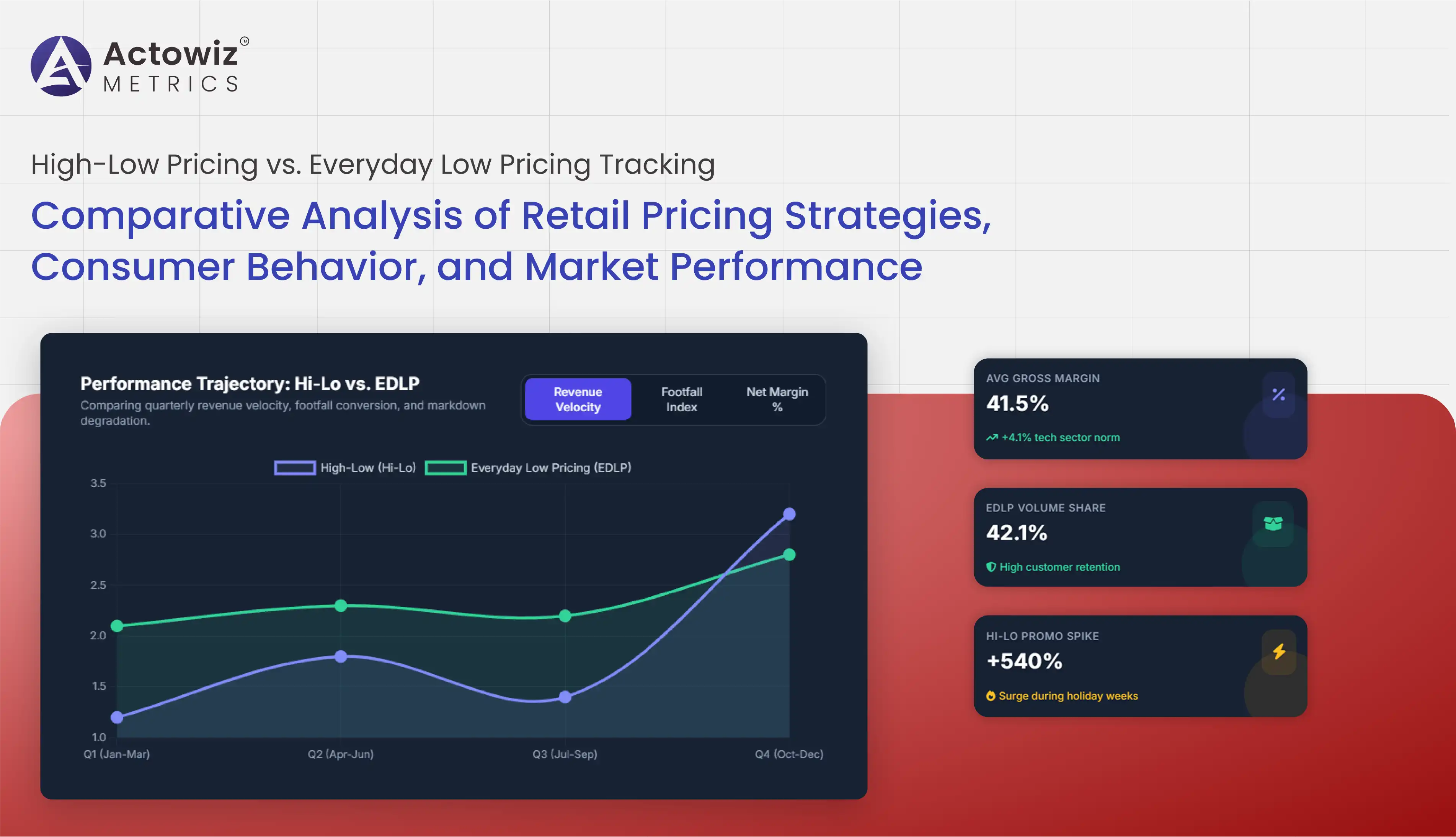
Retail pricing has become one of the most influential factors affecting consumer purchasing decisions and business profitability. As competition intensifies across grocery, eCommerce, and omnichannel retail, companies are increasingly comparing promotional pricing with consistent low-price models to improve customer retention and maximize revenue. High-Low Pricing vs. Everyday Low Pricing Tracking enables retailers, brands, and market researchers to evaluate the effectiveness of different pricing strategies, understand consumer purchasing behavior, and identify opportunities for competitive differentiation.
Today's dynamic retail environment demands continuous monitoring of product prices, promotional campaigns, discount frequency, and assortment changes across multiple competitors. Businesses leverage Price & promotion intelligence to analyze pricing fluctuations, promotional calendars, loyalty discounts, and seasonal offers in real time. These insights help organizations optimize pricing strategies, improve inventory planning, strengthen promotional performance, and enhance overall customer experience.
This research report explores the evolution of retail pricing models between 2020 and 2026, comparing High-Low Pricing and Everyday Low Pricing (EDLP) approaches through comprehensive market intelligence, pricing analytics, consumer behavior trends, and competitive benchmarking. The findings provide actionable insights for retailers, manufacturers, FMCG brands, and investors seeking sustainable growth in increasingly competitive retail markets.
Retailers adopting an Everyday Low Pricing (EDLP) model aim to build long-term customer trust by maintaining consistently competitive prices rather than relying heavily on temporary promotions. Businesses increasingly use Everyday Low Pricing (EDLP) data scraping to monitor pricing consistency, product availability, category performance, and competitive positioning across leading retail chains. Automated data collection enables organizations to evaluate how EDLP strategies influence customer loyalty, purchase frequency, and overall profitability.
Between 2020 and 2026, consumer expectations shifted toward transparent and predictable pricing due to inflation, economic uncertainty, and increased digital price comparisons. Retailers implementing EDLP strategies experienced improved customer confidence, reduced promotional dependency, and more stable demand forecasting. Data-driven monitoring allows retailers to analyze pricing behavior across thousands of SKUs while identifying deviations that may impact competitive positioning.
Retail intelligence platforms provide comprehensive visibility into shelf prices, inventory availability, regional pricing differences, and promotional frequency. These insights support merchandising optimization, category management, supplier negotiations, and pricing strategy refinement across both physical and digital retail channels.
| Year | Retailers Using EDLP (%) | Customer Price Trust (%) | Average Basket Growth (%) |
|---|---|---|---|
| 2020 | 38 | 74 | 3.8 |
| 2021 | 41 | 77 | 4.4 |
| 2022 | 45 | 80 | 5.2 |
| 2023 | 49 | 83 | 6.1 |
| 2024 | 53 | 86 | 7.0 |
| 2025* | 57 | 88 | 7.8 |
| 2026* | 61 | 90 | 8.5 |
Organizations continuously monitoring EDLP strategies gain valuable insights into pricing consistency, consumer satisfaction, inventory planning, and long-term competitive performance while reducing reliance on aggressive promotional campaigns.
The rapid growth of digital commerce has made real-time pricing intelligence essential for retailers seeking to remain competitive. Organizations increasingly depend on Retail pricing intelligence via web scraping to collect accurate data on product prices, promotional offers, competitor discounts, stock availability, and assortment changes across multiple retail platforms. Automated pricing intelligence enables businesses to make faster, data-driven decisions while responding proactively to market changes.
From 2020 to 2026, retailers significantly expanded digital pricing strategies as consumers became more price-conscious and relied on online comparison tools before making purchases. Web scraping technologies allow organizations to monitor thousands of products simultaneously, providing continuous visibility into competitor pricing behavior and promotional effectiveness. These insights help pricing teams optimize discount strategies, protect profit margins, and improve customer acquisition efforts.
Pricing intelligence also supports category management by identifying high-performing products, monitoring seasonal demand, and evaluating promotional ROI. Manufacturers and suppliers benefit by understanding retailer pricing trends, negotiating more effectively, and improving product placement strategies based on real-time market conditions.
| Year | Businesses Using Web Scraping (%) | Pricing Accuracy (%) | Competitive Response Time (Days) |
|---|---|---|---|
| 2020 | 34 | 89 | 7.5 |
| 2021 | 40 | 91 | 6.8 |
| 2022 | 47 | 93 | 5.9 |
| 2023 | 55 | 95 | 5.1 |
| 2024 | 63 | 96 | 4.4 |
| 2025* | 71 | 97 | 3.8 |
| 2026* | 79 | 98 | 3.2 |
Businesses integrating advanced pricing intelligence into their operations can improve promotional planning, optimize pricing strategies, strengthen competitive positioning, and respond more effectively to evolving consumer expectations in an increasingly dynamic retail marketplace.
Retailers operating in highly competitive markets require continuous visibility into competitor pricing models, promotional frequency, and consumer response. Organizations increasingly Scrape retail pricing strategy data to compare pricing structures across multiple retailers, evaluate promotional effectiveness, and identify patterns that influence purchasing behavior. Access to structured pricing datasets enables decision-makers to optimize revenue strategies while maintaining competitiveness in rapidly changing retail environments.
Between 2020 and 2026, retailers significantly increased investment in pricing analytics as inflation, supply chain disruptions, and digital commerce reshaped consumer expectations. Data-driven pricing analysis allows businesses to monitor price movements across thousands of SKUs, detect market shifts, and evaluate the effectiveness of promotional campaigns. Comparing historical pricing trends also supports accurate demand forecasting and more efficient inventory planning.
Retail pricing strategy data benefits manufacturers, suppliers, and retailers by providing detailed insights into category-level pricing, promotional schedules, seasonal discounts, and competitor positioning. Businesses can identify pricing gaps, benchmark product performance, and refine merchandising strategies using continuously updated market intelligence.
| Year | Products Monitored (Million) | Promotion Accuracy (%) | Pricing Decision Efficiency (%) |
|---|---|---|---|
| 2020 | 18 | 82 | 71 |
| 2021 | 22 | 84 | 74 |
| 2022 | 27 | 87 | 78 |
| 2023 | 33 | 90 | 82 |
| 2024 | 40 | 92 | 86 |
| 2025* | 47 | 94 | 89 |
| 2026* | 55 | 96 | 92 |
Organizations leveraging comprehensive retail pricing analytics improve strategic planning, enhance pricing precision, reduce revenue leakage, and strengthen long-term competitiveness by making informed decisions based on real-time market intelligence.
Retailers frequently use promotional campaigns to attract customers, increase store traffic, and stimulate short-term sales growth. The High-Low Pricing Strategy remains one of the most widely adopted pricing approaches because it combines regular pricing with periodic discounts designed to encourage impulse purchases and promotional engagement. Continuous monitoring of this strategy enables retailers to evaluate campaign effectiveness while maintaining healthy profit margins.
From 2020 to 2026, promotional activity increased across grocery, apparel, electronics, and eCommerce sectors as businesses competed for increasingly price-sensitive consumers. While promotions successfully generate temporary sales spikes, excessive discounting may reduce brand value and create long-term customer expectations for lower prices. Retail analytics help organizations identify the optimal balance between promotional frequency, discount depth, and profitability.
Advanced pricing intelligence also enables companies to analyze customer response across different regions, product categories, and seasonal events. These insights support more targeted promotions, improved inventory management, and stronger category performance while minimizing unnecessary markdowns.
| Year | Promotional Campaigns (%) | Sales Lift (%) | Gross Margin Retention (%) |
|---|---|---|---|
| 2020 | 42 | 11 | 78 |
| 2021 | 46 | 13 | 79 |
| 2022 | 51 | 15 | 80 |
| 2023 | 56 | 17 | 81 |
| 2024 | 61 | 19 | 83 |
| 2025* | 65 | 21 | 84 |
| 2026* | 69 | 23 | 85 |
Businesses that strategically manage promotional pricing through advanced analytics can maximize campaign effectiveness, strengthen customer loyalty, improve inventory turnover, and sustain long-term profitability without over-reliance on discounts.
Modern retailers increasingly depend on automation to monitor pricing, promotions, and assortment changes across physical stores and online marketplaces. High-low pricing and EDLP data scraping enables businesses to collect structured, near real-time information on product prices, promotional offers, inventory availability, and competitor activities. Automated data collection eliminates manual monitoring while providing comprehensive market visibility that supports faster decision-making.
Between 2020 and 2026, organizations accelerated investment in automated retail intelligence platforms to respond more effectively to dynamic pricing environments. AI-powered data scraping solutions help businesses monitor thousands of products across multiple retailers simultaneously, ensuring accurate competitive benchmarking and rapid identification of pricing opportunities.
The collected data supports pricing optimization, promotional planning, category management, assortment analysis, and customer behavior research. Retailers can evaluate pricing consistency, compare promotional strategies, forecast demand, and improve merchandising decisions using continuously updated datasets. Manufacturers and suppliers also benefit by gaining visibility into retailer pricing practices and identifying new market opportunities.
| Year | Automated Retail Monitoring (%) | Data Accuracy (%) | Pricing Update Frequency (Per Day) |
|---|---|---|---|
| 2020 | 36 | 89 | 2 |
| 2021 | 43 | 91 | 3 |
| 2022 | 50 | 93 | 4 |
| 2023 | 58 | 95 | 5 |
| 2024 | 66 | 96 | 6 |
| 2025* | 74 | 97 | 7 |
| 2026* | 81 | 98 | 8 |
Organizations embracing automated pricing intelligence gain significant advantages through improved operational efficiency, faster competitive responses, enhanced pricing accuracy, and data-driven strategies that support sustainable growth across evolving retail markets.
Success in modern retail depends on understanding competitors' pricing strategies, promotional campaigns, assortment changes, and customer engagement. Businesses increasingly rely on Competitor intelligence to gain a comprehensive view of market dynamics and identify opportunities that strengthen their competitive position. Continuous monitoring of competitor activities enables organizations to react quickly to pricing changes, optimize promotional planning, and improve merchandising decisions across multiple retail channels.
From 2020 to 2026, growing competition and digital transformation significantly increased the demand for real-time competitive analytics. Retailers now monitor thousands of products across online marketplaces and physical stores to evaluate price movements, promotion frequency, stock availability, and new product introductions. These insights help organizations anticipate market trends rather than simply reacting to them.
Advanced competitor intelligence supports category management, pricing optimization, demand forecasting, and strategic planning. Brands can benchmark their product portfolios against leading retailers, identify assortment gaps, and evaluate promotional effectiveness while maintaining profitable pricing strategies. Investors and market researchers also benefit from competitive analytics by identifying growth opportunities, market share shifts, and emerging consumer preferences.
| Year | Retailers Using Competitive Analytics (%) | Average Pricing Accuracy (%) | Market Response Time (Days) |
|---|---|---|---|
| 2020 | 40 | 88 | 7.2 |
| 2021 | 46 | 90 | 6.4 |
| 2022 | 53 | 92 | 5.7 |
| 2023 | 61 | 94 | 4.9 |
| 2024 | 69 | 96 | 4.2 |
| 2025* | 76 | 97 | 3.6 |
| 2026* | 83 | 98 | 3.0 |
Organizations leveraging comprehensive competitive intelligence can improve pricing precision, strengthen promotional effectiveness, enhance customer satisfaction, and make faster strategic decisions that drive sustainable growth in increasingly competitive retail environments.
Actowiz Metrics is a trusted provider of advanced retail analytics, web scraping, and market intelligence solutions that empower businesses with accurate, scalable, and actionable insights. Our expertise in Price Benchmarking and High-Low Pricing vs. Everyday Low Pricing Tracking enables retailers, FMCG brands, manufacturers, and market research firms to compare pricing strategies, monitor promotions, evaluate assortment changes, and benchmark competitor performance across global retail markets.
Using AI-powered data extraction and automated monitoring technologies, Actowiz Metrics delivers high-quality retail intelligence from eCommerce platforms, grocery chains, marketplaces, and omnichannel retailers. Our solutions help businesses optimize pricing strategies, track promotional effectiveness, forecast demand, improve inventory planning, and strengthen competitive positioning through real-time analytics.
Whether your organization requires competitor monitoring, pricing intelligence, assortment analysis, or customized retail dashboards, Actowiz Metrics provides flexible and scalable solutions tailored to your business objectives. Our commitment to data accuracy, innovation, and customer success helps organizations make informed decisions and achieve sustainable growth in an increasingly data-driven retail landscape.
Retail pricing strategies continue to evolve as businesses balance profitability, customer expectations, and competitive pressures. High-Low Pricing vs. Everyday Low Pricing Tracking provides valuable insights into pricing consistency, promotional effectiveness, consumer purchasing behavior, and market performance. By continuously monitoring pricing movements and competitor activities, organizations can optimize pricing models, improve merchandising strategies, and strengthen long-term customer loyalty.
Modern retail success depends on timely access to reliable pricing intelligence and actionable analytics. Businesses that invest in automated data collection and competitive monitoring are better equipped to identify emerging opportunities, respond quickly to market changes, and maintain a sustainable competitive advantage.
Partner with Actowiz Metrics to leverage advanced retail intelligence, AI-powered pricing analytics, and web scraping solutions that help you optimize pricing strategies, outperform competitors, and accelerate business growth with data-driven decision-making!
Expert blogs, research reports and infographics — practical, data-driven reading across e-commerce and quick-commerce.
Most fields are optional — the more you share, the better your sample.


.webp "infographics")
.webp "infographics")