BLOG








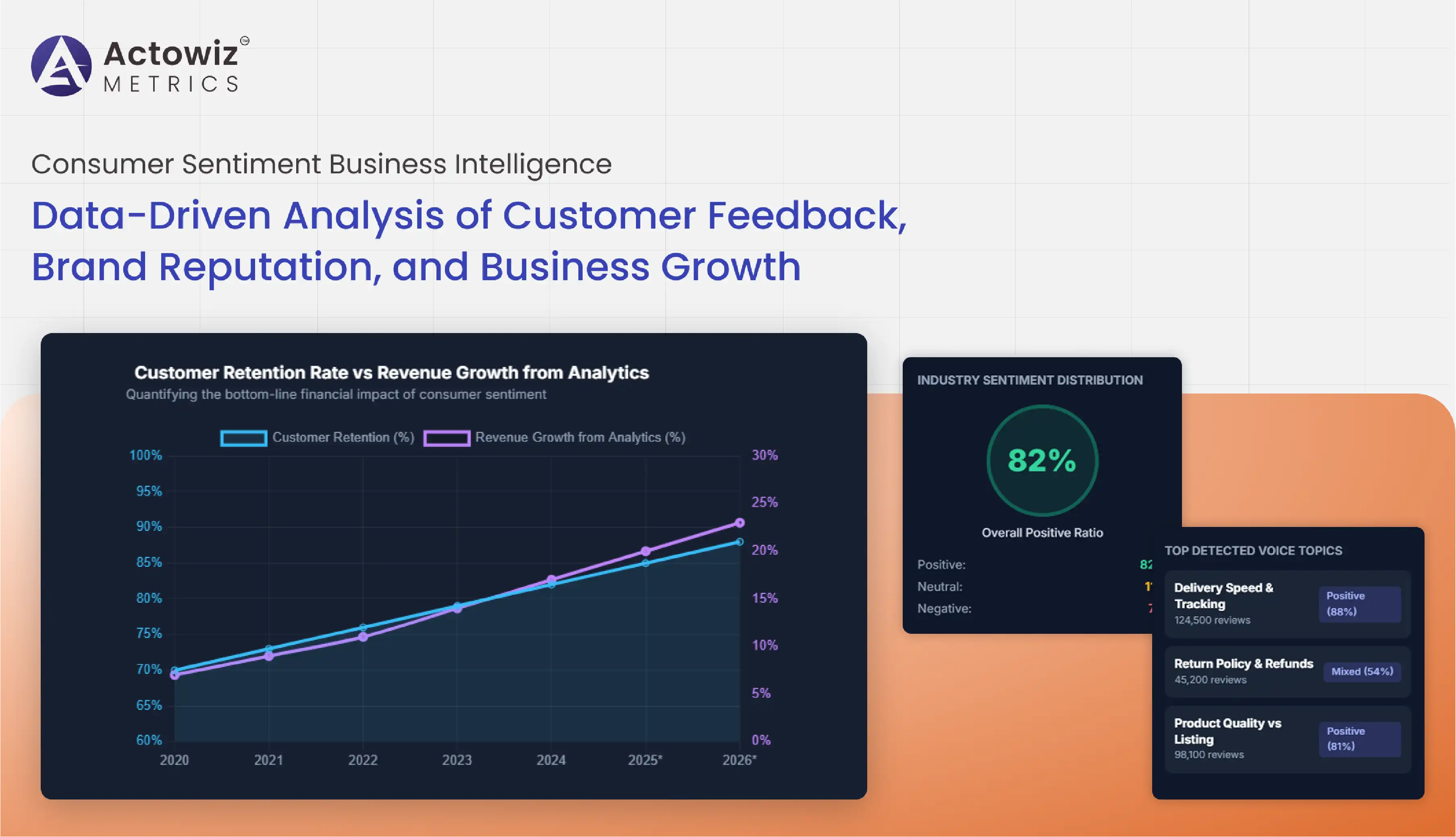
In today's digital economy, customer opinions influence purchasing decisions, brand reputation, and long-term business success more than ever before. Consumers actively express their experiences across eCommerce platforms, social media, online marketplaces, review portals, and community forums, creating vast amounts of valuable business data. Consumer Sentiment Business Intelligence enables organizations to transform this unstructured feedback into actionable insights that improve customer experiences, strengthen brand perception, and support data-driven strategic planning.
As businesses compete in increasingly customer-centric markets, leveraging Ratings and Reviews Analysis has become essential for understanding customer satisfaction, identifying recurring concerns, evaluating product performance, and monitoring competitor reputation. Advanced analytics technologies powered by artificial intelligence (AI) and natural language processing (NLP) help organizations detect emerging trends, measure consumer emotions, and uncover opportunities that drive innovation and sustainable growth.
This research report explores the evolution of sentiment analytics between 2020 and 2026, highlighting how organizations across retail, eCommerce, healthcare, finance, travel, and consumer goods industries utilize customer intelligence to improve decision-making. The report provides practical insights into customer feedback analysis, Voice of Customer programs, market intelligence, and business growth strategies driven by real-time consumer sentiment.
Organizations today collect millions of customer interactions every day through product reviews, surveys, support tickets, social media, and online discussions. Businesses increasingly rely on consumer sentiment analysis to understand customer emotions, identify satisfaction drivers, and detect recurring issues that influence purchasing behavior. By converting qualitative feedback into measurable insights, companies can make informed decisions that improve products, services, and customer experiences.
Between 2020 and 2026, advances in AI, machine learning, and NLP significantly enhanced the ability to classify customer feedback into positive, neutral, and negative sentiment categories. Businesses now analyze customer opinions across multiple digital channels in near real time, enabling faster responses to changing consumer expectations. Sentiment analysis also helps organizations monitor product launches, evaluate marketing campaigns, and identify emerging trends before they affect business performance.
Beyond customer satisfaction, sentiment analytics supports competitive benchmarking by comparing brand perception across industry leaders. Marketing teams can refine messaging based on customer preferences, while product development teams prioritize improvements using data-backed insights derived from actual consumer experiences.
| Year | Customer Feedback Analyzed (Million) | Positive Sentiment (%) | AI Analysis Accuracy (%) |
|---|---|---|---|
| 2020 | 180 | 71 | 84 |
| 2021 | 215 | 74 | 87 |
| 2022 | 255 | 77 | 89 |
| 2023 | 302 | 80 | 91 |
| 2024 | 356 | 82 | 93 |
| 2025* | 418 | 84 | 95 |
| 2026* | 489 | 86 | 97 |
Organizations integrating sentiment analytics into their decision-making processes gain faster visibility into customer expectations, improve operational performance, strengthen brand loyalty, and develop more customer-centric business strategies.
Modern organizations recognize that customer feedback is one of the most valuable assets for improving products, services, and overall business performance. Businesses increasingly adopt customer feedback intelligence to consolidate customer opinions from reviews, surveys, emails, support interactions, social media, and online communities into a centralized analytics platform. This comprehensive approach enables organizations to identify recurring issues, understand customer expectations, and make proactive improvements.
From 2020 to 2026, customer engagement across digital platforms increased significantly as consumers became more willing to share detailed feedback regarding product quality, pricing, delivery, customer service, and overall brand experience. Organizations that actively analyzed this feedback experienced higher customer satisfaction, stronger retention rates, and improved competitive positioning.
Advanced customer intelligence platforms categorize feedback by sentiment, product category, region, customer demographics, and purchasing channel. These insights enable businesses to prioritize operational improvements, personalize customer experiences, optimize marketing campaigns, and enhance product innovation. Leadership teams also use customer intelligence to evaluate long-term market trends and allocate resources more effectively.
| Year | Organizations Using Customer Intelligence (%) | Customer Satisfaction Improvement (%) | Average Response Time (Hours) |
|---|---|---|---|
| 2020 | 39 | 8 | 30 |
| 2021 | 46 | 11 | 24 |
| 2022 | 54 | 14 | 19 |
| 2023 | 62 | 17 | 15 |
| 2024 | 70 | 20 | 11 |
| 2025* | 77 | 23 | 8 |
| 2026* | 84 | 26 | 6 |
Organizations leveraging customer feedback intelligence gain a significant competitive advantage by responding more quickly to customer needs, improving service quality, strengthening brand reputation, and driving continuous business improvement through data-driven decision-making.
Every customer interaction provides valuable information that can help organizations improve products, services, and overall customer experiences. Businesses increasingly leverage voice of customer (VoC) analytics to collect, analyze, and interpret customer opinions from reviews, surveys, support conversations, social media discussions, and online communities. These insights allow organizations to understand customer expectations, identify pain points, and align business strategies with evolving consumer needs.
Between 2020 and 2026, Voice of Customer programs became an integral part of customer experience management across industries including retail, banking, healthcare, hospitality, telecommunications, and eCommerce. Advances in artificial intelligence and natural language processing enabled businesses to process millions of customer interactions in near real time, uncovering recurring themes and emerging market trends with greater accuracy.
VoC analytics also supports cross-functional decision-making by providing actionable insights to marketing, product development, customer support, and executive leadership teams. Organizations can evaluate campaign effectiveness, improve service quality, prioritize product enhancements, and strengthen customer engagement based on authentic customer feedback rather than assumptions.
| Year | Organizations with VoC Programs (%) | Customer Engagement Improvement (%) | AI-Based Feedback Processing (%) |
|---|---|---|---|
| 2020 | 36 | 10 | 42 |
| 2021 | 43 | 13 | 49 |
| 2022 | 51 | 16 | 57 |
| 2023 | 60 | 19 | 66 |
| 2024 | 69 | 22 | 74 |
| 2025* | 77 | 25 | 81 |
| 2026* | 84 | 28 | 88 |
Organizations implementing comprehensive Voice of Customer initiatives strengthen customer relationships, accelerate innovation, improve service delivery, and create long-term competitive advantages through continuous customer listening.
Customer-centric organizations consistently outperform competitors because they make strategic decisions based on real customer needs and market expectations. Businesses increasingly utilize customer insights for business growth to identify purchasing trends, understand customer preferences, improve product offerings, and optimize marketing investments. Data-driven customer insights help organizations move beyond reactive decision-making toward proactive growth strategies.
From 2020 to 2026, organizations expanded their use of predictive analytics to combine customer feedback with sales data, behavioral analytics, loyalty programs, and operational performance metrics. This integrated approach provides a comprehensive understanding of customer journeys while helping businesses identify opportunities to improve customer retention and lifetime value.
Marketing teams use customer insights to personalize campaigns, while product teams prioritize innovation based on recurring customer suggestions. Executive leadership benefits from predictive reporting that supports investment planning, resource allocation, and long-term strategic development. Businesses that continuously monitor customer behavior can quickly adapt to changing market conditions and consumer expectations.
| Year | Businesses Using Customer Insights (%) | Customer Retention (%) | Revenue Growth from Customer Analytics (%) |
|---|---|---|---|
| 2020 | 40 | 70 | 7 |
| 2021 | 47 | 73 | 9 |
| 2022 | 55 | 76 | 11 |
| 2023 | 63 | 79 | 14 |
| 2024 | 71 | 82 | 17 |
| 2025* | 79 | 85 | 20 |
| 2026* | 86 | 88 | 23 |
Organizations that prioritize customer insights achieve stronger customer loyalty, faster innovation, improved operational efficiency, and sustainable business growth by aligning strategies with evolving customer expectations.
Consumer opinions provide a powerful source of market intelligence that extends beyond customer satisfaction. Businesses increasingly adopt sentiment-driven market intelligence to evaluate brand perception, monitor competitor reputation, identify emerging industry trends, and anticipate changes in consumer demand. Combining sentiment analytics with broader market data enables organizations to make faster and more informed strategic decisions.
Between 2020 and 2026, businesses increasingly integrated sentiment intelligence into executive dashboards, allowing decision-makers to track customer perception alongside pricing trends, product performance, and competitive activity. AI-powered analytics platforms now process millions of customer interactions daily, enabling organizations to identify potential risks, detect market opportunities, and measure the impact of strategic initiatives in near real time.
Market intelligence derived from customer sentiment supports multiple business functions, including product innovation, competitive benchmarking, pricing optimization, demand forecasting, and crisis management. Organizations can identify changing consumer preferences early and adjust business strategies before competitors respond.
| Year | Organizations Using Sentiment Intelligence (%) | Forecast Accuracy (%) | Strategic Decision Improvement (%) |
|---|---|---|---|
| 2020 | 34 | 76 | 68 |
| 2021 | 42 | 79 | 72 |
| 2022 | 50 | 82 | 76 |
| 2023 | 59 | 85 | 81 |
| 2024 | 68 | 88 | 85 |
| 2025* | 76 | 91 | 89 |
| 2026* | 83 | 94 | 92 |
Organizations leveraging sentiment-driven intelligence gain a comprehensive understanding of market dynamics, improve competitive positioning, reduce strategic risks, and enhance long-term business performance through continuous analysis of customer perceptions and market trends.
Organizations that prioritize customer experiences consistently outperform competitors by making informed decisions based on real customer opinions. Voice of Customer Analytics enables businesses to collect, process, and interpret customer feedback from reviews, surveys, contact centers, social media platforms, and digital communities. By converting customer conversations into measurable insights, organizations gain a comprehensive understanding of customer expectations, satisfaction levels, and evolving market preferences.
Between 2020 and 2026, the adoption of AI-powered customer analytics accelerated across industries as organizations sought deeper visibility into customer behavior and engagement. Advanced analytics platforms combine structured and unstructured data to identify recurring issues, evaluate product performance, predict customer churn, and measure the effectiveness of customer experience initiatives. These capabilities empower businesses to make proactive improvements rather than reacting to customer complaints after they impact brand reputation.
Voice of Customer Analytics also supports cross-functional collaboration by providing marketing, product development, customer support, and executive teams with a unified view of customer needs. Organizations can optimize customer journeys, personalize interactions, strengthen loyalty programs, and improve operational efficiency through continuous customer listening.
| Year | Organizations Using VoC Analytics (%) | Customer Experience Improvement (%) | Customer Retention (%) |
|---|---|---|---|
| 2020 | 38 | 11 | 71 |
| 2021 | 45 | 14 | 74 |
| 2022 | 53 | 17 | 77 |
| 2023 | 61 | 20 | 80 |
| 2024 | 69 | 23 | 83 |
| 2025* | 77 | 26 | 86 |
| 2026* | 84 | 29 | 89 |
Organizations investing in Voice of Customer programs gain stronger customer relationships, faster product innovation, improved service quality, and sustainable competitive advantages by embedding customer feedback into every stage of business decision-making.
Actowiz Metrics empowers businesses with AI-driven market intelligence, advanced web scraping, and customer analytics solutions that transform raw consumer data into actionable business insights. Our expertise in Marketplace Data Tracking and Consumer Sentiment Business Intelligence enables organizations to monitor customer opinions, analyze market trends, benchmark competitors, and identify emerging opportunities across eCommerce platforms, marketplaces, review portals, and social media channels.
Using cutting-edge artificial intelligence, natural language processing (NLP), and automated data extraction technologies, Actowiz Metrics delivers highly accurate, real-time intelligence that supports strategic decision-making. Our customized solutions help businesses improve customer experience, strengthen brand reputation, optimize product development, monitor competitor performance, and forecast changing consumer behavior with confidence.
Whether you operate in retail, FMCG, healthcare, travel, finance, or eCommerce, Actowiz Metrics provides scalable analytics solutions tailored to your business objectives. Our commitment to innovation, data quality, and customer success enables organizations to gain measurable competitive advantages and accelerate sustainable growth in rapidly evolving digital markets.
Customer opinions have become one of the most valuable assets for organizations seeking sustainable growth in today's competitive business environment. Consumer Sentiment Business Intelligence enables companies to transform customer feedback into meaningful insights that improve customer experiences, strengthen brand perception, optimize products, and support strategic decision-making. Organizations that continuously monitor and analyze consumer sentiment are better equipped to anticipate market shifts, identify emerging opportunities, and respond proactively to evolving customer expectations.
By integrating AI-powered analytics, Voice of Customer programs, and real-time market intelligence into business operations, companies can improve customer loyalty, enhance operational efficiency, and build stronger competitive positioning across global markets.
Partner with Actowiz Metrics to leverage advanced consumer sentiment analytics, AI-powered market intelligence, and customized data solutions that help your business understand customer behavior, outperform competitors, and achieve long-term growth through data-driven decision-making!
Expert blogs, research reports and infographics — practical, data-driven reading across e-commerce and quick-commerce.
Most fields are optional — the more you share, the better your sample.


.webp "infographics")
.webp "infographics")