BLOG














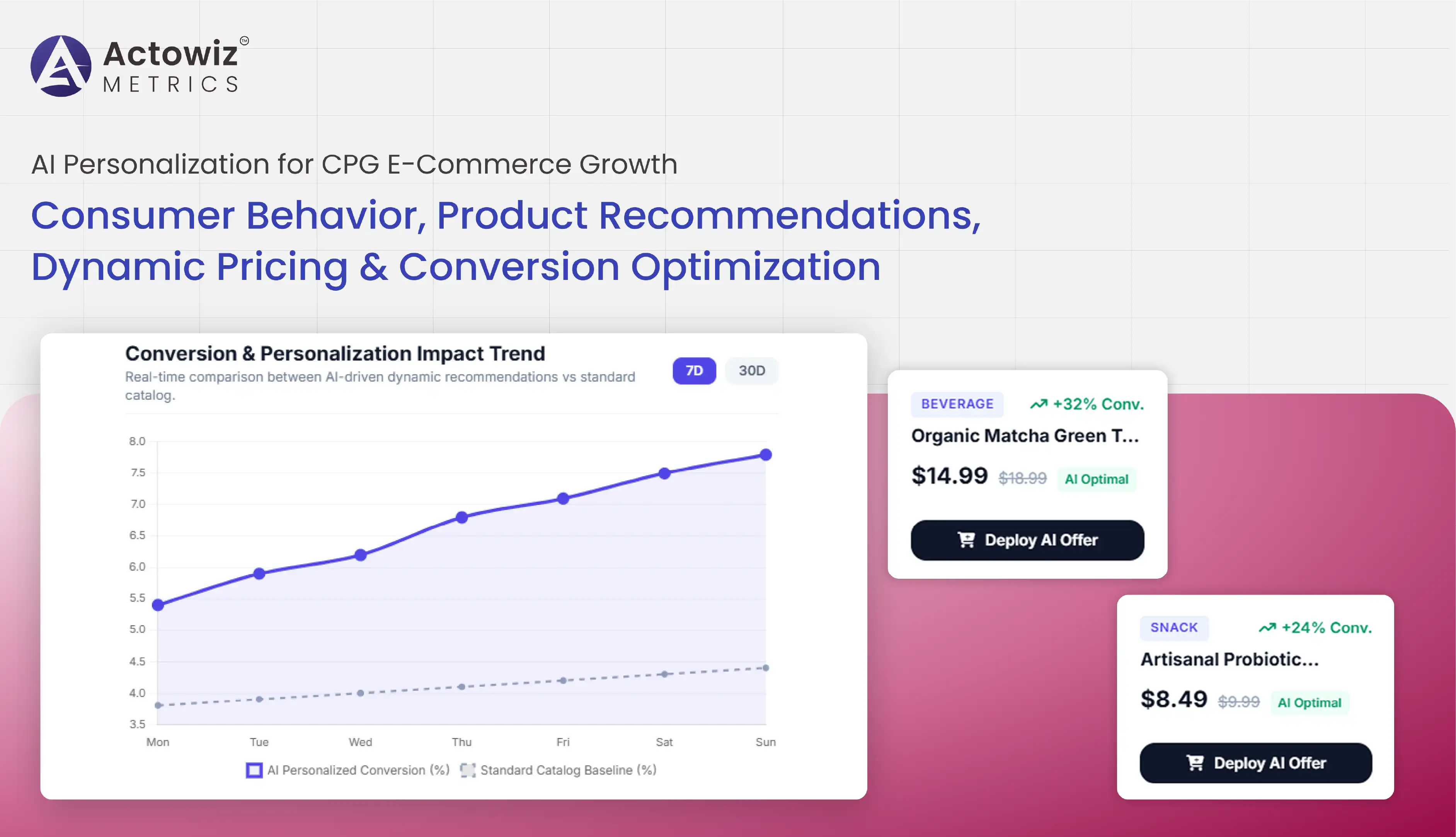
Digital commerce has transformed how consumers discover, compare, and purchase CPG products. Shoppers now expect relevant recommendations, personalized promotions, and seamless buying experiences across every touchpoint. Traditional marketing approaches are no longer sufficient in an environment where customer expectations continue to evolve.
AI Personalization for CPG E-Commerce Growth enables brands to analyze customer behavior, predict purchasing intent, personalize product recommendations, optimize pricing, and improve conversion performance using real-time data. By combining customer insights with machine learning, businesses can deliver individualized shopping experiences that increase engagement and long-term customer loyalty.
Another important industry metric is the Share of AI, which measures the growing contribution of artificial intelligence across retail operations, merchandising, pricing, marketing, customer service, and supply chain management. As AI adoption increases, CPG companies gain greater visibility into consumer preferences while improving operational efficiency and revenue generation.
This report analyzes industry developments, emerging technologies, and market trends shaping AI-driven personalization between 2020 and 2026. The findings are intended for CPG manufacturers, retailers, e-commerce platforms, marketing leaders, data analysts, and business decision-makers seeking practical insights for accelerating digital transformation.
Modern consumers interact with thousands of products during every online shopping session. Without personalization, discovering relevant products becomes difficult and often results in abandoned purchases. Artificial intelligence addresses this challenge by delivering highly relevant recommendations based on browsing behavior, purchase history, customer preferences, demographics, and contextual shopping signals.
This is where AI personalization in e-commerce creates measurable business value. Machine learning models continuously analyze customer interactions to personalize search results, promotions, homepage content, product rankings, and checkout experiences. As algorithms learn from customer behavior, personalization accuracy improves, creating stronger engagement and higher conversion rates.
Leading CPG retailers are using AI to:
Personalization also supports dynamic merchandising by adapting recommendations in real time according to seasonality, inventory levels, customer preferences, and purchasing trends. These capabilities allow retailers to maximize both customer satisfaction and revenue.
| Year | Retailers Using AI Personalization | Average Conversion Rate Improvement | Average Customer Retention |
|---|---|---|---|
| 2020 | 26% | 8% | 62% |
| 2021 | 34% | 11% | 65% |
| 2022 | 43% | 15% | 69% |
| 2023 | 55% | 19% | 73% |
| 2024 | 66% | 24% | 78% |
| 2025* | 74% | 28% | 82% |
| 2026* | 82% | 33% | 86% |
The data demonstrates that AI adoption continues to accelerate across the CPG sector. Retailers investing in personalized shopping experiences consistently achieve stronger conversion rates, higher customer retention, and improved revenue growth. As AI technologies mature, personalization will remain one of the most significant competitive advantages in digital commerce, enabling businesses to deliver relevant experiences that strengthen customer relationships and increase long-term profitability.
Successful personalization goes beyond recommending products. It requires a unified understanding of customer preferences, shopping habits, seasonal demand, and engagement across multiple digital channels. Brands that develop structured personalization programs are better positioned to increase loyalty, improve customer lifetime value, and maximize marketing efficiency.
Implementing CPG personalization strategies enables organizations to create tailored shopping experiences using first-party data, purchase history, browsing behavior, loyalty program insights, and predictive analytics. Instead of delivering identical promotions to every customer, brands can personalize messaging, discounts, product assortments, and recommendations based on individual preferences.
Leading CPG organizations focus on:
These strategies improve customer engagement while helping brands reduce marketing waste and increase return on investment. Personalization also strengthens customer trust by presenting relevant products rather than overwhelming shoppers with unnecessary choices.
| Year | Brands Using Personalization | Personalized Campaign CTR | Customer Lifetime Value Growth |
|---|---|---|---|
| 2020 | 28% | 4.6% | 7% |
| 2021 | 36% | 5.4% | 10% |
| 2022 | 46% | 6.3% | 13% |
| 2023 | 58% | 7.5% | 17% |
| 2024 | 69% | 8.8% | 22% |
| 2025* | 77% | 9.9% | 26% |
| 2026* | 84% | 11.1% | 31% |
The increasing adoption of personalization demonstrates that customer-centric strategies are becoming a core driver of competitive advantage in CPG e-commerce.
Online shoppers expect relevant suggestions that simplify decision-making and improve the buying experience. Recommendation engines powered by artificial intelligence analyze large volumes of behavioral and transactional data to identify products customers are most likely to purchase.
Using AI-driven product recommendations, retailers can deliver personalized suggestions across product pages, search results, shopping carts, email campaigns, and mobile applications. Recommendation models continuously improve as they learn from customer interactions, making future recommendations increasingly accurate.
Businesses benefit from recommendation systems by:
Recommendation engines also help retailers introduce newly launched products to highly relevant customer segments while minimizing irrelevant product exposure. This creates a smoother shopping journey and improves overall customer satisfaction.
| Year | AI Recommendation Adoption | Avg. Increase in Basket Size | Conversion Improvement |
|---|---|---|---|
| 2020 | 24% | 6% | 7% |
| 2021 | 33% | 9% | 10% |
| 2022 | 44% | 12% | 14% |
| 2023 | 57% | 16% | 18% |
| 2024 | 68% | 20% | 23% |
| 2025* | 77% | 24% | 28% |
| 2026* | 85% | 29% | 34% |
The data indicates that AI-powered recommendation systems continue to deliver measurable improvements in basket value and conversion rates. As recommendation algorithms become more sophisticated, they will play an even greater role in helping CPG brands personalize customer experiences, strengthen loyalty, and drive sustainable e-commerce growth.
Customer engagement has become one of the most important success factors in digital commerce. Consumers expect fast responses, personalized communication, relevant offers, and seamless shopping experiences across websites, mobile apps, and social commerce channels. Brands that fail to meet these expectations often experience lower conversion rates and reduced customer loyalty.
Implementing AI for retail customer engagement enables businesses to analyze customer behavior in real time and deliver personalized experiences throughout the buying journey. AI models evaluate browsing history, purchase frequency, shopping preferences, customer feedback, and engagement patterns to determine the most relevant content and offers for every shopper.
Organizations use AI to:
AI-powered engagement also enables brands to identify customers at risk of leaving and proactively launch retention campaigns through personalized discounts, loyalty rewards, or product recommendations. This improves customer satisfaction while increasing lifetime value.
| Year | Brands Using AI Engagement | Customer Retention | Repeat Purchase Rate |
|---|---|---|---|
| 2020 | 29% | 63% | 38% |
| 2021 | 37% | 66% | 42% |
| 2022 | 47% | 70% | 47% |
| 2023 | 59% | 74% | 53% |
| 2024 | 70% | 79% | 59% |
| 2025* | 79% | 83% | 64% |
| 2026* | 87% | 87% | 70% |
The growing adoption of AI engagement tools demonstrates that personalized customer experiences have become essential for improving retention, strengthening loyalty, and driving long-term revenue growth.
Data has become one of the most valuable assets for Consumer Packaged Goods brands. However, collecting information alone is not enough. Organizations need intelligent analytics that convert customer interactions, sales trends, and operational data into actionable business insights.
This is where AI-powered CPG growth analytics provides strategic value. Machine learning models identify purchasing patterns, forecast demand, optimize marketing investments, and evaluate campaign effectiveness with greater speed and accuracy than traditional analytical methods.
Businesses use AI-driven analytics to:
Predictive analytics also enables organizations to anticipate future market changes rather than reacting after they occur. These insights help businesses allocate budgets more effectively while improving profitability across multiple sales channels.
| Year | Companies Using AI Analytics | Forecast Accuracy | Revenue Growth from AI |
|---|---|---|---|
| 2020 | 27% | 69% | 6% |
| 2021 | 35% | 73% | 8% |
| 2022 | 45% | 77% | 11% |
| 2023 | 57% | 82% | 15% |
| 2024 | 68% | 86% | 19% |
| 2025* | 77% | 89% | 23% |
| 2026* | 85% | 92% | 28% |
The increasing accuracy of AI analytics demonstrates its growing role in helping CPG organizations make faster, data-driven decisions that support sustainable growth and operational excellence.
The digital shelf has become the primary storefront for CPG products sold online. Product titles, descriptions, images, reviews, ratings, availability, pricing, and search rankings directly influence purchasing decisions. Poor digital shelf execution can reduce product visibility even when product quality remains high.
Leveraging digital shelf analytics enables brands to continuously monitor online product performance across retailers and marketplaces. These insights help organizations identify content gaps, pricing inconsistencies, stock availability issues, and search ranking opportunities before they affect sales.
Digital shelf monitoring supports businesses by helping them:
By continuously monitoring digital shelf performance, brands can improve discoverability, strengthen customer trust, and increase conversion rates across e-commerce platforms. Better visibility also supports stronger collaboration with retail partners by ensuring products remain competitive throughout the customer buying journey.
| Year | Brands Using Digital Shelf Monitoring | Average Search Visibility | Online Conversion Improvement |
|---|---|---|---|
| 2020 | 23% | 61% | 5% |
| 2021 | 31% | 66% | 8% |
| 2022 | 42% | 71% | 12% |
| 2023 | 54% | 76% | 16% |
| 2024 | 66% | 81% | 21% |
| 2025* | 75% | 86% | 25% |
| 2026* | 84% | 90% | 30% |
The continued growth of digital shelf monitoring reflects its importance in modern CPG e-commerce. Organizations that optimize product visibility, pricing, and content are better positioned to attract customers, improve conversions, and sustain long-term competitive advantage in an increasingly digital marketplace.
Actowiz Metrics empowers CPG brands, retailers, and e-commerce businesses with actionable market intelligence and AI-driven analytics. Our advanced data collection and analytics solutions help organizations monitor customer behavior, optimize product assortments, improve pricing strategies, measure competitor performance, and strengthen digital shelf execution. Whether you need retail intelligence, pricing analytics, consumer insights, or AI Personalization for CPG E-Commerce Growth, our customized datasets and scalable solutions deliver accurate, real-time intelligence that supports informed decision-making. By transforming complex market data into meaningful business insights, Actowiz Metrics enables organizations to improve customer experiences, increase conversion rates, and accelerate sustainable digital growth.
Artificial intelligence is reshaping the future of CPG e-commerce by enabling smarter customer engagement, personalized shopping experiences, predictive analytics, and data-driven merchandising. Organizations that invest in AI Personalization for CPG E-Commerce Growth can better understand consumer behavior, optimize pricing strategies, enhance product recommendations, and improve digital shelf performance. As AI adoption continues to expand between 2020 and 2026, businesses that embrace personalization will be better positioned to strengthen customer loyalty, increase revenue, and maintain a competitive advantage in an increasingly dynamic marketplace.
Ready to accelerate your AI-powered commerce strategy? Partner with Actowiz Metrics to unlock advanced retail intelligence, personalization analytics, and market insights that drive measurable growth, improve customer experiences, and help your business lead the future of CPG e-commerce!
Expert blogs, research reports and infographics — practical, data-driven reading across e-commerce and quick-commerce.
Most fields are optional — the more you share, the better your sample.


.webp "infographics")
.webp "infographics")