BLOG
















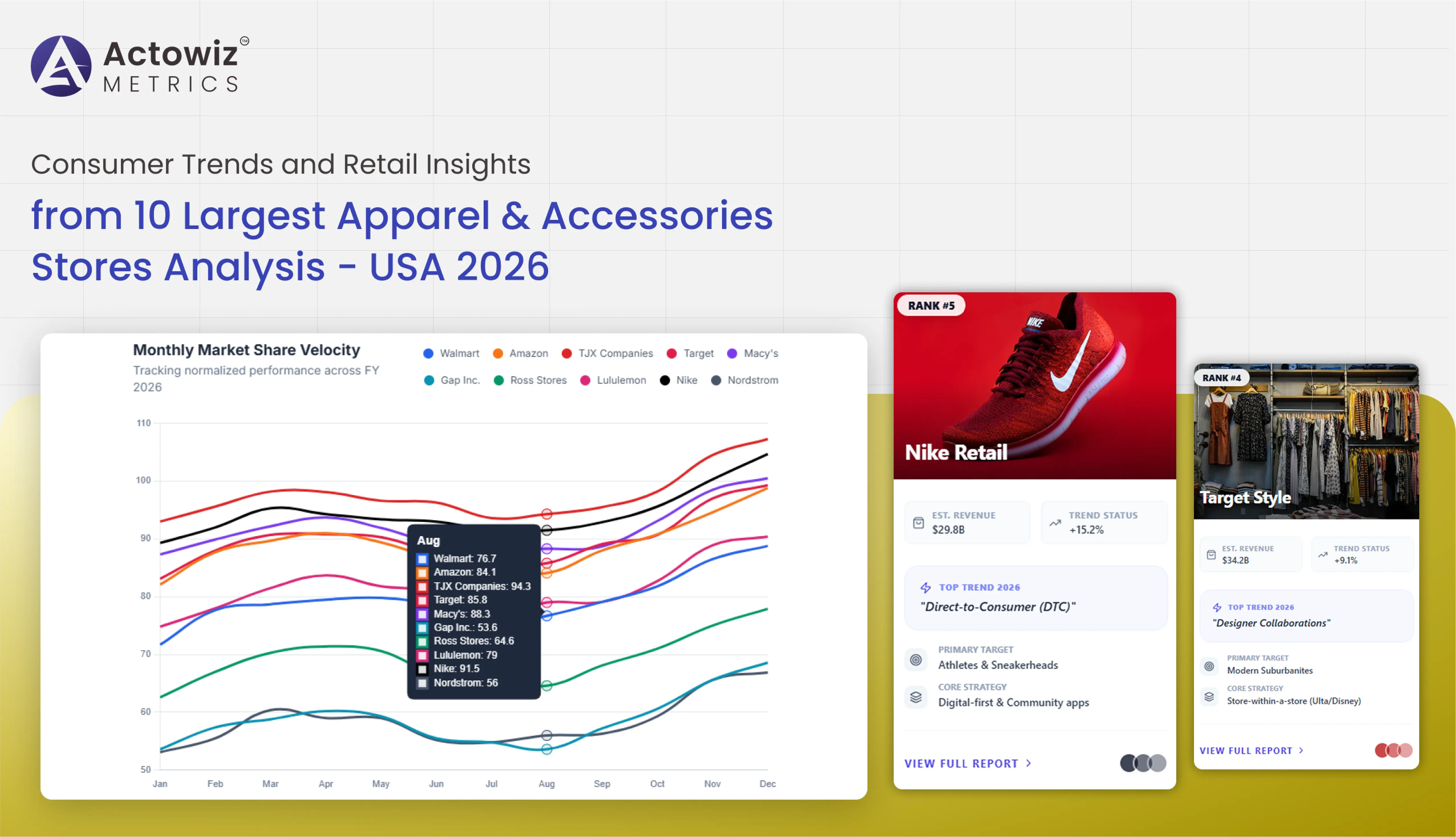
consumer preferences reshape the competitive landscape. Retailers are increasingly investing in technology-driven merchandising, dynamic pricing strategies, personalized shopping experiences, and faster fulfillment systems to strengthen customer engagement and improve profitability. This research report on 10 Largest Apparel & Accessories Stores Analysis - USA 2026 provides deep insights into the operational trends, pricing dynamics, inventory movements, and consumer buying behaviors influencing the nation’s leading fashion retailers.
Modern retailers rely heavily on E-commerce Analytics to monitor category performance, identify bestselling products, analyze customer demand patterns, and optimize promotional campaigns across online and offline channels. The growing importance of data intelligence has enabled apparel brands and fashion chains to improve decision-making while responding faster to market fluctuations and seasonal shopping trends.
Between 2020 and 2026, the U.S. apparel industry experienced significant transformation due to digital acceleration, changing fashion preferences, inflationary pricing pressures, and rising demand for sustainable products. Major retailers adopted automated analytics solutions to improve inventory planning, strengthen competitive positioning, and increase customer retention. This report highlights how the top apparel and accessories retailers leverage marketplace intelligence, competitor monitoring, and advanced analytics to maintain market leadership while adapting to evolving consumer expectations in the highly competitive U.S. retail sector.
Consumer shopping behavior across the U.S. apparel market has shifted dramatically between 2020 and 2026 due to digital adoption, social commerce growth, and increasing demand for personalized shopping experiences. Through Scraping Top Apparel Stores Data In The United States, retailers can identify evolving customer preferences, pricing trends, and bestselling product categories more effectively. Combined with advanced Brand Competition Analysis, businesses gain deeper visibility into how leading apparel chains position themselves across premium, fast fashion, and value-based retail segments.
Consumers increasingly prioritize convenience, flexible returns, mobile shopping, and fast delivery when purchasing apparel online. Sustainable fashion, athleisure wear, and affordable luxury products have emerged as dominant growth categories across major U.S. retailers.
| Year | Online Apparel Revenue (USD Bn) | Mobile Shopping Share | Avg. Order Value (USD) | Repeat Purchase Rate |
|---|---|---|---|---|
| 2020 | 110 | 54% | 68 | 38% |
| 2021 | 126 | 58% | 72 | 41% |
| 2022 | 142 | 63% | 76 | 45% |
| 2023 | 158 | 67% | 81 | 48% |
| 2024 | 174 | 70% | 84 | 51% |
| 2025 | 189 | 73% | 88 | 54% |
| 2026 | 205 | 76% | 92 | 57% |
Retailers leveraging marketplace intelligence solutions improved customer targeting, optimized merchandising strategies, and strengthened customer retention through personalized shopping experiences and dynamic promotional campaigns.
Retailers increasingly rely on automated analytics systems to strengthen operational efficiency and optimize market positioning across fashion categories. Using Extracting Clothing Retail Data For Market Research USA, businesses gain access to structured pricing intelligence, customer engagement metrics, and inventory visibility across multiple apparel chains and marketplaces.
From 2020 to 2026, fashion retailers accelerated investments in AI-driven recommendation systems, predictive inventory management, and omnichannel shopping infrastructure. Data-driven decision-making became essential for identifying high-performing product categories and understanding changing consumer demand patterns.
| Category | Market Share 2020 | Market Share 2026 | Avg. Growth Rate |
|---|---|---|---|
| Athleisure | 18% | 29% | 11% |
| Sustainable Fashion | 9% | 24% | 15% |
| Luxury Accessories | 16% | 22% | 6% |
| Fast Fashion | 31% | 27% | -4% |
| Footwear | 26% | 33% | 7% |
Analytics reveal that sustainability-focused products and sportswear categories generated the strongest consumer engagement growth. Retailers utilizing automated extraction and market research intelligence improved assortment planning, pricing strategies, and product lifecycle management across highly competitive retail environments.
The integration of predictive analytics also helped businesses optimize promotional timing, forecast seasonal demand, and reduce excess inventory levels while maintaining profitability.
Digital merchandising has become a critical growth driver within the apparel and accessories retail sector. Through Web Scraping Apparel And Accessories Store Data USA, businesses can continuously monitor pricing consistency, promotional campaigns, and product assortment changes across leading retailers. Combined with advanced Product Data Tracking, companies gain actionable insights into bestseller rankings, stock availability, and customer engagement trends.
Between 2020 and 2026, retailers significantly expanded digital product catalogs and increased investments in personalization technologies to improve online conversion rates. Product-level analytics enabled brands to optimize pricing structures and improve digital shelf visibility across eCommerce platforms.
| Year | Avg. SKU Count | Avg. Discount Rate | Cart Abandonment Rate | Conversion Rate |
|---|---|---|---|---|
| 2020 | 45,000 | 18% | 74% | 2.1% |
| 2021 | 51,000 | 20% | 71% | 2.4% |
| 2022 | 58,000 | 23% | 68% | 2.8% |
| 2023 | 64,000 | 25% | 65% | 3.2% |
| 2024 | 71,000 | 27% | 61% | 3.6% |
| 2025 | 77,000 | 29% | 58% | 4.0% |
| 2026 | 84,000 | 31% | 54% | 4.4% |
Retailers using advanced product intelligence systems improved customer acquisition while increasing conversion efficiency through targeted discounts, optimized product recommendations, and better inventory visibility.
Omnichannel retailing continues to redefine how consumers interact with apparel and accessories brands across the United States. Businesses that Scrape Fashion Retail Chains Data In USA 2026 gain deeper visibility into pricing movements, store-level promotions, inventory synchronization, and customer purchasing behavior across physical and digital channels.
Retailers increasingly integrated online ordering, in-store pickup, same-day delivery, and mobile commerce experiences to strengthen customer engagement and reduce fulfillment friction. Investments in fulfillment automation and real-time inventory management improved operational agility across large retail chains.
| Year | Omnichannel Sales Share | Same-Day Delivery Usage | Buy Online Pickup In Store (%) | Avg. Fulfillment Time |
|---|---|---|---|---|
| 2020 | 24% | 11% | 19% | 5.2 Days |
| 2021 | 31% | 15% | 26% | 4.6 Days |
| 2022 | 39% | 21% | 33% | 4.0 Days |
| 2023 | 46% | 28% | 41% | 3.5 Days |
| 2024 | 52% | 34% | 47% | 3.0 Days |
| 2025 | 57% | 39% | 53% | 2.7 Days |
| 2026 | 63% | 45% | 59% | 2.4 Days |
Data intelligence solutions enabled retailers to improve order fulfillment efficiency, reduce delivery delays, and enhance customer satisfaction across multiple shopping channels.
Regional store intelligence has become increasingly important as fashion retailers optimize expansion strategies and localized pricing decisions. Through US Clothing Store Database Monitoring 2026, brands gain visibility into regional assortment performance, inventory trends, and localized promotional campaigns. Combined with advanced Map Monitoring, retailers can identify high-performing store clusters and optimize regional pricing strategies more effectively.
Between 2020 and 2026, suburban retail locations experienced stronger growth due to evolving shopping patterns and population migration trends. Retailers increasingly adjusted assortments based on regional demographics and climate preferences.
| Region | Avg. Revenue Growth | Avg. Inventory Turnover | Avg. Store Traffic Growth |
|---|---|---|---|
| Northeast | 6% | 4.2x | 5% |
| Midwest | 8% | 4.7x | 7% |
| South | 11% | 5.3x | 10% |
| West | 9% | 4.9x | 8% |
Retailers leveraging regional intelligence improved inventory allocation, reduced markdown dependency, and optimized localized promotional campaigns based on market-specific consumer behavior patterns.
Real-time store monitoring also helped businesses evaluate competitor store expansion activity and regional pricing competitiveness across major metropolitan areas.
The U.S. apparel industry continues to experience intense competition as retailers balance pricing pressures, supply chain costs, and evolving consumer expectations. Through Scraping Apparel Industry Data For Competitive Analysis, businesses gain comprehensive insights into competitor strategies, pricing structures, assortment changes, and promotional effectiveness.
Between 2020 and 2026, leading apparel retailers adopted predictive analytics and AI-powered demand forecasting systems to improve pricing optimization and inventory planning. Data intelligence became essential for maintaining profitability within highly promotional retail environments.
| Metric | 2020 | 2026 |
|---|---|---|
| Avg. Apparel Discount Rate | 18% | 31% |
| AI-Driven Pricing Adoption | 12% | 58% |
| Sustainable Product Share | 9% | 24% |
| Inventory Automation Adoption | 21% | 66% |
| Personalized Marketing Usage | 27% | 71% |
Retailers utilizing predictive analytics improved inventory efficiency, reduced stockouts, and enhanced long-term profitability through smarter merchandising decisions. Competitive intelligence also enabled businesses to identify emerging fashion trends and adapt faster to evolving customer expectations.
Actowiz Metrics delivers advanced retail intelligence solutions powered by automation, AI-driven analytics, and scalable marketplace monitoring systems. Through industry-leading Digital Shelf Analytics, businesses gain complete visibility into pricing trends, product availability, competitor strategies, promotional campaigns, and consumer engagement across apparel and accessories marketplaces.
Our expertise in 10 Largest Apparel & Accessories Stores Analysis - USA 2026 enables retailers, fashion brands, and eCommerce businesses to improve assortment planning, optimize pricing decisions, and strengthen competitive positioning using real-time marketplace intelligence.
Actowiz Metrics provides customized analytics solutions for inventory monitoring, competitor benchmarking, regional store intelligence, and customer demand forecasting. Our scalable data extraction infrastructure ensures accurate reporting across millions of SKUs while reducing manual operational workloads.
With advanced dashboards, automated reporting workflows, and high-frequency monitoring systems, businesses can make faster, data-driven decisions that improve profitability, operational efficiency, and customer engagement across highly competitive fashion retail environments.
The U.S. apparel and accessories industry is undergoing rapid transformation driven by digital commerce growth, omnichannel retailing, sustainability trends, and evolving consumer expectations. Retailers increasingly rely on automated analytics solutions to strengthen operational efficiency, optimize pricing strategies, and improve customer retention across competitive marketplaces.
By leveraging advanced Price Benchmarking capabilities and insights from 10 Largest Apparel & Accessories Stores Analysis - USA 2026, businesses can gain deeper visibility into competitor activities, regional performance trends, inventory fluctuations, and promotional effectiveness.
Partner with Actowiz Metrics to unlock real-time retail intelligence, optimize apparel pricing strategies, and accelerate data-driven growth across the evolving U.S. fashion marketplace!
Expert blogs, research reports and infographics — practical, data-driven reading across e-commerce and quick-commerce.
Most fields are optional — the more you share, the better your sample.

.webp "infographics")
.webp "infographics")